
Class 6 Science Chapter 3: Mindful Eating: A Path to a Healthy Body Notes
This chapter in five lines
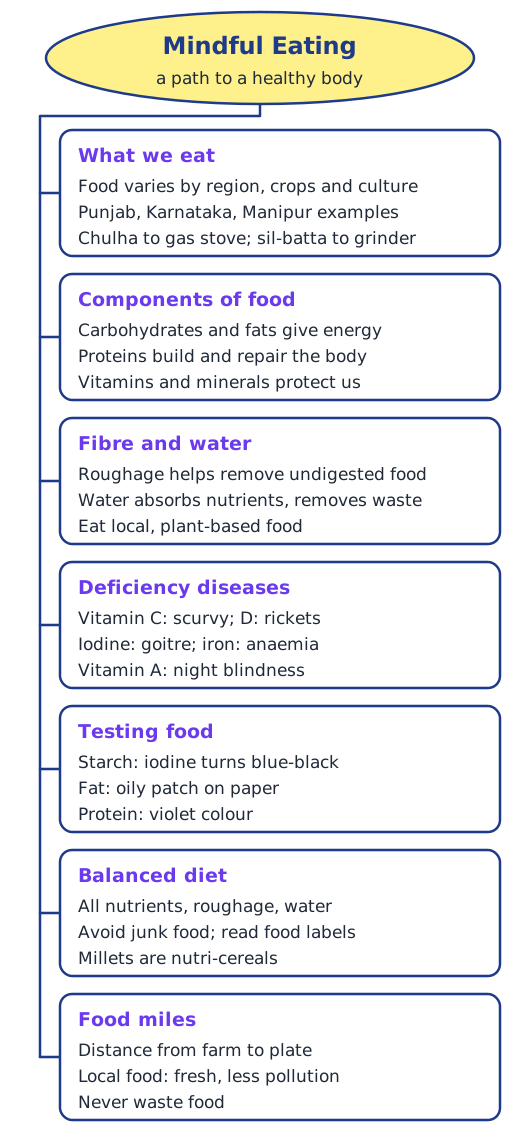
Food gives life to living beings. People across India eat different foods, depending on local crops, taste, culture and traditions. Food contains nutrients: carbohydrates and fats give energy, proteins build and repair the body, and vitamins and minerals protect us from diseases. We also need dietary fibre and water. Simple tests detect starch, fat and protein. A balanced diet has all nutrients, roughage and water in the right amounts; junk food does not. Millets are nutri-cereals, and eating local food reduces food miles.
Food gives life
The chapter opens with a wise saying: a healthy person eats food that is wholesome, in moderate quantities, and right for the season, time and place. On the school noticeboard, Medu and Mishti read the thought of the day, ‘annena jātāni jivanti’, a Sanskrit saying that means food gives life to living beings.
In Activity 3.1 you list everything you eat in a week. Comparing lists with friends shows a lot of variety: you may eat different things at different meals, and your friends’ food may be quite different from yours.
Food in different regions
India is an agricultural country with many soil and climate types, so different crops grow in different regions. The traditional food of a state is usually based on the crops grown there.
| State | Locally grown crops | Traditional food items | Beverages |
|---|---|---|---|
| Punjab | Maize, wheat, chickpea, pulses | Makki di roti, sarson da saag, chhole bhature, parantha, halwa, kheer | Lassi, chhach (buttermilk), milk, tea |
| Karnataka | Rice, ragi, urad, coconut | Idli, dosa, sambhar, coconut chutney, ragi mudde, palya, rasam, rice | Buttermilk, coffee, tea |
| Manipur | Rice, bamboo, soya bean | Rice, eromba (chutney), utti (yellow peas and green onion curry), singju, kangsoi | Black tea |
Some foods are common to many states, while others are eaten only in one. Food choices vary with the crops of a region, taste preferences, culture and traditions.
Cooking then and now
Cooking practices, also called culinary practices, have changed over time. Earlier, most cooking was done on a chulha and grinding was done by hand on a sil-batta; today most of us use a gas stove and an electrical grinder. These changes came with technological development, improved transportation and better communication. In Activity 3.3 you interview elderly people about what they ate and how they cooked.
The components of food
At the school’s ‘Traditional Food Festival’, with the theme ‘Eat Healthy, Live Healthy’, the nutrition expert Dr Poshita says that health is the ultimate wealth.
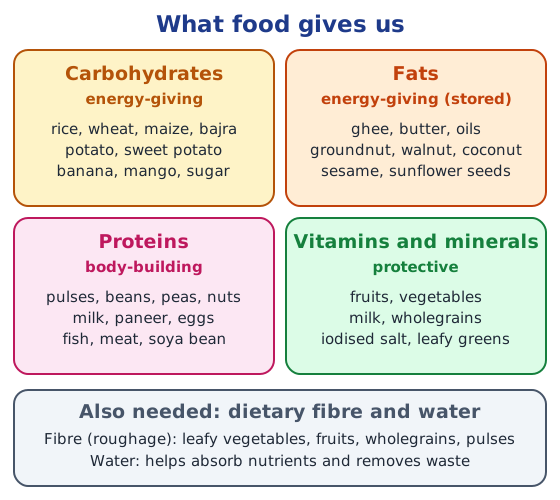
- Carbohydrates give energy. Glucose gives instant energy, which is why a marathon runner drinks glucose water. Wheat, rice, maize, bajra, potato, sweet potato, banana, pineapple, mango and common sugar are sources.
- Fats give energy and are a store of energy. Ghee, oils, butter, nuts such as groundnuts, walnuts and almonds, and seeds such as pumpkin and sunflower seeds are sources. Laddoos rich in ghee and nuts keep us warm in winter, and polar bears live on stored fat during their months-long winter sleep.
- Proteins help in growth and repair, so they are body-building foods. Plant sources are pulses, beans, peas and nuts; animal sources are milk, paneer, eggs, fish and meat. Edible mushrooms are good sources too.
Carbohydrates and fats are energy-giving foods. Read more in components of food.
Vitamins, minerals and deficiency diseases
Two cases show why fruits, vegetables and other plant foods matter. In 1746, on a long sea voyage, the Scottish physician James Lind saw that sailors with bleeding, swollen gums recovered after eating lemons and oranges. These are symptoms of scurvy, caused by a lack of vitamin C. In the 1960s, Indian scientists found swelling at the front of the neck, goitre, common in the Himalayan region and the Northern plains, because the soil, food and water there lacked iodine. Adding iodine to common salt to make iodised salt visibly reduced it.
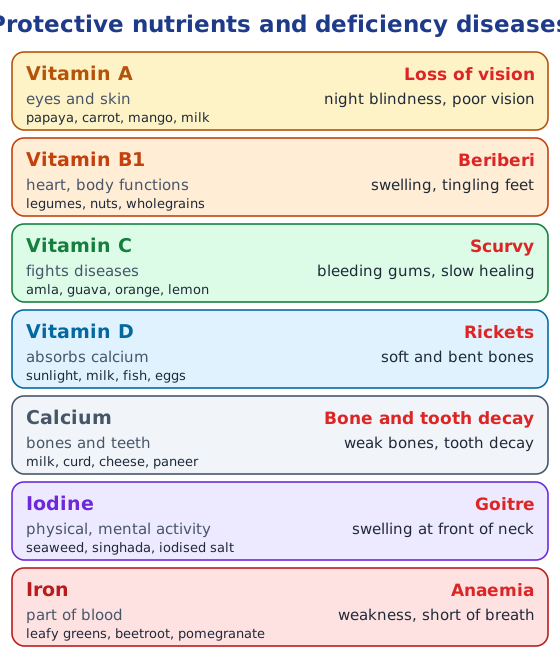
Vitamins and minerals are protective nutrients: needed in small amounts, but essential. Diseases caused by a long lack of a nutrient are deficiency diseases. Salt comes from seawater or rocks, as with the Agariya salt farmers of the Little Rann of Kutch (see separating salt by evaporation), and our body makes vitamin D in sunlight. Read more in deficiency diseases.
Fibre, water, and raw or cooked food
Dietary fibre, or roughage, gives no nutrients but helps the body get rid of undigested food and ensures smooth passage of stools. Green leafy vegetables, fresh fruits, wholegrains, pulses and nuts are good sources. Water helps the body absorb nutrients and removes waste through sweat and urine.
Cooking at high heat destroys some nutrients such as vitamin C, and washing cut or peeled vegetables can wash away some vitamins, so include some fruits and uncooked vegetables, and wash everything well before eating. The scientist Coluthur Gopalan (1918–2019) analysed more than 500 Indian foods; his work led to the Mid Day Meal Programme, now PM POSHAN, which gives balanced food in government and government-aided schools.
Testing food for starch, fat and protein
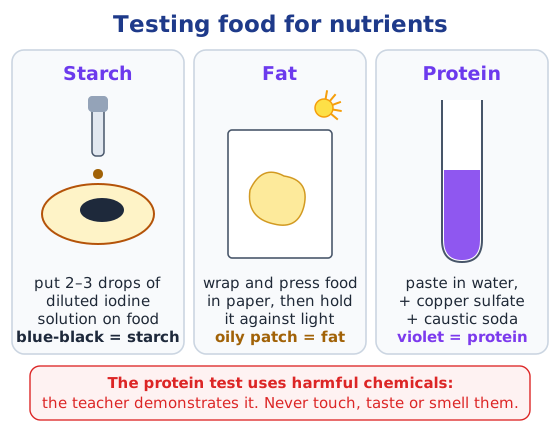
- Starch: 2–3 drops of diluted iodine solution turn it blue-black.
- Fat: pressed in paper, it leaves an oily patch through which light faintly shines.
- Protein: a paste in water with 2 drops of copper sulfate solution and 10 drops of caustic soda solution turns violet. These chemicals are harmful, so the teacher demonstrates this test.
Many foods have more than one nutrient: peanuts contain both fat and protein. Read more in tests for starch, protein and fat.
A balanced diet, not junk food
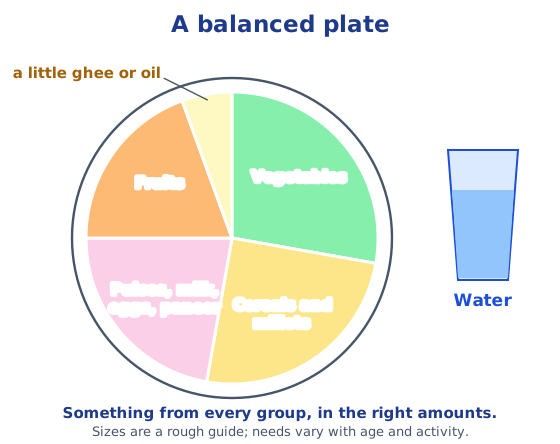
A balanced diet has all essential nutrients, roughage and water in the right amounts for proper growth and development. Needs vary with age, gender, physical activity, health status and lifestyle.
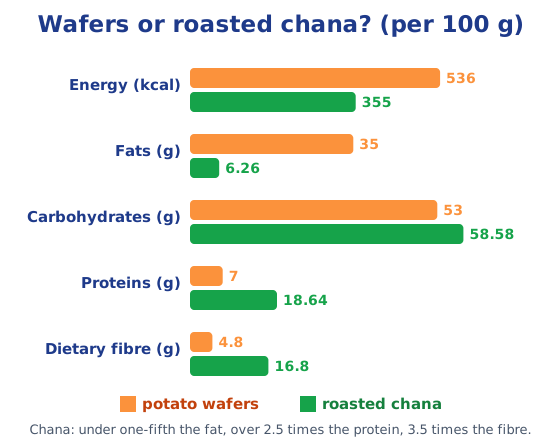
In Activity 3.9, potato wafers give 536 kcal and 35 g of fat per 100 g, against 355 kcal and 6.26 g of fat for roasted chana, which also has far more protein and fibre. Foods high in sugar and fat but low in other nutrients are junk foods: potato wafers, candy bars and carbonated drinks. Eating them often can make a person obese. Packaged foods must list their nutrients; adding nutrients during processing is fortification, and the Food Safety and Standards Authority of India (FSSAI) regulates food quality. Read more in what is a balanced diet.
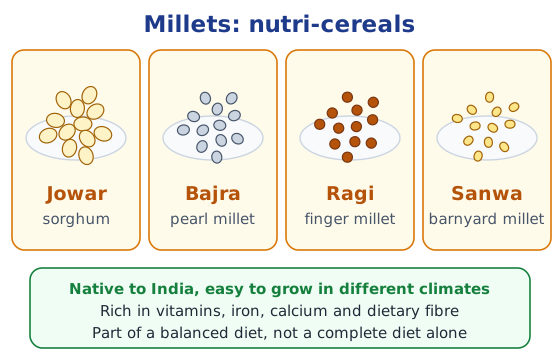
Millets: nutri-cereals
Jowar, bajra, ragi and sanwa are small, nutritious grains native to India that grow easily in different climates. They are rich in vitamins, minerals such as iron and calcium, and dietary fibre, so they are called nutri-cereals.
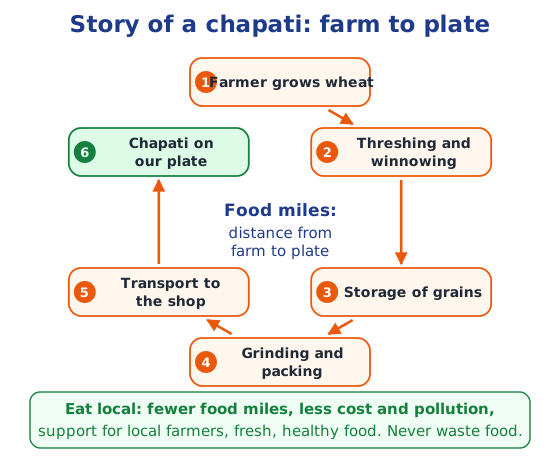
Food miles: from farm to plate
A chapati’s journey: a farmer grows wheat; the grains are threshed and winnowed (see handpicking, threshing and winnowing), stored, ground and packed, and transported to a shop before reaching our plate. The whole distance a food travels from producer to consumer is its food miles. Eating local food reduces food miles, cuts the cost and pollution of transport, supports local farmers and keeps food fresh and healthy. Remember the farmers’ effort: take only as much food as you can eat, and never waste it.
Answers to every activity and question are in the NCERT solutions for Chapter 3.
Key terms
| Term | Meaning |
|---|---|
| Culinary practices | Ways of preparing and cooking food. They have changed over time, from the chulha and sil-batta to the gas stove and electrical grinder. |
| Nutrients | Food components that provide energy, support growth, help repair and protect the body, and maintain body functions: carbohydrates, fats, proteins, vitamins and minerals. |
| Carbohydrates | Energy-giving nutrients found in cereals such as wheat, rice and maize, in potato, sweet potato, banana and mango, and in sugar. Starch, glucose and sugar are carbohydrates. |
| Fats | Energy-giving nutrients and a store of energy, found in ghee, oils, butter, nuts and seeds. |
| Proteins | Body-building nutrients that help in growth and repair, found in pulses, beans, peas, nuts, milk, paneer, eggs, fish and meat. |
| Vitamins and minerals | Protective nutrients, needed in small amounts, that protect the body from diseases: for example vitamins A, B1, C and D, and the minerals calcium, iodine and iron. |
| Deficiency diseases | Diseases or disorders caused when one or more nutrients are lacking in the diet for a long time, such as scurvy (vitamin C) and goitre (iodine). |
| Roughage (dietary fibre) | The part of plant food that gives no nutrients but helps the body get rid of undigested food and ensures smooth passage of stools. |
| Iodised salt | Common salt mixed with the required quantities of salts of iodine, used to prevent goitre. |
| Balanced diet | A diet that has all essential nutrients, roughage and water in the right amounts for proper growth and development of the body. |
| Junk food | Food with high calories from sugar and fat but very little protein, vitamins, minerals and fibre, such as potato wafers, candy bars and carbonated drinks. |
| Fortification | Adding nutrients to food during processing to improve its nutritional quality, as in iodised salt and some baby foods. |
| Millets | Small, nutritious grains native to India, such as jowar, bajra, ragi and sanwa, rich in vitamins, iron, calcium and dietary fibre; also called nutri-cereals. |
| Food miles | The entire distance a food item travels from the producer to the consumer. |
Topics in this chapter
Practice
-
Which of these is a body-building food?
Show answer
Answer: (c) Paneer
-
Bleeding and swollen gums are symptoms caused by a lack of:
Show answer
Answer: (b) vitamin C
-
A few drops of iodine solution turn a food blue-black. The food contains:
Show answer
Answer: (c) starch
-
Which of these is a millet?
Show answer
Answer: (a) Ragi
-
The distance a food travels from the producer to the consumer is called its:
Show answer
Answer: (b) food miles
Questions students ask
What are the main topics of Class 6 Science Chapter 3?
Food in different regions of India, changes in cooking practices, the components of food and their sources, deficiency diseases, tests for starch, fat and protein, balanced diet and junk food, millets, and food miles from farm to plate.
Is Mindful Eating in the new Curiosity book?
Yes. Mindful Eating: A Path to a Healthy Body is Chapter 3 of Curiosity, the Class 6 Science textbook (Reprint 2026-27). It comes after Chapter 2, Diversity in the Living World.
How many questions does Chapter 3 have at the end?
The “Let us enhance our learning” section has 13 questions, followed by Learning further tasks. Our NCERT solutions page answers all of them, along with Activities 3.1 to 3.9 and the in-text questions.
Stuck on a question?
Take a photo and Lagnever AI explains it step by step. Try it for 7 days for ₹2.
Get it on Google Play Open in browser
For parents: after the trial, the plan renews monthly by UPI or card autopay. You can cancel anytime in the app.