
How do we separate salt from water by evaporation?
Answer in short
Salt dissolves completely in water, so sieving, decantation and filtration cannot remove it. To get it back, keep the salt solution in the sun or heat it in a china dish. The water changes into vapour and goes into the air, but the salt stays behind. This is evaporation, a liquid changing into its vapour.
Stuck on a question? Take a photo and Lagnever AI explains it step by step. Try it for 7 days for ₹2. Get it on Google Play
Where does the salt go?
Stir two or three teaspoons of salt into half a bowl of water and the salt seems to vanish. It has dissolved, forming a salt solution. The salt is still there: the water tastes salty. Because the salt has dissolved, sieving, decantation and filtration cannot separate it; its particles pass through any filter along with the water. These methods only work for solids that do not dissolve, as explained in sieving, sedimentation, decantation and filtration.
Salt art: watching evaporation
Spread a few drops of the salt solution on a piece of black or dark, thick paper, or paint a picture with it, and let it dry. White patches appear where the drops were. Touch them and you can feel the salt. The water has gone into the air as vapour, but the salt could not go with it.
The same thing happens on dark clothes on hot summer days: sweat dries and leaves white, salty patches.
Getting the salt back by heating
Your teacher can show this. Pour some salt solution into a china dish and heat it on a wire gauze over a spirit lamp until the water boils away. Let the dish cool. Salt is left in the dish; you can feel it with your fingers. (Heat the dish carefully, and only with an adult.)
This method is evaporation: the process in which a liquid changes into its vapour. It is used to separate a solid that is dissolved in a liquid.
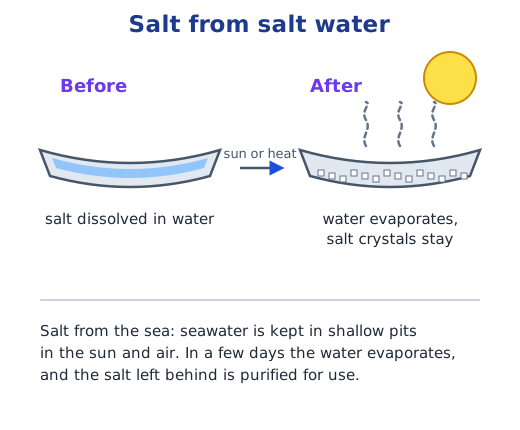
Salt from the sea
When Malli asks where namak comes from, Ghanshyam bhai says: from seawater. Seawater is a mixture of salts and some other substances dissolved in water. To obtain salt, seawater is kept in shallow pits and left in the sunlight and air. In a few days the water evaporates completely, leaving behind a solid mixture, and common salt is obtained from it by further purification. Some lakes, such as Sambhar Lake in Rajasthan, also contain common salt.
Salt has a special place in India’s history too. At the Sabarmati Ashram in Ahmedabad, Malli and Valli learn about the Namak Satyagraha, the Dandi March.
Can we get back both salt and water?
Evaporation sends the water into the air. To collect the water as well, the vapour must be cooled so that it turns back into a liquid, which is condensation. If the vapour from heated salt water is led into a cooled container, drops of water collect there, and they are not salty. The salt stays behind in the dish.
Evaporation in daily life
In Ayurveda, India’s traditional system of health and medicine, roots, leaves, flowers or seeds of medicinal plants are often dried in the shade. The extra water evaporates, leaving behind the useful part of the medicine.
| Mixture | Method | Why |
|---|---|---|
| Salt dissolved in water | Evaporation | Water turns into vapour, salt does not |
| Sand in water | Sedimentation, decantation or filtration | Sand does not dissolve |
| Salt and water, both needed | Evaporation, then condensation | The vapour is cooled back into water |
Practice
-
Which method separates salt from salt solution?
Show answer
Answer: (b) Evaporation
-
Why can salt not be filtered out of salt water?
Show answer
Answer: (b) Dissolved salt passes through the filter with the water
-
Salt is obtained from seawater by keeping it in:
Show answer
Answer: (a) shallow pits in the sun and air
-
Why do white patches appear on dark clothes on hot summer days?
Show answer
Answer: Sweat is water with salts dissolved in it. When the sweat evaporates, the salts are left behind on the cloth as white patches.
-
How can we get back both the salt and the water from salt solution?
Show answer
Answer: Heat the solution so that the water evaporates, and cool the vapour, for example on a cold plate or in a cooled tube, so that it condenses into water in another container. The salt stays behind in the first vessel.
Questions students ask
What is evaporation?
Evaporation is the process in which a liquid changes into its vapour. When salt water evaporates, only the water turns into vapour, and the salt is left behind.
How is common salt obtained from seawater?
Seawater is kept in shallow pits and left in the sun and air. In a few days the water evaporates completely, leaving a solid mixture behind, and common salt is obtained from it by further purification.
Is there salt water on land in India?
Yes. Sambhar Lake in Rajasthan is one water body that contains common salt.
Stuck on a question?
Take a photo and Lagnever AI explains it step by step. Try it for 7 days for ₹2.
Get it on Google Play Open in browser
For parents: after the trial, the plan renews monthly by UPI or card autopay. You can cancel anytime in the app.