
What are sieving, sedimentation, decantation and filtration?
Answer in short
Sieving separates solid particles of different sizes using a sieve, like bran from flour. Sedimentation is the settling of heavier insoluble particles at the bottom of a liquid. Decantation then pours off the liquid by tilting the vessel. Filtration passes the mixture through a filter, such as a strainer, cloth or filter paper, to hold back the insoluble solid.
Stuck on a question? Take a photo and Lagnever AI explains it step by step. Try it for 7 days for ₹2. Get it on Google Play
Sieving
Before Valli’s Mami kneads wheat flour for meethi puri, she sieves it. The fine flour passes through the holes of the sieve, and the bigger particles, such as bran and small stones, stay on top. This is sieving.
Sieving is used when the parts of a solid–solid mixture have different sizes. It only works if the holes are bigger than one part and smaller than the other: if the holes were larger than everything, all of it would fall through. You can also see sieves at construction sites, where they separate pebbles and stones from sand.
Sedimentation and decantation
In Puducherry, Dada shows the children how to remove tea leaves without a strainer. He leaves the vessel of tea undisturbed for a while, and the tea leaves settle at the bottom. Then he tilts the vessel and pours the tea gently into a cup.
- The settling of a heavier insoluble part at the bottom of a liquid is sedimentation.
- Removing the liquid by tilting the vessel is decantation.
Decantation is also used when rice and pulses are washed, and to separate oil and water, which do not mix: the oil forms a layer on top and can be poured off. But decantation is not complete, so a few tea leaves still reach the cup.
Filtration
With a tea strainer, all the tea leaves are held back. Separating the leaves from the tea this way is filtration. A strainer has fairly big holes, so it cannot clean muddy water. A piece of cloth has much smaller pores between its threads and works better; people have used cloth this way since ancient times. For water that is still muddy, filter paper, with very fine pores, is used.
To filter muddy water in the laboratory, fold a filter paper into a cone, place it in a funnel over a conical flask, and pour the muddy water in. The mud stays on the paper as the residue, and clear water collects in the flask as the filtrate.
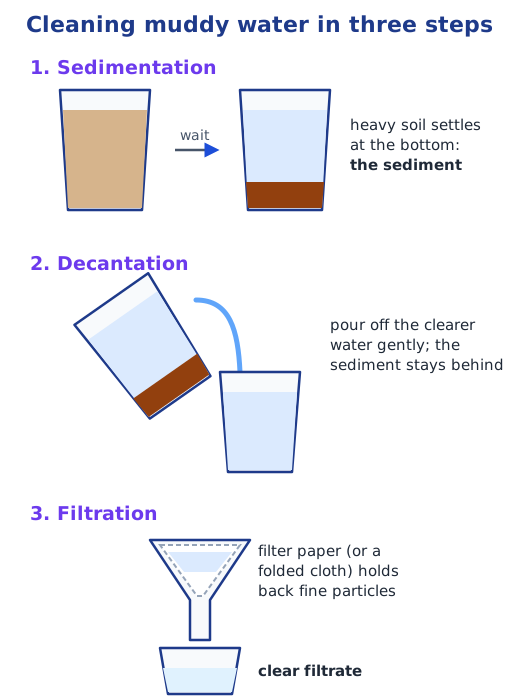
Other materials, such as cotton, charcoal and sand, can also be used as filters. The choice depends on the size of the particles to be removed: the pore size of the filter is what matters. Tea bags show this history well: they were first made of silk, then of gauze or muslin, and today mostly of filter paper.
Filtration around us
- A fishing net lets the water drain out through its mesh and keeps the fish, a bit like a filter.
- Our nose has hairs that trap dust from the air we breathe.
- A mask stops tiny droplets and dust from passing through.
What these methods cannot do
Sieving, sedimentation, decantation and filtration separate parts that do not dissolve. Salt dissolved in water passes straight through any filter. To get it back, the water has to be removed by evaporation. And clear-looking filtered water may still have germs, which is why drinking water from a pond should also be boiled.
Choosing the method
| Mixture | Method | Why |
|---|---|---|
| Bran in flour, pebbles in sand | Sieving | Different particle sizes |
| Tea leaves in tea, oil and water | Sedimentation and decantation | The heavier part settles, or the liquids form layers |
| Mud in water, chalk powder in water | Filtration | Insoluble solid held back by the filter |
Grains go through threshing and winnowing before they ever reach the sieve.
Practice
-
Which method removes bran from wheat flour?
Show answer
Answer: (a) Sieving
-
The mud left on the filter paper after filtration is called the:
Show answer
Answer: (b) residue
-
Which factor matters most for filtration to work?
Show answer
Answer: (b) The pore size of the filter
-
How can most tea leaves be removed if there is no strainer?
Show answer
Answer: Leave the vessel undisturbed so the leaves settle at the bottom (sedimentation), then tilt it and pour the tea gently into a cup (decantation).
-
Which method would you use to separate oil from water? Why?
Show answer
Answer: Decantation. Oil does not mix with water and forms a separate layer on top when left undisturbed, so it can be poured off carefully.
Questions students ask
What is the difference between sedimentation and decantation?
Sedimentation is the settling of heavier insoluble particles at the bottom of a liquid. Decantation is the next step: removing the liquid by tilting the vessel, leaving the settled particles behind.
What can be used as a filter?
A strainer, a piece of cloth, filter paper, and materials such as cotton, charcoal and sand. The choice depends on the size of the particles to be removed.
Where do we see sieving outside the kitchen?
At construction sites, where sieves separate pebbles and stones from sand.
Stuck on a question?
Take a photo and Lagnever AI explains it step by step. Try it for 7 days for ₹2.
Get it on Google Play Open in browser
For parents: after the trial, the plan renews monthly by UPI or card autopay. You can cancel anytime in the app.