
Class 6 Science Chapter 9: Methods of Separation in Everyday Life Notes
This chapter in five lines
A mixture has two or more substances mixed together. We separate it to remove a part that is not useful, or to get two useful parts. The method depends on how the parts differ: handpicking, threshing, winnowing and sieving for solids; sedimentation, decantation and filtration for insoluble solids in liquids; evaporation for dissolved solids; churning for butter from curd; and a magnet for iron.
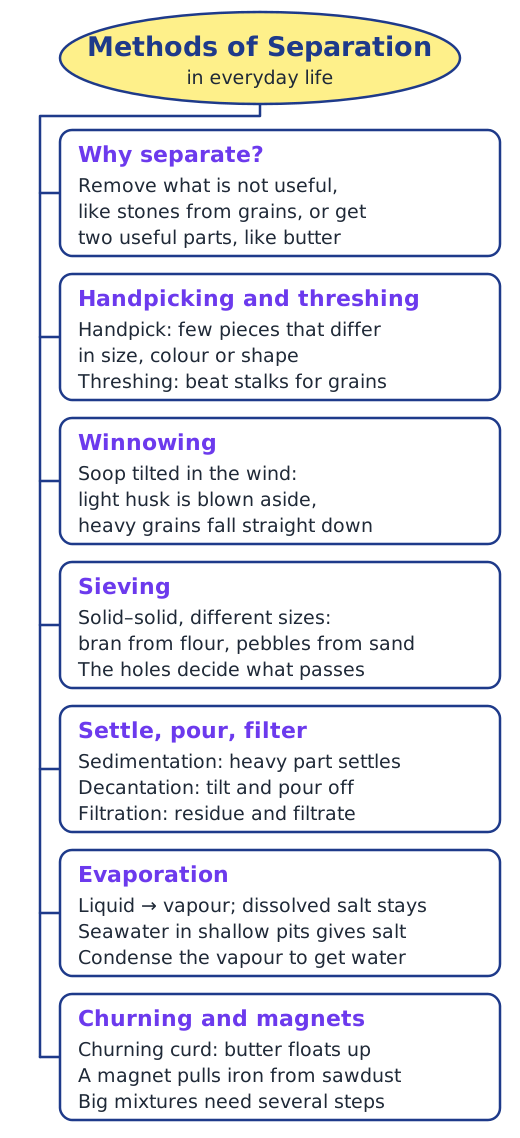
What is a mixture, and why do we separate it?
When two or more substances are mixed together, we get a mixture: stones in grains, bran in flour, salt in seawater. In the chapter, Malli and Valli travel across India, from Haryana to Ahmedabad, Puducherry, Bhopal and Shillong, and see mixtures being separated everywhere. We separate a mixture for two reasons: to remove a part that is not useful, or to separate two useful parts. The method depends on how the parts differ.
Handpicking and threshing
Handpicking picks out unwanted pieces by hand, like small stones and husk from wheat, using differences in size, colour and shape. It suits a small number of pieces that are easy to pick. Threshing separates the grains from harvested stalks, for example by beating the stalks on a wooden log. See handpicking, threshing and winnowing.
Winnowing
After threshing, the grains are mixed with light husk. The farmer stands on a raised platform and tilts a soop (bamboo tray) in the direction of the wind. The light husk is blown aside and the heavy grains fall straight down. This is winnowing. Machines called threshers do threshing and winnowing together.
Sieving
A sieve lets fine particles pass through its holes and holds back bigger ones. It removes bran and small stones from flour, and at construction sites it separates pebbles from sand. Sieving is used for solid–solid mixtures whose particles have different sizes.
Evaporation
Salt dissolved in water cannot be filtered out. To get it back, the water is removed as vapour: this is evaporation, the change of a liquid into its vapour. Seawater is kept in shallow pits in the sun and air; in a few days the water evaporates and salt is left behind, which is then purified. Cooling the vapour so that it condenses gives the water back too. See separating salt by evaporation.
Sedimentation, decantation and filtration
Leave a vessel of tea undisturbed and the tea leaves settle: this is sedimentation. Tilting the vessel to pour off the tea is decantation, which also separates oil from water. A few leaves still get through, so we use a strainer: filtration. Cloth and filter paper have smaller pores and can clean muddy water, leaving the mud as residue and giving clear filtrate. See sieving, sedimentation, decantation and filtration.
Churning and magnetic separation
In Bhopal, a painting shows a woman churning curd with a big mathni. The lighter butter floats to the top and buttermilk is left behind. In Shillong, a carpenter drops iron nails in sawdust; a magnet moved through the sawdust picks up all the nails. Using a magnet to separate magnetic substances like iron is magnetic separation. Recyclers use magnets fitted to cranes to pick scrap iron out of heaps of waste.
Choosing the right method
| Method | Works because of | Example |
|---|---|---|
| Handpicking | Size, colour, shape | Stones from grains |
| Winnowing | Weight (light and heavy) | Husk from grains |
| Sieving | Particle size | Bran from flour |
| Sedimentation and decantation | Heavier part settles | Tea leaves, oil and water |
| Filtration | Pore size of the filter | Mud from water |
| Evaporation | Liquid evaporates, solid stays | Salt from seawater |
| Churning | Butter is lighter | Butter from curd |
| Magnetic separation | Attraction to a magnet | Iron nails from sawdust |
A mixture with many parts usually needs several of these methods, one after another.
Key terms
| Term | Meaning |
|---|---|
| Mixture | Two or more substances mixed together, like stones in grains or salt in water. |
| Handpicking | Picking out a part of a mixture by hand, using differences in size, colour and shape. |
| Threshing | Beating harvested stalks to separate the grains from them. |
| Winnowing | Separating lighter and heavier parts of a mixture, like husk and grains, by wind or blowing air. |
| Sieving | Separating solid particles of different sizes with a sieve, like bran from flour. |
| Sedimentation | The settling of a heavier insoluble part at the bottom of a liquid. |
| Decantation | Removing a liquid by tilting the vessel, leaving the settled part behind. |
| Filtration | Separating an insoluble solid from a liquid with a filter. The solid left is the residue; the liquid that passes is the filtrate. |
| Evaporation | The change of a liquid into its vapour. It separates a solid dissolved in a liquid, like salt from salt water. |
| Condensation | The change of vapour back into a liquid, used to collect the water as well. |
| Churning | Stirring curd fast with a churner (mathni) so that the lighter butter separates and floats up. |
| Magnetic separation | Separating magnetic substances, such as iron, from others using a magnet. |
Topics in this chapter
Practice
-
Bran is removed from flour by:
Show answer
Answer: (b) sieving
-
Which method separates butter from curd?
Show answer
Answer: (b) Churning
-
Iron nails that fell into sawdust are most easily separated by:
Show answer
Answer: (b) magnetic separation
-
Salt is obtained from seawater by:
Show answer
Answer: (b) evaporation
-
The clear liquid that passes through a filter is the:
Show answer
Answer: (c) filtrate
Questions students ask
What are the main topics of Class 6 Science Chapter 9?
Mixtures and why we separate them, and the methods of separation: handpicking, threshing, winnowing, sieving, evaporation, sedimentation, decantation, filtration, churning and magnetic separation, told through Malli and Valli's tour of India.
Is “Methods of Separation in Everyday Life” in the new Curiosity book?
Yes. It is Chapter 9 of Curiosity, the Class 6 Science textbook used in the 2026-27 session.
How many questions are in the Chapter 9 exercise?
The “Let us enhance our learning” section has 10 questions. All of them are answered on our NCERT solutions page, together with the Wise Fish game and Activity 9.6.
Stuck on a question?
Take a photo and Lagnever AI explains it step by step. Try it for 7 days for ₹2.
Get it on Google Play Open in browser
For parents: after the trial, the plan renews monthly by UPI or card autopay. You can cancel anytime in the app.