
What is a balanced diet?
Answer in short
A balanced diet is a diet that has all essential nutrients, roughage and water in the right amounts for proper growth and development of the body. Needs vary with age, gender, physical activity, health and lifestyle. Junk foods are high in sugar and fat but low in other nutrients, so a balanced diet avoids them.
Stuck on a question? Take a photo and Lagnever AI explains it step by step. Try it for 7 days for ₹2. Get it on Google Play
The meaning of a balanced diet
A diet that has all the essential nutrients, roughage and water in the right amount for proper growth and development of the body is a balanced diet. The nutrients are carbohydrates and fats for energy, proteins for growth and repair, and vitamins and minerals for protection from diseases (see components of food).
Needs are not the same for everyone
Do you and your grandparents need the same type or the same amount of nutrients? No. Needs vary with age, gender, physical activity, health status and lifestyle. A growing child needs the right amount of protein, a sportsperson needs more protein to build muscles, and a person who works hard in the fields needs more energy than one who sits for most of the day.
In Activity 3.8, look again at the food you listed for a week in Activity 3.1. Does it contain every nutrient, along with roughage and water? If not, which foods should you add? A week of biscuits and noodles needs more vegetables, fruits and pulses; a week with no milk or curd may need more calcium.
A balanced plate
One easy way to plan a meal is to put something from every food group on your plate.
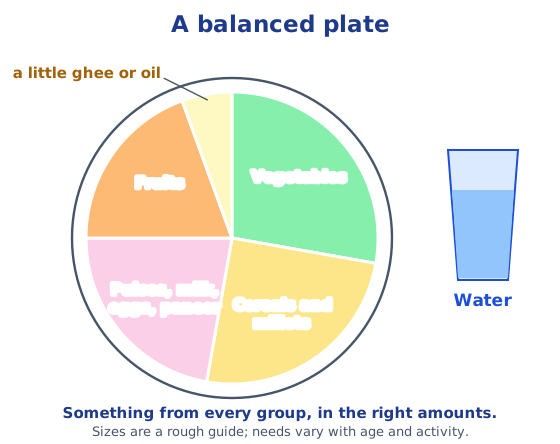
The plate is only a rough guide. Dal, chapati or rice, a green vegetable, salad, curd and a seasonal fruit, with enough water, make a simple balanced meal from food that is easily available.
Junk food or a healthy snack?
Activity 3.9 compares the nutritional information on two packets, per 100 g:
| Per 100 g | Potato wafers | Roasted chana |
|---|---|---|
| Energy | 536 kcal | 355 kcal |
| Fats | 35.0 g | 6.26 g |
| Carbohydrates | 53.0 g | 58.58 g |
| Proteins | 7.0 g | 18.64 g |
| Dietary fibre | 4.8 g | 16.8 g |
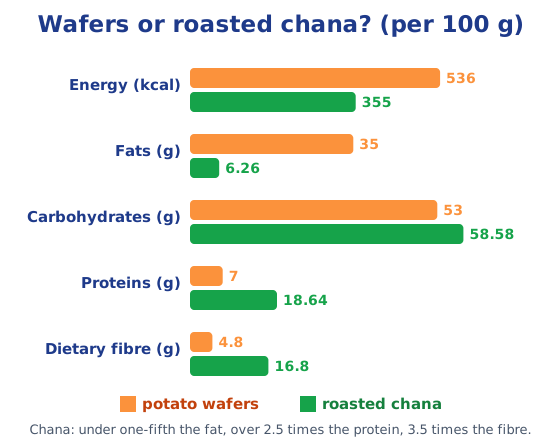
Roasted chana is the healthier choice: it has less than one-fifth of the fat, more than two and a half times the protein, and three and a half times the fibre. Foods with high calories from sugar and fat but very little protein, minerals, vitamins and fibre are junk foods: potato wafers, candy bars and carbonated drinks. Eating them often is not healthy and can make a person obese, which may lead to several health problems. As Dr Poshita says, health is the ultimate wealth.
Read the food label
Packaged foods must show information about the nutrients they contain and the amount of each. Sometimes extra nutrients are added during processing to improve nutritional quality; this is fortification. Iodised salt and some baby foods are fortified foods. The Food Safety and Standards Authority of India (FSSAI) is the government agency that regulates food quality in India.
Millets: nutri-cereals
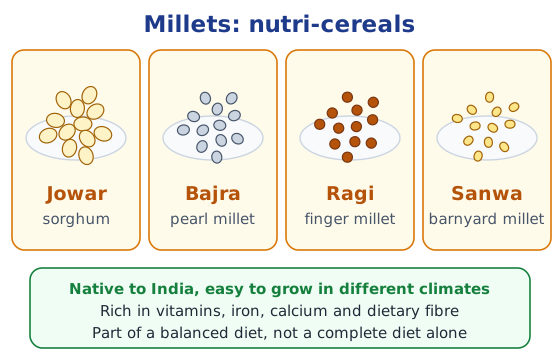
Jowar, bajra, ragi and sanwa are small grains native to India that grow easily in different climates. They have been part of the Indian diet for centuries and are popular again for their health benefits. They are good sources of vitamins, minerals such as iron and calcium, and dietary fibre, so they are called nutri-cereals. Millets add a lot to a balanced diet, but millets alone are not enough: we still need pulses, milk, vegetables and fruits.
Food miles and food waste
How does a chapati reach our plate? A farmer grows wheat; the grains are threshed and winnowed (see handpicking, threshing and winnowing), stored, ground into flour and packed, and transported to a shop. The entire distance a food travels from producer to consumer is its food miles.
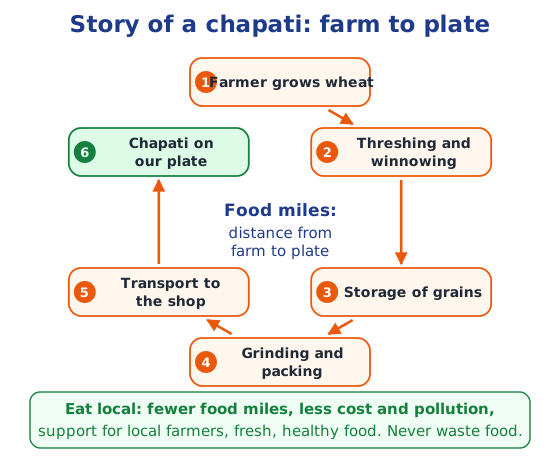
Eating local food reduces food miles: it cuts the cost and pollution of transport, supports local farmers, and keeps food fresh and healthy. Remember the time and effort of farmers and others who bring food to our plate. Take only as much as you can eat, and never waste food.
For diseases caused by a poor diet, read deficiency diseases. For the textbook’s questions, see the Chapter 3 NCERT solutions; for the whole chapter, see the Chapter 3 notes.
Practice
-
Per 100 g, potato wafers have 7 g of protein and roasted chana 18.64 g. Which has more protein?
Show answer
Answer: (b) Roasted chana
-
Which of these is a junk food?
Show answer
Answer: (b) Carbonated drink
-
Adding nutrients to food during processing is called:
Show answer
Answer: (a) fortification
-
Why are millets called nutri-cereals?
Show answer
Answer: They are good sources of vitamins, minerals such as iron and calcium, and dietary fibre, and they contribute significantly to a balanced diet.
-
Give two reasons to reduce food miles.
Show answer
Answer: It cuts the cost and pollution of transporting food, supports local farmers, and keeps food fresh and healthy.
Questions students ask
What is a balanced diet?
A diet that has all the essential nutrients (carbohydrates, fats, proteins, vitamins and minerals), roughage and water in the right amounts for proper growth and development of the body.
Do all people need the same diet?
No. The type and amount of nutrients needed vary with age, gender, physical activity, health status and lifestyle. A growing child, a sportsperson and a grandparent need different amounts.
Why are junk foods unhealthy?
They have high calories from sugar and fat but very little protein, vitamins, minerals and dietary fibre. Eating them often is not healthy and can make a person obese, which may lead to several health problems.
Stuck on a question?
Take a photo and Lagnever AI explains it step by step. Try it for 7 days for ₹2.
Get it on Google Play Open in browser
For parents: after the trial, the plan renews monthly by UPI or card autopay. You can cancel anytime in the app.