
Components of food
Answer in short
Food has five major nutrients: carbohydrates, fats, proteins, vitamins and minerals. Carbohydrates and fats give energy, proteins build and repair the body, and vitamins and minerals protect us from diseases. Food also contains dietary fibre (roughage) and water, which give no nutrients but are essential for a healthy body.
Stuck on a question? Take a photo and Lagnever AI explains it step by step. Try it for 7 days for ₹2. Get it on Google Play
Why we need food
Have you ever missed a meal? You probably felt tired and low on energy. Food gives us energy, helps us grow, repairs the body and protects it from diseases. The food components that do these jobs and keep the body working are called nutrients. The major nutrients are carbohydrates, fats, proteins, vitamins and minerals. Along with them, our body needs dietary fibre and water.
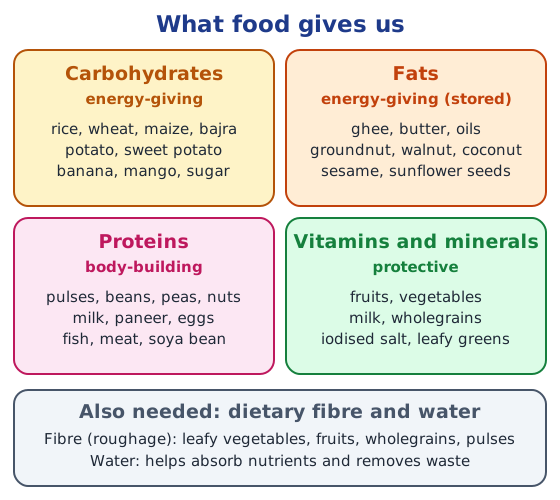
Carbohydrates: the main source of energy
Why does a marathon runner drink glucose water during and after a race? Glucose gives instant energy, and glucose is a carbohydrate. Carbohydrates are one of the primary sources of energy in our diet.
- Cereals: wheat, rice, maize and bajra.
- Vegetables: potato and sweet potato.
- Fruits: banana, pineapple and mango.
- Others: sugarcane, and common sugar, which is also a carbohydrate.
Starch is a type of carbohydrate found in foods such as potato, rice and bread. It can be detected by a simple iodine test (see tests for starch, protein and fat).
Fats: energy in store
Why are laddoos a favourite in winter? Besan or wheat flour and ghee are their main ingredients, along with goond (edible gum), nuts and seeds. As Medu’s grandma says, laddoos rich in ghee and nuts give energy that keeps us warm. Ghee and oils belong to the food component called fat.
Fats come from plants and animals: ghee, butter, oils, nuts such as groundnuts, walnuts, coconuts and almonds, and seeds such as pumpkin, sunflower and sesame seeds. Fat is a source of stored energy. Polar bears build up a thick layer of fat under their skin, which keeps them alive through their months-long winter sleep (hibernation) without eating.
Carbohydrates and fats both give us energy for our activities, so they are called energy-giving foods.
Proteins: body-building foods
Sportspersons need more protein to build their muscles, and growing children need the right amount for proper growth and development. Protein-rich foods help in the growth and repair of the body, so they are called body-building foods.
| Plant sources | Animal sources |
|---|---|
| Pulses (moong, tuar dal, gram), kidney beans, peas, soya bean, nuts | Milk, paneer, eggs, fish, meat |
Edible mushrooms, which grow in dark, moist places, are also good sources of protein.
Vitamins and minerals: protective nutrients
Vitamins (A, B1, C and D) and minerals (calcium, iodine and iron) protect the body from diseases and keep us healthy, so they are called protective nutrients. They are needed in small amounts, but they are essential. Milk, green vegetables, fruits and wholegrains are good sources. A long lack of them causes diseases such as scurvy and goitre: see deficiency diseases.
Not every nutrient comes from plants or animals. Salt is obtained from seawater or rocks, and our body makes vitamin D when the skin is exposed to sunlight.
Dietary fibre and water
Dietary fibre, also called roughage, gives no nutrients, yet it is an essential part of food. It helps the body get rid of undigested food and ensures smooth passage of stools. Roughage comes mainly from plant foods: green leafy vegetables, fresh fruits, wholegrains, pulses and nuts. That is why a doctor may advise a person who has difficulty passing stools to eat food high in fibre.
Water helps the body absorb nutrients from food and removes waste through sweat and urine. Drink enough water regularly. Fruits such as watermelon and oranges, cucumber, milk, buttermilk and dal also give us water.
Raw or cooked?
Cooked vegetables often lose their bright colour and become softer and less crisp. Some nutrients, such as vitamin C, are lost during cooking because of the high heat. Washing cut or peeled vegetables and fruits can also wash away some vitamins. So it is wise to eat some fruits and uncooked vegetables, and to wash all fruits and vegetables thoroughly before eating.
Eating food that is locally grown and plant-based, as far as possible, is healthy for the body and good for our planet. To combine all these components in the right amounts, read what is a balanced diet. For the textbook’s questions, see the Chapter 3 NCERT solutions; for the whole chapter, see the Chapter 3 notes.
Practice
-
Which pair are both energy-giving foods?
Show answer
Answer: (a) Rice and ghee
-
Protein-rich foods are called:
Show answer
Answer: (b) body-building foods
-
Polar bears survive their months-long winter sleep using:
Show answer
Answer: (a) stored fat
-
Why does a marathon runner drink glucose water during and after a race?
Show answer
Answer: Glucose is a carbohydrate that gives instant energy, so it quickly makes up for the energy used in running.
-
Name two plant sources and two animal sources of protein.
Show answer
Answer: Plant sources: pulses such as moong and tuar dal, beans, peas, nuts or soya bean. Animal sources: milk, paneer, eggs, fish or meat.
Questions students ask
What are the components of food?
The major nutrients are carbohydrates, fats, proteins, vitamins and minerals, and food also contains dietary fibre and water. Food components that provide energy, support growth, help repair and protect the body, and maintain body functions are called nutrients.
Why are carbohydrates and fats called energy-giving foods?
Because they give us energy for all our activities. Carbohydrates such as glucose give quick energy, while fat is a store of energy: laddoos rich in ghee and nuts keep us warm in winter, and polar bears live on stored fat while they hibernate.
Why are proteins called body-building foods?
Protein-rich foods help in the growth and repair of the body. Growing children need the right amount of protein for proper growth, and sportspersons need more of it to build their muscles.
Stuck on a question?
Take a photo and Lagnever AI explains it step by step. Try it for 7 days for ₹2.
Get it on Google Play Open in browser
For parents: after the trial, the plan renews monthly by UPI or card autopay. You can cancel anytime in the app.