
NCERT Solutions Class 6 Science Chapter 3: Mindful Eating: A Path to a Healthy Body
Answers to Activities 3.1 to 3.9, the in-text questions and all 13 questions of “Let us enhance our learning” in Chapter 3, Mindful Eating: A Path to a Healthy Body, of Curiosity (Reprint 2026-27). The page numbers match the book. Many tasks ask about your own food and family, so the answers show sample entries; yours will differ. Short notes: Chapter 3 notes.
Activity 3.1: food over a week (pages 35–36)
Table 3.1, with sample entries:
| Day | Food items |
|---|---|
| Monday | Poha and milk; dal, rice and bhindi; a banana; chapati and paneer curry |
| Tuesday | Idli and sambhar; chapati, rajma and salad; roasted chana; khichdi and curd |
| Wednesday | Paratha and curd; rice, dal and aloo gobhi; a guava; chapati and mixed vegetables |
| Thursday | Upma and milk; chapati, chhole and salad; peanuts; rice and egg curry |
| Friday | Ragi porridge; rice, sambhar and cabbage palya; an orange; chapati, dal and spinach |
| Saturday | Bread and omelette; vegetable pulao and raita; sprouts chaat; chapati and kadhi |
| Sunday | Aloo paratha and curd; puri, chhole and kheer; fruit chaat; khichdi and papad |
Observations: most meals are built around a cereal (rice, wheat or ragi) with dal or a vegetable; the choices vary from meal to meal and day to day. Friends eat many of the same foods (rice, chapati, dal) but also different ones, depending on their family’s region and traditions.
Does such diversity exist in all states? Yes. Every state has its own traditional foods, as Activity 3.2 shows.
Activity 3.2: food in different regions (pages 36–37)
More rows for Table 3.2 (sample entries; check them with your own sources):
| State | Locally grown crops | Traditional food items | Beverages |
|---|---|---|---|
| Gujarat | Groundnut, bajra, wheat, cotton | Dhokla, thepla, khichdi, kadhi, bajra rotla | Chhaas (buttermilk), tea |
| West Bengal | Rice, jute, potato, mustard | Rice, fish curry, shukto, luchi, mishti doi | Tea |
| Kerala | Coconut, rice, tapioca, spices | Puttu, appam, avial, fish curry, sadya | Tea, coffee, coconut water |
| Rajasthan | Bajra, jowar, moth bean, mustard | Dal baati churma, bajra roti, ker sangri, gatte ki sabzi | Chhaas, lassi |
Why is there diversity in traditional food? India has many soil and climate types, so different crops grow in different regions. Taste preferences, culture and traditions also differ.
Foods common to many states: rice, chapati or roti, dal, curd or buttermilk, khichdi and tea.
Relation with local crops: the traditional food of a state is usually based on the crops grown there: wheat and maize in Punjab (makki di roti, parantha), rice and ragi in Karnataka (idli, dosa, ragi mudde), rice and bamboo in Manipur.
Activity 3.3: cooking then and now (pages 38–39)
Sample findings from interviews with elderly people:
- Still eaten: dal, rice, chapati, seasonal vegetables, pickles. New: noodles, bread, packaged snacks and soft drinks.
- Changes: cooking on a chulha with wood or cow-dung cakes has given way to the gas stove; grinding on a sil-batta or a hand chakki has given way to the mixer-grinder and the flour mill; refrigerators keep food longer.
- Causes: technological development, improved transportation and better communication, along with the wish to save time and effort and to avoid a smoky kitchen.
Other ways of cooking and grinding: earlier, food was cooked on an angithi (coal stove), in a tandoor or in earthen pots over a slow fire, and grains were pounded in an okhli-musal (a large mortar and pestle) or ground in a hand chakki (stone mill). Today we also use pressure cookers, microwave ovens and induction cooktops.
Components of food: in-text questions (pages 39–42)
- How do you feel when you miss a meal? Tired and less energetic.
- Why does a marathon runner drink glucose water? Glucose is a carbohydrate that gives instant energy.
- Why are laddoos eaten in winter? They are rich in ghee, nuts and seeds, which contain fat; fat gives energy that keeps us warm.
- More rich sources: carbohydrates – jowar, ragi, poha, bread, jaggery, sweet potato; fats – mustard oil, cheese, cream (malai), cashew nuts, sesame seeds.
- Which components are in your daily diet? Sample: carbohydrates (rice, chapati), proteins (dal, milk), fats (ghee, oil), vitamins and minerals (vegetables, fruits).
- Why eat fruits, vegetables and other plant foods daily? They give vitamins, minerals and dietary fibre, which protect the body from diseases and help digestion.
Cases 1 and 2 (pages 42–43)
Case 1: sailors with bleeding, swollen gums recovered after eating lemons and oranges. These are symptoms of scurvy, caused by a lack of vitamin C; citrus fruits contain vitamin C and cure it.
Case 2: goitre (swelling at the front of the neck) was common where the soil, and so the food and water, lacked iodine. Iodised salt, common salt mixed with salts of iodine, visibly reduced it. A lack of a nutrient causes disease, and adding it to the diet helps.
How can you find out about other protective food components? Study the chart in Fig. 3.5, read books, ask a doctor or health worker, and do the survey in Activity 3.4.
Activity 3.4: survey on vitamins and minerals (pages 43–44)
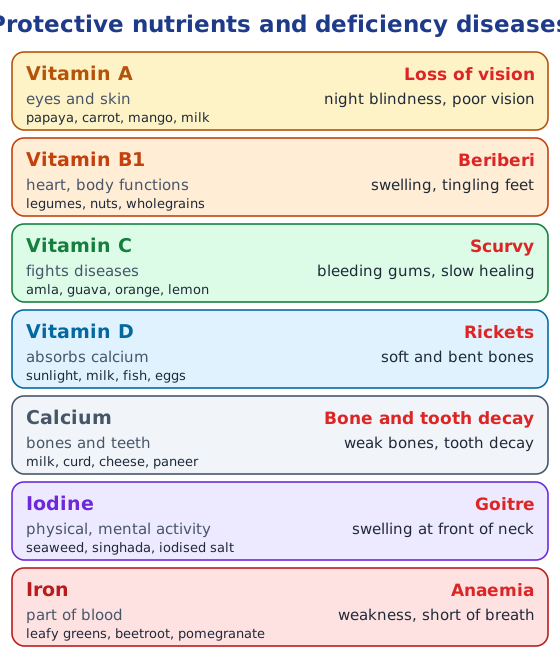
More sources (from Fig. 3.6 and beyond): vitamin A – papaya, mango, carrot, green leafy vegetables, pumpkin; vitamin B1 – wheat, rice, flax seeds, paneer, pumpkin seeds; vitamin C – orange, guava, tomato, green chilli, amla, lemon; vitamin D – butter, fish, eggs, edible mushrooms; calcium – ragi, sesame seeds; iron – pulses, bajra, ragi.
For the survey: under your teacher’s guidance, note any symptom from the chart, ask what the person usually eats, link the symptom to a possible deficiency (for example, bleeding gums and few fruits may point to a lack of vitamin C), suggest the change in diet, and advise a visit to a doctor. Keep the person’s name private.
How can we overcome deficiencies? Eat a balanced diet with foods rich in the missing nutrient, use iodised salt, get some sunlight for vitamin D, and follow a doctor’s advice. Read more in deficiency diseases.
Raw and cooked food, fibre and water (pages 46–47)
Raw and cooked vegetables: cooked vegetables often lose their bright colour and become softer and less crisp. Some nutrients, such as vitamin C, are lost because of the high heat, so eating some fruits and uncooked vegetables is wise.
Food sources of water: watermelon, cucumber, oranges, tomatoes, coconut water, milk, buttermilk, dal and soups.
Activities 3.5 to 3.7: Table 3.3 (pages 48–51)
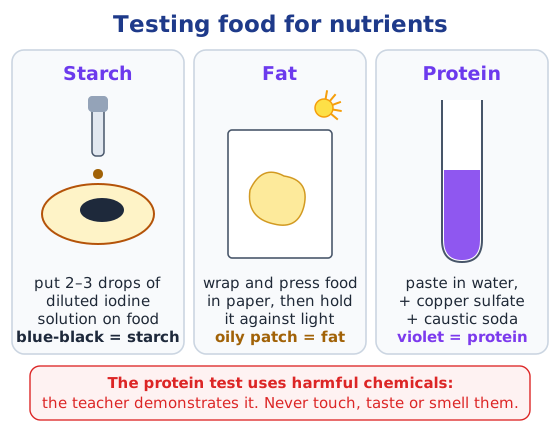
Table 3.3, typical results (write your own predictions first, and note each food’s own colour before testing; results can differ a little with the sample):
| Food item | Starch (iodine test) | Fat (paper test) | Protein (violet test) |
|---|---|---|---|
| Potato | Blue-black: yes | No patch: no | Stays blue: no |
| Cucumber | Stays yellow-brown: no | No patch: no | Stays blue: no |
| Boiled rice | Blue-black: yes | No patch: no | Blue or faint violet: little, if any |
| Boiled gram | Blue-black: yes | Very faint patch: very little | Violet: yes |
| Peanuts | Little or no change: very little | Oily patch: yes | Violet: yes |
| Bread or chapati | Blue-black: yes | Patch only if made with fat | Light violet: yes |
| Butter | No change: no | Oily patch: yes | Stays blue: no |
| Coconut | No change: no | Oily patch: yes | Faint violet: little |
Without starch, the food just shows the yellow-brown colour of iodine; without protein, the mixture stays the light blue of copper sulfate.
Conclusions: foods with more than one nutrient include boiled gram (starch and protein), peanuts (fat and protein) and bread (starch and protein). Peanuts show both protein and fat. Cucumber shows none of the three, as it is mostly water. Foods you eat daily, such as rice, chapati and dal, carry starch and protein. Other good sources: wheat flour and sweet potato (starch), ghee and sesame seeds (fat), paneer and moong dal (protein). More in tests for starch, protein and fat.
Activity 3.8: is my diet balanced? (page 51)
Check your Table 3.1 for each component. Sample findings: the week has enough cereals but few fruits and green vegetables, so add a seasonal fruit and a green vegetable daily; add dal, sprouts, milk or eggs if protein is low; drink more water; cut down on fried and packaged snacks.
Activity 3.9: wafers or roasted chana? (pages 52–53)
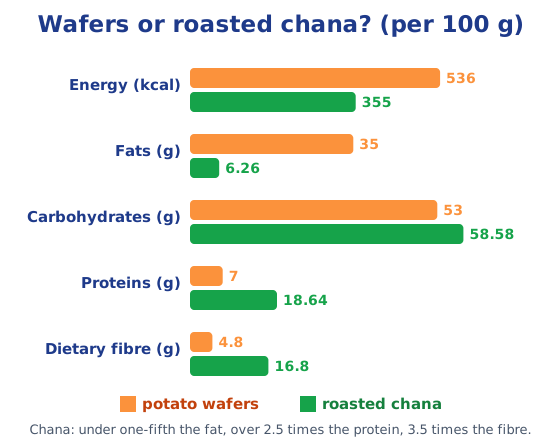
Which would you choose? Roasted chana. Per 100 g it has 6.26 g of fat against 35 g in potato wafers, 18.64 g of protein against 7 g, and 16.8 g of dietary fibre against 4.8 g, with less energy from fat.
Which could be labelled junk food? Potato wafers: high in fat and calories, low in protein and fibre.
Millets and food miles (pages 53–55)
Food made from millets: ragi mudde, ragi dosa, bajra roti, jowar bhakri, and sanwa khichdi, often eaten on fasting days.
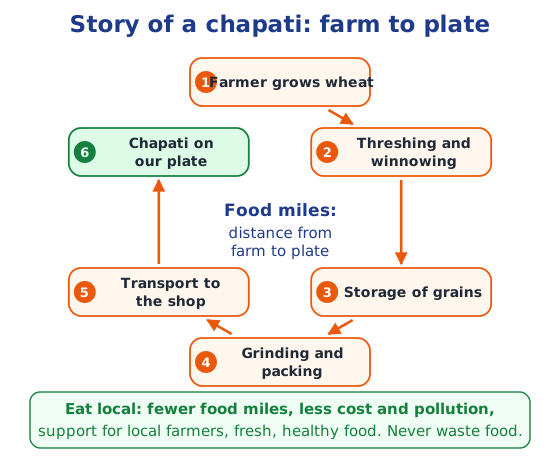
How does eating local food reduce food miles? Local food is grown nearby, so it travels a shorter distance from the farm to our plate. This cuts the cost and pollution of transport, supports local farmers and keeps the food fresh.
Timeline from farm to plate for wheat (approximate): wheat is a rabi crop, sown around October–December and harvested around March–April, so it stays about four to five months in the field. Threshing and winnowing take some days, storage lasts weeks or months, grinding and packing take a day or two, and transport to the shop a few days.
Let us enhance our learning (pages 56–58)
1. Pick the odd one out
(i) Chana. Jowar, bajra and ragi are millets (cereals); chana is a pulse, rich in protein.
(ii) Rice. Kidney beans, green gram and soya bean are pulses (legumes), rich in protein; rice is a cereal, rich in carbohydrates (starch).
2. Traditional versus modern culinary practices
| Traditional | Modern | |
|---|---|---|
| Cooking | Chulha using wood or cow-dung cakes, earthen pots, slow cooking | Gas stove, pressure cooker, microwave, induction cooktop |
| Grinding | Sil-batta, okhli-musal, hand chakki | Electrical mixer-grinder, flour mill |
| Ingredients | Mostly local, seasonal and freshly prepared | Wider choice from far away, including packaged food |
Modern practices save time and effort and avoid a smoky kitchen, while traditional ones used local, seasonal food. The changes came with technological development, better transport and communication. Sensible eating can combine both: modern tools with local, fresh, home-cooked food.
3. Ravi’s questions on “good food may act as medicine”
- Which foods can prevent or cure particular diseases, for example scurvy or goitre?
- If we eat a balanced diet, will we fall ill less often and need fewer medicines?
- Can food alone cure every illness, or do we still need a doctor and medicines?
4. Delicious versus nutritious
It is true. Many delicious foods, such as potato wafers, candy bars, carbonated drinks and fried snacks, are high in sugar and fat but low in protein, vitamins, minerals and fibre, so eating them often is unhealthy. Some nutritious foods, such as bitter gourd, some green leafy vegetables or plain sprouts, are not enjoyed by everyone. Nutritious food can also be made tasty, for example spinach in a paratha, sprouts in a chaat, or ragi in a dosa. Choose healthy food most of the time and eat treats only rarely.
5. Medu’s diet
Medu’s diet lacks roughage (dietary fibre), which helps the body get rid of undigested food and ensures smooth passage of stools; that is why he has constipation and stomach aches. Biscuits, noodles and white bread are made from refined flour with little fibre. He should eat green leafy vegetables, other vegetables, salads and fresh fruits every day, choose wholegrains such as whole wheat chapati or millets instead of white bread, add pulses, drink enough water, and cut down on biscuits and noodles.
6. Reshma’s eyesight
(i) Loss of vision in dim light: night blindness.
(ii) Vitamin A.
(iii) Papaya, carrot, mango and milk (also green leafy vegetables and pumpkin).
7. Canned juice, fresh juice or fresh fruit?
Fresh fruit. It has all its nutrients plus dietary fibre, and it fills us up. Fresh juice loses most of the fibre, and some vitamin C is lost if it is kept for long. Canned juice is processed, often has added sugar, and loses some vitamins, such as vitamin C, during processing. So: fresh fruit first, fresh juice next, canned juice last.
8. Gourav’s fracture
(i) Calcium keeps bones and teeth healthy, so the calcium tablets help the broken bone heal and become strong.
(ii) Vitamin D helps the body absorb calcium. Without enough vitamin D, the calcium from the tablets would not be used well.
(iii) Sample questions: Why did the doctor not give vitamin D on the first visit? Could sitting in the sunlight replace the syrup? Could milk, curd and paneer give enough calcium instead of tablets? How long should Gourav take them?
9. Sugar and iodine
The iodine test detects only starch. Sugar is a carbohydrate but not starch, so it does not turn blue-black.
10. “All starches are carbohydrates but not all carbohydrates are starches”
Raman is right. Activity to test it: take a few starch foods (a potato slice, boiled rice) and some other carbohydrates (sugar and glucose, each dissolved in a little water) in separate dishes. Put 2–3 drops of diluted iodine solution on each. The potato and rice turn blue-black, but sugar and glucose do not, though all are carbohydrates. So starch is only one type of carbohydrate.
11. Iodine on the socks and the saree
The saree had starch on it: cotton sarees are often stiffened with starch after washing, and iodine turns starch blue-black. The socks had no starch, so the colour did not change.
12. Millets
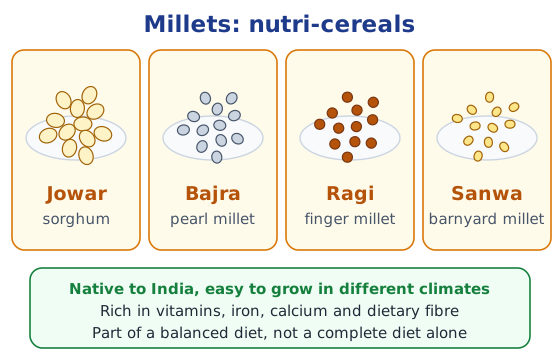
Why healthy: millets such as jowar, bajra, ragi and sanwa are good sources of vitamins, minerals like iron and calcium, and dietary fibre; they are called nutri-cereals. They also grow easily in different climates.
Are millets alone enough? No. A balanced diet needs all nutrients in the right amounts. Millets mainly give carbohydrates, with some protein, minerals and fibre, but we also need more protein from pulses, milk or eggs, fats in small amounts, vitamins such as vitamin C from fruits and vegetables, and water. Millets are an important part of a balanced diet, not the whole of it.
13. Is it iodine solution?
Put a few drops of the solution on a food that contains starch, such as a potato slice or boiled rice. If it turns blue-black, the solution may be iodine solution. For comparison, drops on a cucumber slice (no starch) show no blue-black colour. Do not taste or smell the solution.
Learning further (pages 58–59)
Extra: the starting points below go beyond the book; check the details in books or reliable websites.
Fortified foods: look for the +F logo of FSSAI. Examples are iodised salt (iodine), fortified atta and rice (iron, folic acid, vitamin B12) and fortified milk or oil (vitamins A and D). Note which nutrient is added and how much.
Tapyo: the Apatani people of the Ziro valley in Arunachal Pradesh traditionally make tapyo from the ash of certain plants. Their valley has no sea or salt deposits, and salt was once hard to bring in, so they made their own. Find pictures and details for your chart.
Wild foods: ranbhajis are wild vegetables of Maharashtra that grow on their own in forests and fields, mostly in the monsoon; guchhi (morels) are prized wild mushrooms from the forests of Himachal Pradesh. Never eat a wild plant or mushroom unless an expert has identified it, as some are poisonous.
Letter to the principal (sample): “Respected Principal, many of us eat potato wafers, candy bars and carbonated drinks at school. They are high in sugar and fat and low in other nutrients. We request that these be stopped on the campus, and that healthy snacks such as roasted chana, peanut chikki, fruits, sprouts and buttermilk be offered instead. Yours obediently, Class 6 students.”
Different needs: growing children and teenagers need more protein; sportspersons and people doing hard physical work need more energy; elderly people need less energy but enough calcium and protein; people who are ill may need a special diet on a doctor’s advice.
A sample balanced diet chart for a twelve-year-old:
| Meal | Food |
|---|---|
| Breakfast | Vegetable poha or ragi porridge, a glass of milk |
| Mid-morning | A seasonal fruit such as a guava or banana |
| Lunch | Chapati or rice, dal, a green vegetable, salad, curd |
| Evening | Roasted chana, peanuts or sprouts chaat |
| Dinner | Bajra or jowar roti, rajma, egg curry or paneer, a vegetable |
| Through the day | Enough water |
For more practice, read components of food, what is a balanced diet, tests for starch, protein and fat and deficiency diseases.
Practice
-
Which vitamin helps the body absorb calcium?
Show answer
Answer: (d) Vitamin D
-
Which of these is a fortified food?
Show answer
Answer: (a) Iodised salt
-
Coluthur Gopalan analysed the nutritional value of more than:
Show answer
Answer: (b) 500 Indian foods
-
Why is it better to wash vegetables before cutting them than after?
Show answer
Answer: Washing cut or peeled vegetables can wash away some vitamins. Washing them whole keeps them clean without this loss.
-
Name the government agency that regulates food quality in India.
Show answer
Answer: The Food Safety and Standards Authority of India (FSSAI).
Stuck on a question?
Take a photo and Lagnever AI explains it step by step. Try it for 7 days for ₹2.
Get it on Google Play Open in browser
For parents: after the trial, the plan renews monthly by UPI or card autopay. You can cancel anytime in the app.