
What are microorganisms, and what are their types?
Answer in short
Microorganisms are living things too small to see with the naked eye. They live in water, soil, air, food and even inside us. The main groups are bacteria, fungi, protozoa and algae. Bacteria and protozoa are single cells; fungi and algae have one cell or many. Viruses are not cells and multiply only inside living cells.
Stuck on a question? Take a photo and Lagnever AI explains it step by step. Try it for 7 days for ₹2. Get it on Google Play
What are microorganisms?
Many living things consist of a single cell or only a handful of cells, far too tiny for the naked eye. We call them microorganisms, or microbes: micro means very small, and organism means living being. To see them we need a microscope, which makes them look about 100 to 400 times bigger. Scientists have even made a low-cost microscope from folded paper. It shows less detail than a laboratory microscope, but it lets many more people explore the tiny world. An electron microscope goes much further, magnifying a cell about 10,00,000 times.
Long ago, ancient Indian texts such as the Vedas used the word krimi for tiny beings, both visible and invisible, and noted that some were helpful and some harmful.
Where do microorganisms live?
With an adult’s help, collect a little pond or stagnant water and put a drop under a microscope: tiny creatures swim across it. Stir some moist soil into water (use a spoon or gloves, not bare hands), let it settle and look at a drop from the top: there are moving creatures here too. A lemon or tomato left out for some time grows a powdery or cotton-like layer, because microbes from the air have reached it.
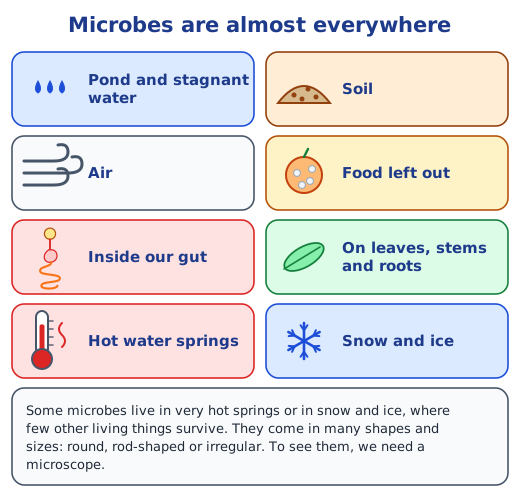
Microbes live almost everywhere: in water, soil and air, on leaves, stems and roots, on food, and inside our bodies. Our intestine holds plenty of bacteria that help us digest food. Some microbes even survive in hot water springs and in snow and ice. Like plants and animals, they show great variety in shape, size and structure. Always wash your hands after handling soil, pond water or spoilt food.
What are the main groups of microorganisms?
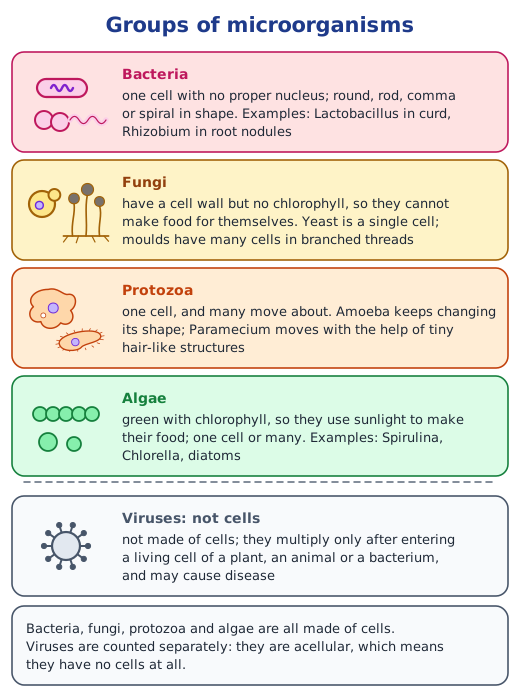
- Protozoa are single cells, and many move about. Amoeba has an irregular shape that keeps changing as it moves. Paramecium moves from place to place with the help of special tiny hair-like structures.
- Algae are green because they contain chlorophyll, so they use sunlight to make their food. Some are single round cells, some are many-celled, and some can swim.
- Fungi have no chlorophyll, so they cannot make food for themselves. Bread mould grows as branched threads topped with round, sac-like parts; another common mould has brush-like tips. Yeast is a fungus made of a single cell.
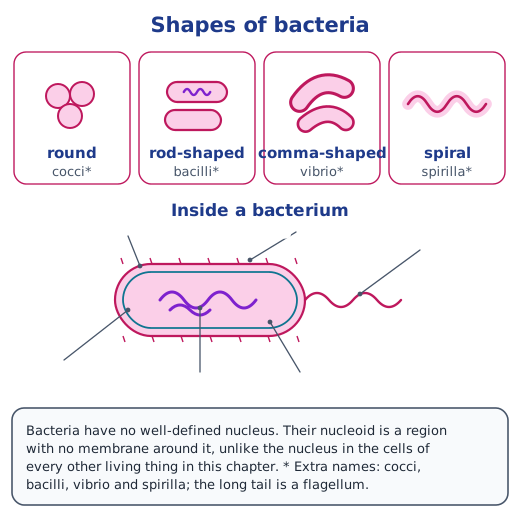
- Bacteria are single cells. They can be round, rod-shaped, comma-shaped or spiral, and some have one long hair-like tail and many tiny hair-like projections.
How are bacteria different from other cells?
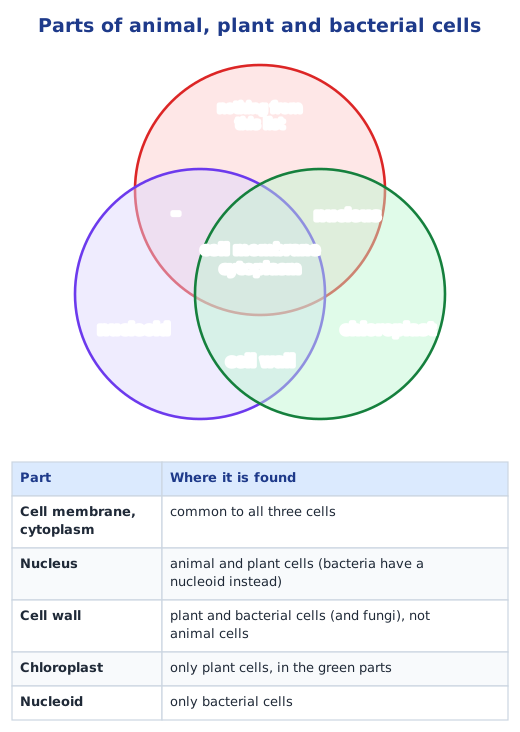
Like all cells, the cells of microbes are surrounded by a cell membrane. Fungal cells also have a cell wall, but no chloroplasts. Bacteria have a cell wall too, but they are special in another way: they lack a well-defined nucleus with its own membrane. Their genetic material lies in a region called the nucleoid, with no membrane around it. That sets them apart from all the other cells we have met: those of plants, animals, fungi, algae, protozoa and yeast.
One cell or many?
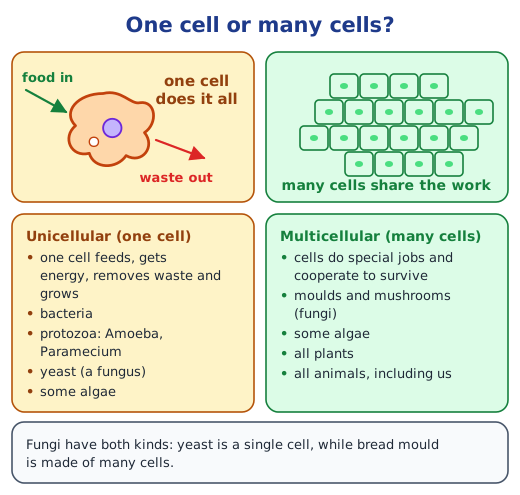
Bacteria and protozoa are unicellular: one cell carries out every job needed to stay alive, from taking in food to getting rid of waste. Plants and animals are multicellular: their many cells take on special jobs and cooperate, which improves their chance of survival. Algae and fungi can be either. Yeast is a single-celled fungus, while bread mould is a many-celled one.
What are viruses?
Viruses are microscopic too, but they are acellular: not made of cells at all. They multiply only after entering a living cell. They can infect plants, animals and even bacteria, and may cause disease. (Extra: the common cold and flu are caused by viruses.) If you feel unwell, tell an adult and see a doctor rather than guessing at medicines. Chapter 3 explains how diseases spread and how we can stay healthy.
Read on: cells and levels of organisation, microorganisms and their uses, the chapter notes and the NCERT solutions.
Practice
-
Which microorganism keeps changing its shape as it moves?
Show answer
Answer: (b) Amoeba
-
Which group of microbes has a cell wall but no chlorophyll?
Show answer
Answer: (b) fungi
-
Which of these can multiply only inside a living cell?
Show answer
Answer: (a) a virus
-
How is a bacterial cell different from a yeast cell?
Show answer
Answer: A bacterium has no proper nucleus and no nuclear membrane; it has a nucleoid instead. Yeast, like plant and animal cells, has a well-defined nucleus.
-
Name two places, other than water and soil, where microorganisms live.
Show answer
Answer: Any two of: the air, food left out, inside our gut, on leaves, stems and roots, hot water springs, snow and ice.
Questions students ask
What are the main types of microorganisms?
Bacteria, fungi, protozoa and algae. Bacteria and protozoa are single cells; fungi such as yeast and moulds, and algae, can be single-celled or many-celled. Viruses are studied with them but are not cells.
Is a virus a living thing?
Viruses are not made of cells. They can multiply only after entering a living cell of a plant, an animal or a bacterium, and may cause disease. (Extra: outside a cell they show no signs of life, so scientists often place them at the border of living and non-living.)
Where are microorganisms found?
Almost everywhere: in water, soil and air, on food, on plants, inside our gut, and even in hot water springs and in snow and ice.
Why can we not see microorganisms with our eyes?
They are made of one cell or a few cells, far smaller than the eye can make out. A microscope that magnifies them about 100 to 400 times makes them visible.
Stuck on a question?
Take a photo and Lagnever AI explains it step by step. Try it for 7 days for ₹2.
Get it on Google Play Open in browser
For parents: after the trial, the plan renews monthly by UPI or card autopay. You can cancel anytime in the app.