
What is a cell, and what are the levels of organisation?
Answer in short
A cell is the basic unit of life. A typical cell has a cell membrane, cytoplasm and a nucleus; plant cells also have a cell wall, a large vacuole and chloroplasts. Similar cells form tissues, tissues form organs, organs form organ systems, and the organ systems together make an organism.
Stuck on a question? Take a photo and Lagnever AI explains it step by step. Try it for 7 days for ₹2. Get it on Google Play
Who discovered the cell?
For a very long time, nobody could see the tiny things that make up living beings, because our eyes have a limit. Curved glass lenses changed that. In 1665 Robert Hooke, a scientist and a careful artist, published a book of drawings made through his microscope. One showed a fine sliver of cork full of small empty compartments, like a honeycomb. He named each one a cell, and with that the word entered science. Soon after, the Dutch scientist Antonie van Leeuwenhoek made better lenses and was the first to describe bacteria and blood cells clearly.
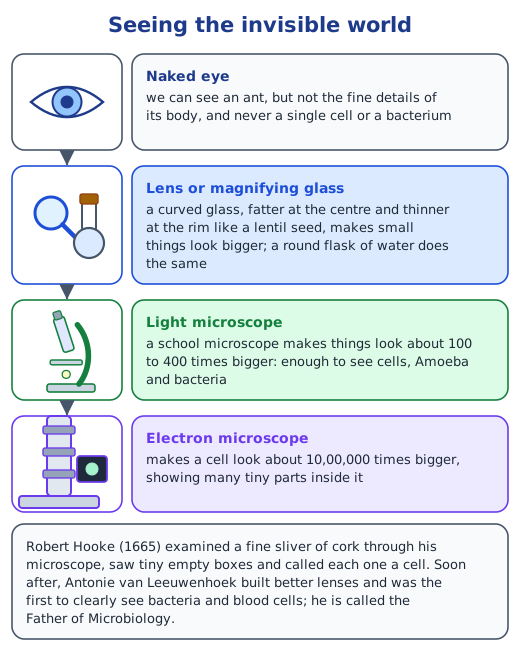
Today we know that every living thing, plant, animal or microbe, is made of one or more cells.
What are the parts of a cell?
In a school laboratory, a teacher can peel the thin, see-through skin from inside an onion, stain it pink and look at it under a microscope. You see nearly rectangular cells packed side by side with no gaps. Cells gently scraped from inside your cheek using a clean toothpick’s rounded end, and stained blue, look different: flat and many-sided. A drop of glycerin keeps the cells from drying out.
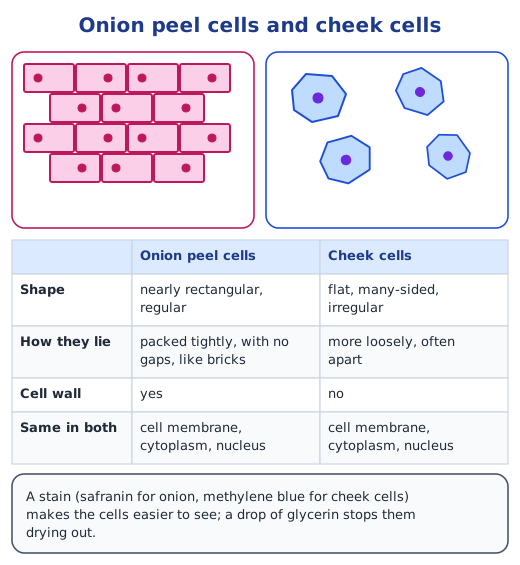
Yet both kinds of cell have the same three main parts.
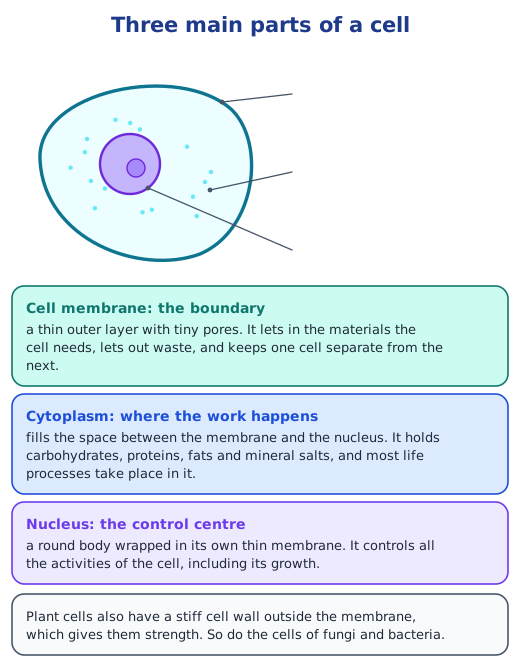
- Cell membrane: the thin outer layer. It has tiny pores, so it lets in the materials needed for life processes and lets out waste. It also keeps one cell separate from the next.
- Cytoplasm: the material that fills the space between the membrane and the nucleus. It holds carbohydrates, proteins, fats and mineral salts, and most life processes take place in it.
- Nucleus: a round body, wrapped in its own thin membrane, that controls all the activities of the cell, including its growth.
How is a plant cell different from an animal cell?
Onion cells have one more layer outside the membrane: a stiff cell wall. It makes plant cells firm and strong, which is why they sit so neatly together. Plant cells also contain tiny bodies called plastids. Green ones, the chloroplasts, hold chlorophyll and carry out photosynthesis; in parts that are not green, plastids store food. A plant cell also has one large vacuole, a space that stores substances, helps get rid of waste and keeps the cell in shape. Animal cells have no wall and no chloroplasts, and their vacuoles are small or missing.
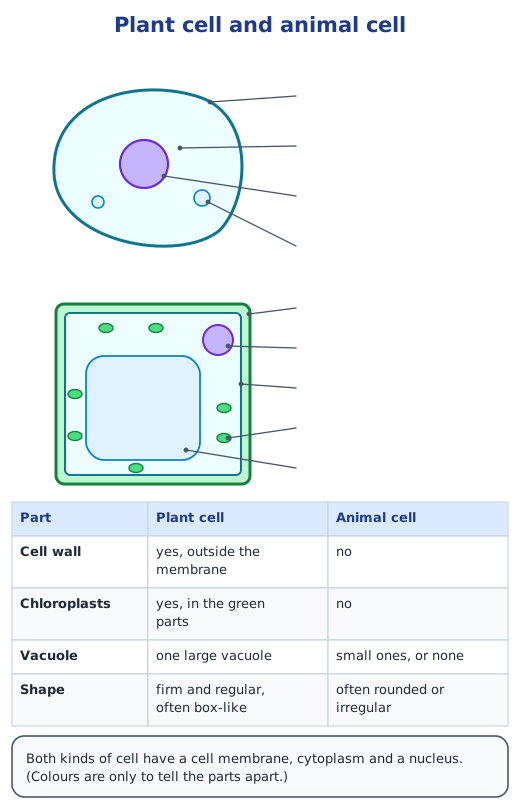
So a cell is far more than a bag of fluid: it is a busy little structure in which every part has its own job.
Why do cells have different shapes?
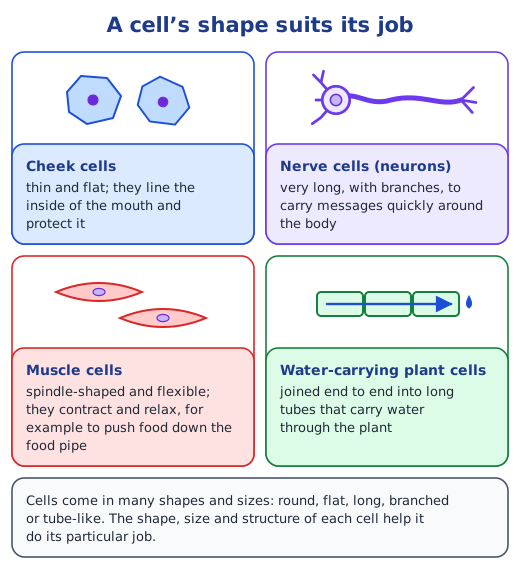
Cells can be round, flat, long and thin, branched or tube-like, and their shape suits their job. Cheek cells are flat, thin sheets that form a protective lining inside the mouth. Nerve cells, also called neurons, are very long with branches, so they reach far and pass messages quickly. Muscle cells are spindle-shaped and flexible. In the food pipe they contract and relax one after another, in a wave that pushes food down to the stomach. In plants, some cells join end to end to form long tubes that carry water.
What are the levels of organisation?
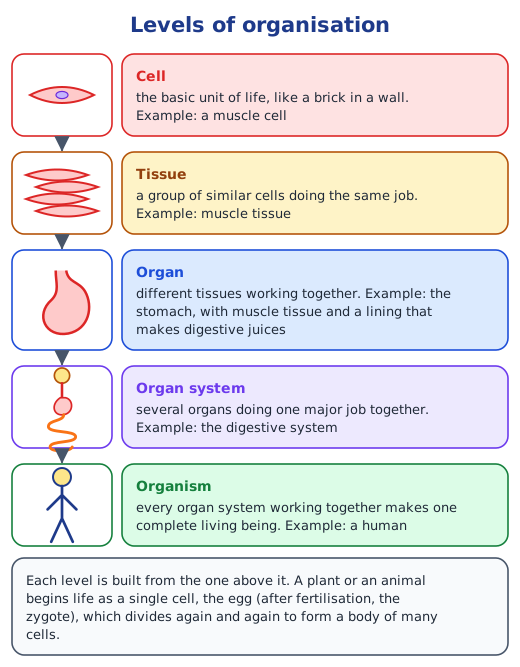
A cell is to the body what a brick is to a wall. A group of similar cells doing the same job forms a tissue, such as muscle tissue. Different tissues working together form an organ: the stomach has muscle tissue that churns food and a lining whose cells make digestive juices and acid. Several organs that work on one major job form an organ system, such as the digestive system. When all the organ systems work together, they make up an organism, a complete plant or animal.
Cell → tissue → organ → organ system → organism
How does one cell become a whole body?
Every plant and animal, including you, began life as a single cell: a fertilised egg (Chapter 13 calls it the zygote). It divides again and again to form a body of very many cells. Living things built of many cells are called multicellular. Some eggs are huge: the yolk of an ostrich egg counts as one single cell, and no bigger cell is known; the shell and the white are not part of that cell.
Read on: microorganisms and their uses, types of microorganisms, the chapter notes and the NCERT solutions.
Practice
-
Which part controls the activities and growth of a cell?
Show answer
Answer: (c) nucleus
-
Onion peel cells look like bricks in a wall mainly because they have:
Show answer
Answer: (b) a cell wall
-
A group of similar cells working together is called:
Show answer
Answer: (b) a tissue
-
Why are nerve cells long and branched?
Show answer
Answer: Being long and branched, they can carry signals far across the body in a very short time.
-
Name the five levels of organisation, from smallest to largest.
Show answer
Answer: Cell, tissue, organ, organ system and organism.
Questions students ask
What are the three main parts of a cell?
The cell membrane, which lets materials in and waste out; the cytoplasm, where most life processes happen; and the nucleus, which controls the cell’s activities and growth.
What is the difference between a plant cell and an animal cell?
A plant cell has a stiff cell wall outside its membrane, one large vacuole and, in green parts, chloroplasts. An animal cell has no wall and no chloroplasts, and its vacuoles are small or absent.
Who discovered the cell?
Robert Hooke, who in 1665 described the tiny boxes he saw in a thin slice of cork and called them cells. Antonie van Leeuwenhoek later made better lenses and was the first to clearly see bacteria and blood cells.
Why is the stomach called an organ and not a tissue?
Because it is made of different tissues working together: muscle tissue that churns the food, and a lining whose cells make digestive juices and acid.
Stuck on a question?
Take a photo and Lagnever AI explains it step by step. Try it for 7 days for ₹2.
Get it on Google Play Open in browser
For parents: after the trial, the plan renews monthly by UPI or card autopay. You can cancel anytime in the app.