
How are microorganisms useful to us?
Answer in short
Many microorganisms help us. Bacteria and fungi decompose waste into manure and clean the environment, and some bacteria make biogas. Yeast makes dough rise, and Lactobacillus turns milk into curd. Rhizobium in the root nodules of legumes adds nitrogen to the soil, and microalgae release oxygen and feed water animals.
Stuck on a question? Take a photo and Lagnever AI explains it step by step. Try it for 7 days for ₹2. Get it on Google Play
How do microbes clean the environment?
Fill a container halfway with garden soil, add fruit and vegetable peels, cover them with more soil and wait 2 to 3 weeks. The peels turn into a dark, crumbly material: manure, full of nutrients that make soil more fertile. The work is done by bacteria and fungi in the soil. They break the complex substances in plant waste into simpler, nutrient-rich ones. This is decomposition. It happens well when the temperature is right and there is enough moisture.
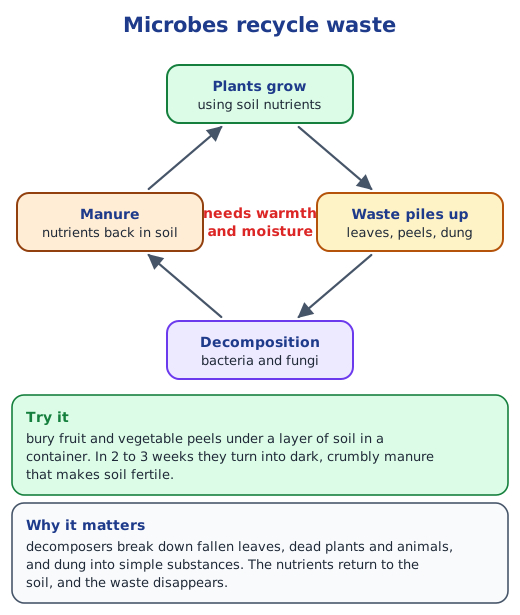
That is why gardeners put dry leaves and plant waste into pits: to make natural manure. Decomposers also break down dead animals and animal waste such as dung. Without them, waste would pile up and its nutrients would never go back to the soil. Microbes recycle nutrients and clean our surroundings. Read more about decomposers in food chains and decomposers.
Can microbes make fuel?
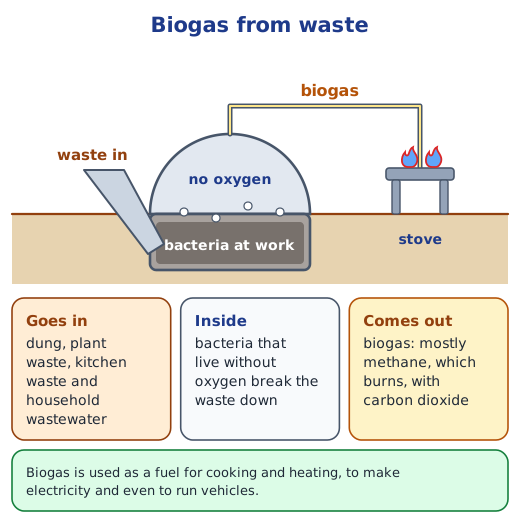
Yes. Some bacteria live where there is no oxygen. In a closed tank they break down dung, plant waste and household wastewater and give off biogas, a mixture of gases that is mostly methane, the part that burns, along with carbon dioxide. Biogas is used for cooking, for heating, to make electricity and even to run vehicles.
Microbes can tackle pollution too. The scientist Ananda Mohan Chakrabarty (1938–2020) developed a bacterium in 1971 that could break down oil from oil spills. His invention was patented: a patent is a legal right that stops others from making, using or selling an invention without the inventor’s permission.
How do microbes help in the kitchen?
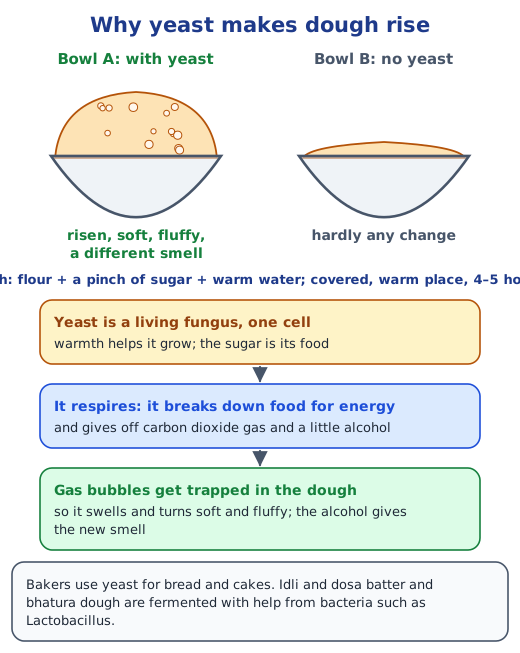
Yeast is a fungus made of a single cell, and it grows well in warmth. Mix flour with a pinch of sugar and a little yeast, knead it with warm water and keep it covered in a warm place for a few hours. It rises and turns soft and fluffy, with a new smell, while dough without yeast hardly changes. The yeast respires: it breaks down food for energy and gives off carbon dioxide, whose bubbles puff up the dough, plus a little alcohol, which gives the smell. Bread and cakes are made this way.
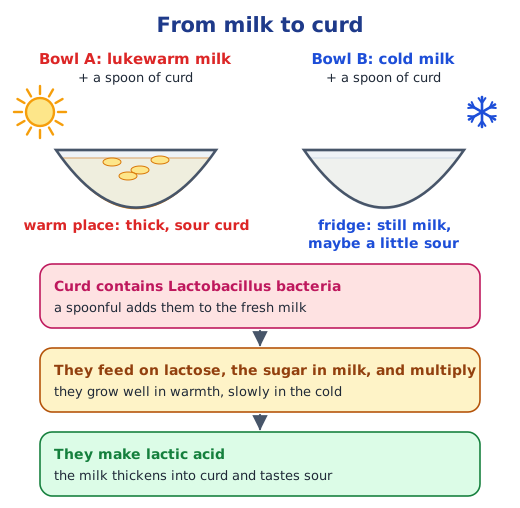
Bacteria help too. Lactobacillus helps ferment idli and dosa batter and bhatura dough. It also turns milk into curd. Add a spoonful of curd to lukewarm milk and keep it warm: in a few hours it sets into sour curd. The Lactobacillus feeds on lactose, the sugar in milk, multiplies and makes lactic acid, which thickens the milk and makes it sour. The same mix kept in a refrigerator hardly sets, because these bacteria grow well only in warmth.
How do bacteria help farmers?
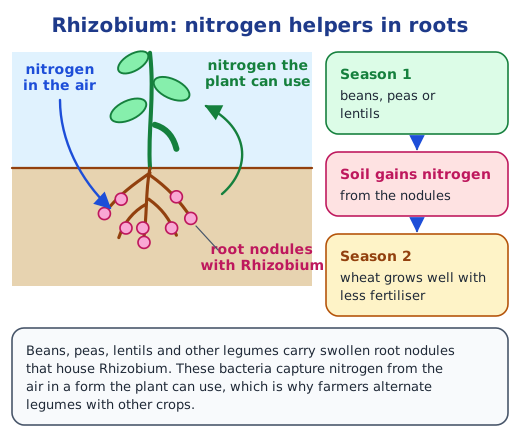
Beans, peas, lentils and other legumes have small swollen lumps on their roots called root nodules. Bacteria named Rhizobium live inside them. They capture nitrogen from the air and change it into a form the plant can use, so these plants do well without chemical fertiliser. When farmers take turns, growing a legume in one season and another crop in the next, the soil gains nitrogen naturally and stays healthy.
What are microalgae good for?
Microalgae are tiny plant-like organisms found in water and soil, in the air and even on tree bark. Using sunlight, they make their own food and give off oxygen; the book says they make over half of the oxygen on Earth. They feed many water animals, help clean water and can be turned into biofuel. Some, such as Spirulina, Chlorella and diatoms, are used in food supplements and medicines, and Spirulina is rich in protein. Pollution, climate change and the loss of their homes threaten them, so they need protecting.
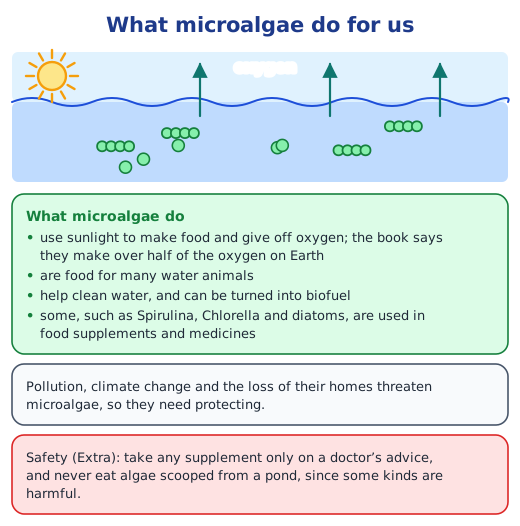
A word of care (Extra): supplements should be taken only on a doctor’s advice, and algae from a pond must never be eaten, because some kinds are harmful.
Why do pickles and murabbas keep for so long?
Microbes grow well with warmth, moisture and food. Pickles and murabbas are full of salt or sugar, with spices, and such high amounts do not let microbes grow. Cold slows microbes down too, which is why food keeps longer in a refrigerator.
Not every microbe is a helper: some cause diseases in plants, animals and people, which Chapter 3 explains. Read on: types of microorganisms, the chapter notes and the NCERT solutions.
Practice
-
Which gas makes dough with yeast soft and fluffy?
Show answer
Answer: (b) carbon dioxide
-
Curd tastes sour because Lactobacillus makes:
Show answer
Answer: (b) lactic acid
-
Biogas is made by bacteria that break down waste:
Show answer
Answer: (b) without oxygen
-
Why does a pit of dry leaves and peels in a garden turn into manure?
Show answer
Answer: Bacteria and fungi in the soil decompose the plant waste into simple, nutrient-rich substances, which is manure.
-
Why do farmers sometimes grow peas or beans between two crops of wheat?
Show answer
Answer: Rhizobium bacteria in the root nodules of peas and beans capture nitrogen from the air, so the soil is richer in nitrogen for the next crop.
Questions students ask
What are the uses of microorganisms?
They decompose waste into manure, make biogas, help dough rise and turn milk into curd, ferment idli and dosa batter, add nitrogen to soil through Rhizobium, and, as microalgae, release oxygen and feed water animals.
How does yeast make bread soft?
Yeast, a one-celled fungus, uses the dough’s sugar as food and respires. It gives off carbon dioxide, whose bubbles get trapped and puff up the dough, plus a little alcohol, which gives the smell.
Why do pickles and murabbas not spoil quickly?
They contain a lot of salt or sugar, along with spices. Such high amounts do not let microorganisms grow, so these act as preservatives.
What would happen if there were no decomposers?
Dead leaves, dead animals and dung would pile up instead of disappearing, and their nutrients would never return to the soil, so plants would slowly run short of them.
Stuck on a question?
Take a photo and Lagnever AI explains it step by step. Try it for 7 days for ₹2.
Get it on Google Play Open in browser
For parents: after the trial, the plan renews monthly by UPI or card autopay. You can cancel anytime in the app.