
NCERT Solutions Class 8 Science Chapter 2: The Invisible Living World: Beyond Our Naked Eye
Answers to Probe and ponder, the questions inside the chapter, Activities 2.1 to 2.9, all nine Keep the curiosity alive questions and the Discover, design, and debate projects in Chapter 2, The Invisible Living World: Beyond Our Naked Eye, of Curiosity, the Grade 8 science textbook. Page numbers follow the 2026-27 reprint (pages 8–27). Short notes: Chapter 2 notes.
Probe and ponder (page 8)
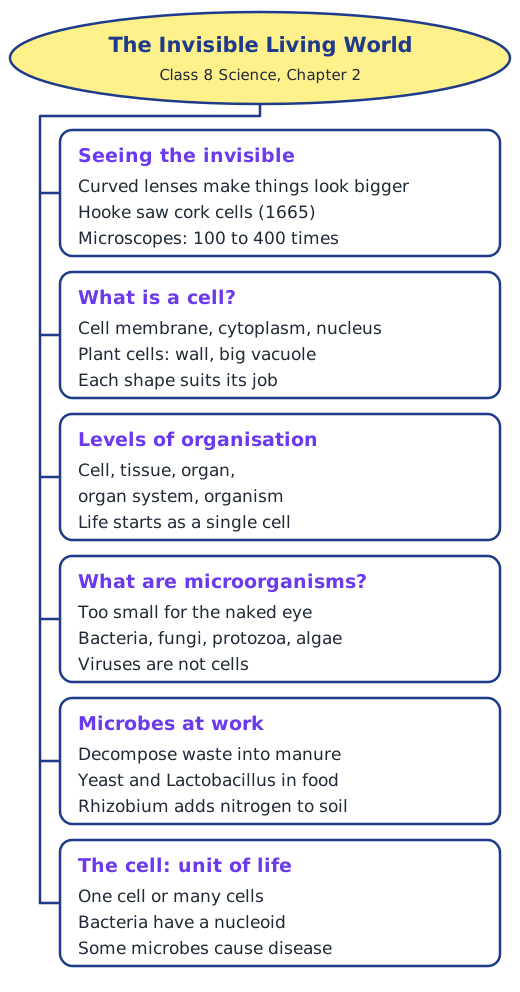
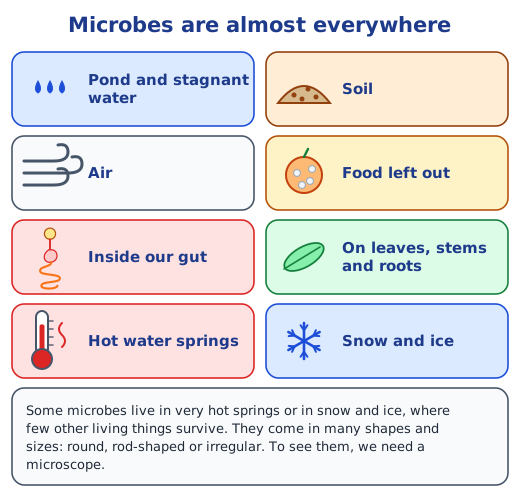
What would you see if the invisible world became visible? Tiny living things everywhere: Amoeba and Paramecium swimming in a drop of pond water, bacteria on our hands, in the soil and in the air, mould spreading over old bread, and huge numbers of bacteria in our gut. We would also see that our own body, and every leaf, is built from cells.
How would seeing it change your ideas of size, complexity and life? A living thing can be just one cell, yet that single cell takes in food, gets rid of waste, grows and multiplies. So tiny does not mean simple. Viruses, which are not cells and multiply only inside living cells, would also make us ask where the line between living and non-living lies.
How do these tiny beings affect one another? They share and compete for food and space. Some live in partnership with bigger living things, such as Rhizobium in the root nodules of legumes or the bacteria in our gut that help digestion. Bacteria and fungi decompose waste together, and some microbes cause diseases in plants, animals and people.
Share your questions. For example: How do bacteria multiply so fast? Why does bread go mouldy before biscuits do? Can microbes eat plastic?
Inside the chapter (pages 9–23)
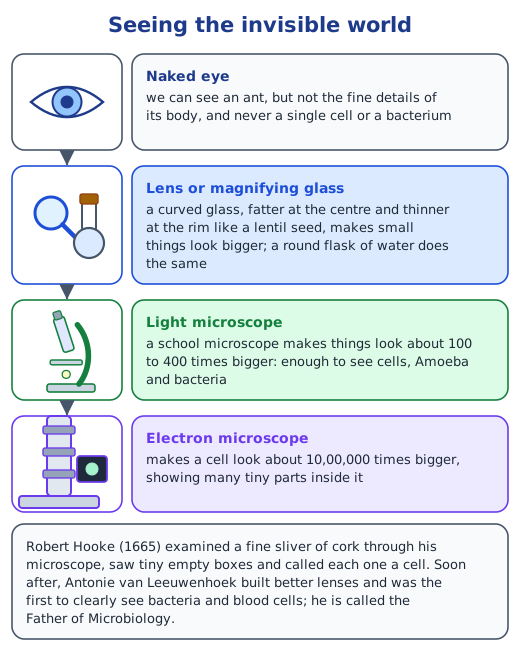
How small a thing can our eyes see? How do reading glasses and a magnifying glass help? The naked eye cannot make out anything much smaller than the full stop at the end of a sentence (Extra: roughly a tenth of a millimetre). Reading glasses and a magnifying glass have curved lenses that make things look bigger and clearer. See mirrors and lenses.
Activity 2.1. Seen through a round flask full of water, the letters look larger, because the flask of water works as a magnifier. Through a real magnifying glass an ant’s legs, joints, feelers and body parts are much clearer. Which discovery first let us see the tiny world? The microscope.
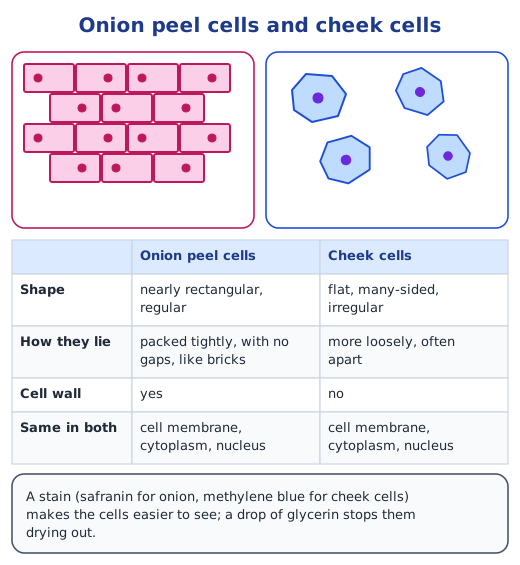
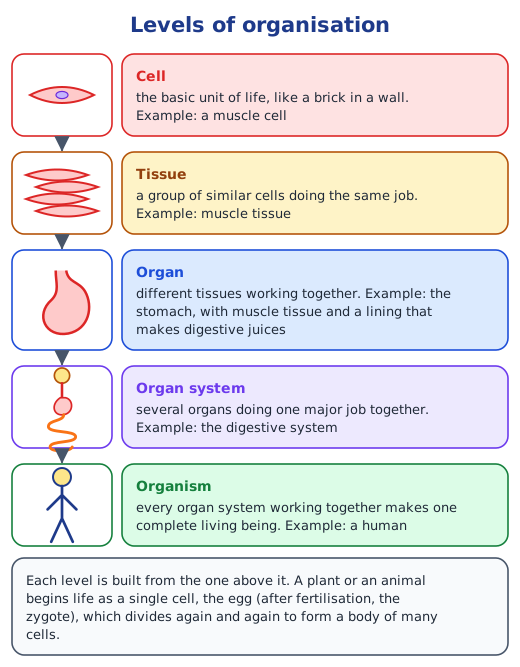
Activity 2.2: onion peel cells. Under the microscope the stained peel shows nearly rectangular cells, each with a dark nucleus, packed tightly with no gaps. Similarities with a brick wall: both are made of many similar units fitted side by side, and the cell is the basic unit just as a brick is. What is an animal’s body made of? Cells too, as Activity 2.3 shows.
Activity 2.3: cheek cells. You see flat, many-sided cells, stained blue, each with a nucleus. Similarities with onion cells: both have a cell membrane, cytoplasm and a nucleus. Differences: onion cells have a cell wall, are nearly rectangular and are packed tightly; cheek cells have no wall, are irregular and lie more loosely.
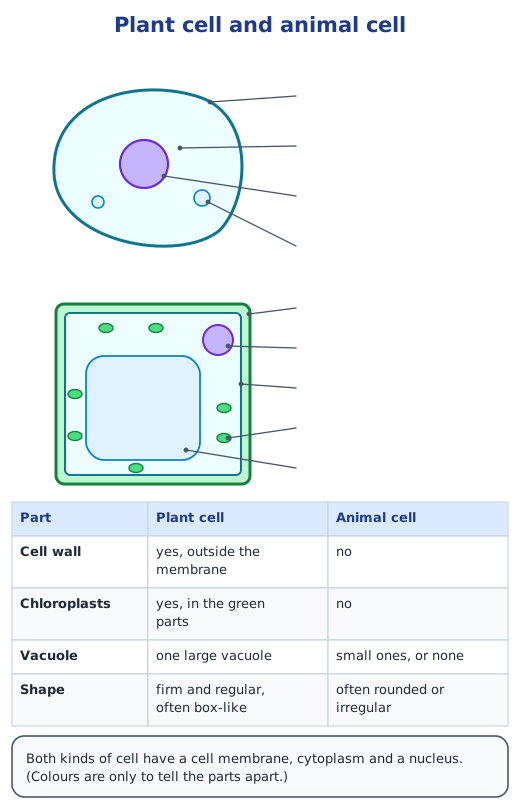
Why are these parts important? The cell membrane lets in what the cell needs and lets out waste; most life processes happen in the cytoplasm; the nucleus controls the cell’s activities and growth; and the cell wall gives plant cells strength. Yes, each is needed to keep the cell, and so the organism, alive.
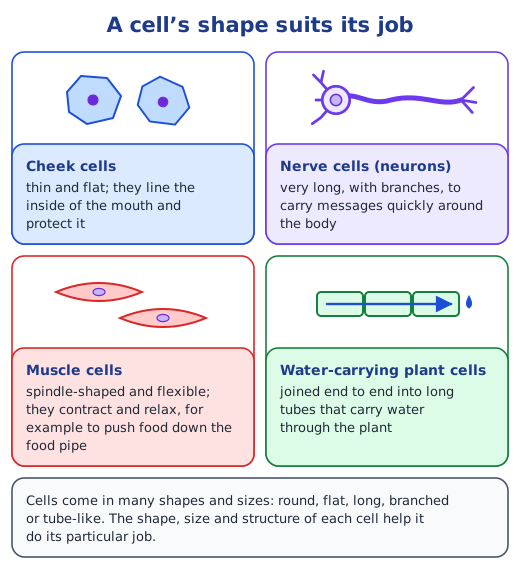
Do animal cells vary in shape and structure? Muscle cell and nerve cell. Yes. Both have a membrane, cytoplasm and a nucleus, but a muscle cell is spindle-shaped, while a nerve cell is very long with branches. Does shape relate to function? Yes: the long, branched nerve cell carries messages quickly to far parts of the body, and the flexible muscle cell contracts and relaxes.
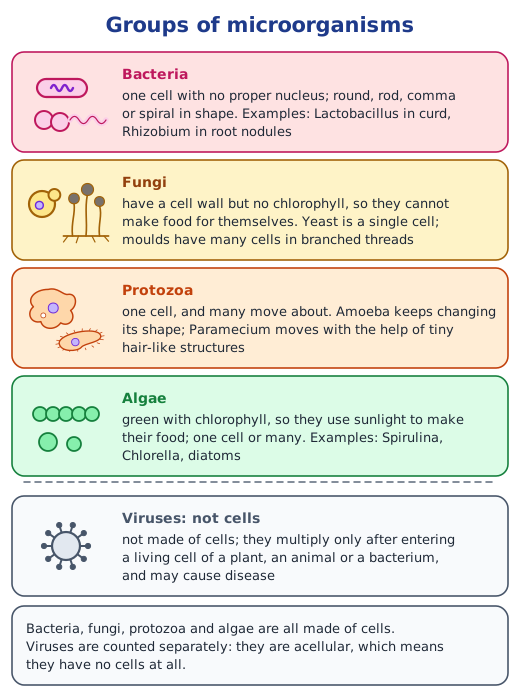
Activities 2.4 to 2.6: pond water and soil. You may see Amoeba (an irregular single cell that changes shape), Paramecium (a slipper-shaped cell moving with tiny hairs), green algae, the threads of moulds and tiny bacteria. Record whatever you find; different ponds and soils give different results. Collect pond water only with an adult, handle soil with a spoon or gloves, and wash your hands afterwards.
Where do the microbes on rotting fruit come from? From the air, from hands and surfaces, and from the soil the fruit grew in. Tiny spores and cells settle on the fruit and grow quickly when it is warm and moist.
Activity 2.7: peels in soil. After 2 to 3 weeks the peels have turned into dark, crumbly manure. Bacteria and fungi in the soil decomposed them into simpler, nutrient-rich substances. That is why gardeners put dry leaves and plant waste into pits: to make natural manure.
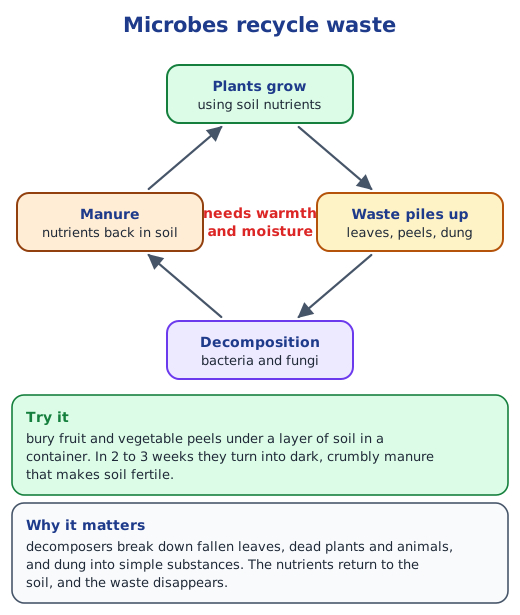
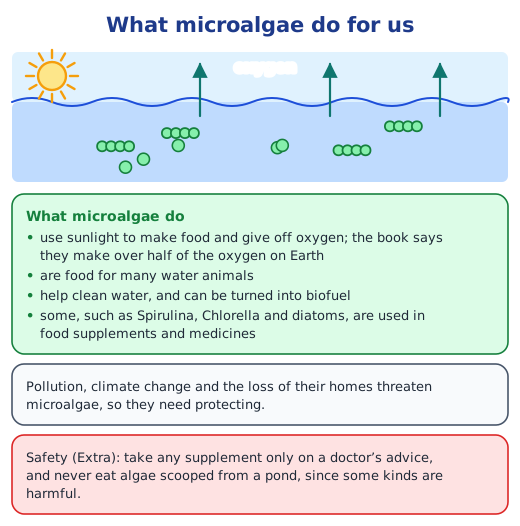
What if there were no microorganisms on Earth? Dead leaves, bodies and dung would pile up, and nutrients would not return to the soil, so plants would starve. There would be no curd or soft bread, legumes would lose their nitrogen helpers, our digestion would suffer, and the oxygen from microalgae would be missing.
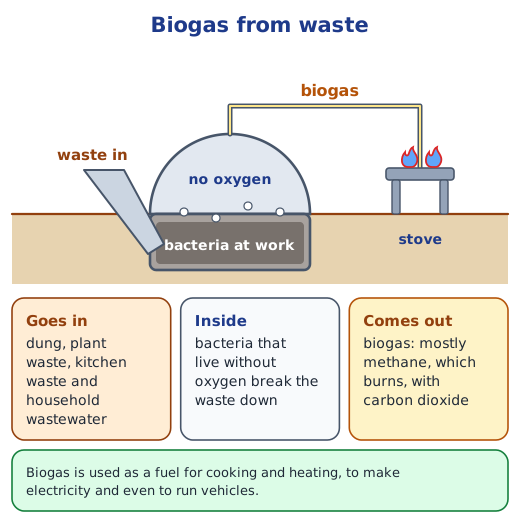
Other problems microbes could help solve. Cleaning sewage and dirty water, turning city waste into compost and biogas, and breaking down harmful wastes. (Extra: scientists are studying microbes that can break down some plastics, and some medicines, such as penicillin, were first obtained from a mould.)
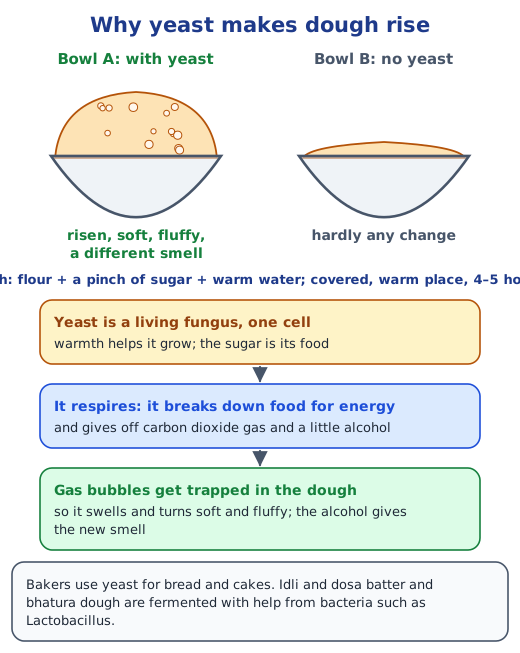
Activity 2.8: dough with and without yeast. After a few hours, the dough with yeast has risen, become soft and fluffy and smells different; the dough without yeast has hardly changed. Role of yeast: it respires and gives off carbon dioxide, whose bubbles puff up the dough, and a little alcohol, which gives the smell. Why sugar and warm water? Sugar is food for the yeast, and warmth helps it grow fast. (Extra: very hot water would kill the yeast.)
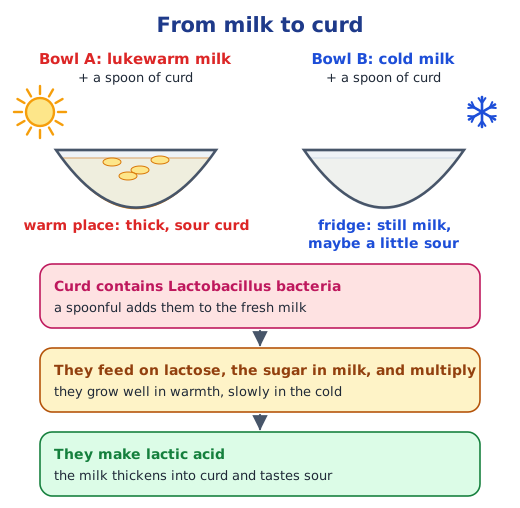
Activity 2.9: Table 2.4 (sample).
| Bowl A: lukewarm, warm place | Bowl B: cold, refrigerator | |
|---|---|---|
| Prediction | will set into curd | will stay milk |
| Appearance seen | thick, set curd | still liquid milk |
| Colour seen | creamy white | white, as before |
| Possible reason | Lactobacillus grows well in warmth and makes lactic acid | the cold slows the bacteria, so little acid forms; it may taste a little sour |
Keep the curiosity alive (pages 25–26)
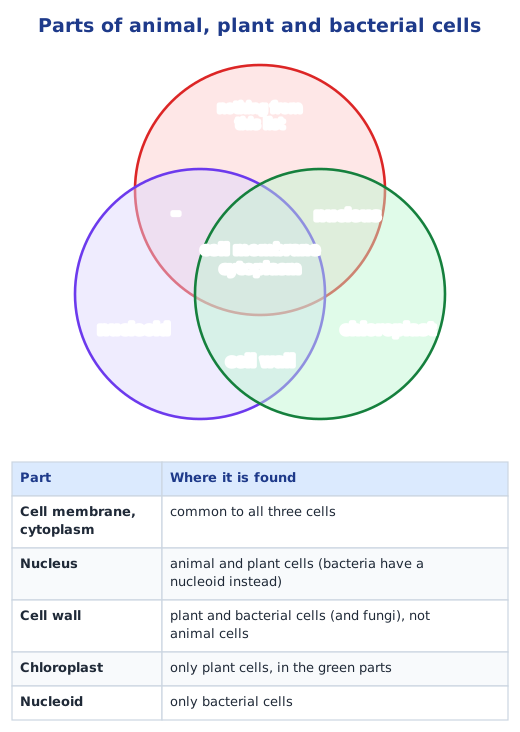
1. “Various parts of a cell are given below. Write them in the appropriate places in the following diagram.” Common to all three cells: cell membrane and cytoplasm. Shared by animal and plant cells: nucleus. Shared by plant and bacterial cells: cell wall. Only in the plant cell: chloroplast. Only in the bacterial cell: nucleoid. None of the six parts is found only in the animal cell.
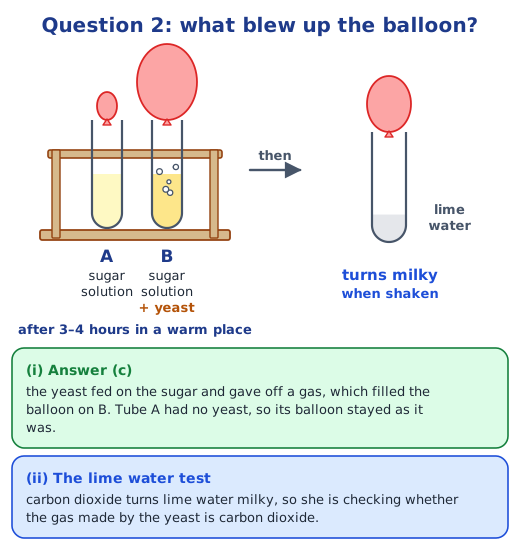
2. “Aanandi took two test tubes and marked them A and B. She put two spoonfuls of sugar solution in each of the test tubes. In test tube B, she added a spoonful of yeast. Then she attached two incompletely inflated balloons to the mouth of each test tube. She kept the set-up in a warm place, away from sunlight.”
(i) “What do you predict will happen after 3–4 hours? She observed that the balloon attached to test tube B was inflated. What can be a possible explanation for this?” (c) Yeast produced a gas inside the test tube B which inflated the balloon. The yeast fed on the sugar and respired, giving off carbon dioxide. Test tube A had no yeast, so its balloon did not change, which rules out (a), (b) and (d).
(ii) “What do you think she wants to find out?” Whether the gas made by the yeast is carbon dioxide. Carbon dioxide turns lime water milky, so if the lime water turns milky, the gas is carbon dioxide.
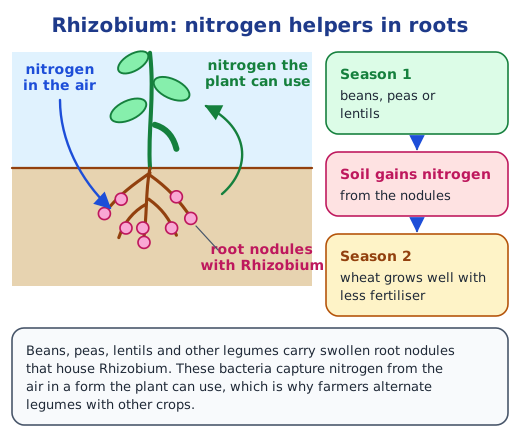
3. “A farmer was planting wheat crops in his field. He added nitrogen-rich fertiliser to the soil to get a good yield of crops. In the neighbouring field, another farmer was growing bean crops, but she preferred not to add nitrogen fertiliser to get healthy crops. Can you think of the reasons?” Beans are legumes. Their roots have nodules in which Rhizobium bacteria live; these capture nitrogen from the air and pass it on to the plant, so beans need little or no nitrogen fertiliser. Wheat has no such nodules, so the first farmer has to add nitrogen to the soil. Growing beans also leaves more nitrogen in the soil for the next crop.
4. “Snehal dug two pits, A and B, in her garden. In pit A, she put fruit and vegetable peels and mixed it with dried leaves. In pit B, she dumped the same kind of waste without mixing it with dried leaves. She covered both the pits with soil and observed after 3 weeks. What is she trying to test?” Whether mixing dried leaves with kitchen waste changes how quickly and how well it turns into manure. The only difference between the pits is the dried leaves, so any difference after 3 weeks comes from them. (Extra: gardeners often find that dry leaves help, because they keep the heap loose so that air gets in and soak up extra water from wet peels, which helps the decomposers.)
5. “Identify the following microorganisms:” (i) “I live in every kind of environment, and inside your gut.” Bacteria. (ii) “I make bread and cakes soft and fluffy.” Yeast. (iii) “I live in the roots of pulse crops and provide nutrients for their growth.” Rhizobium, the bacterium in the root nodules of legumes, which supplies nitrogen.
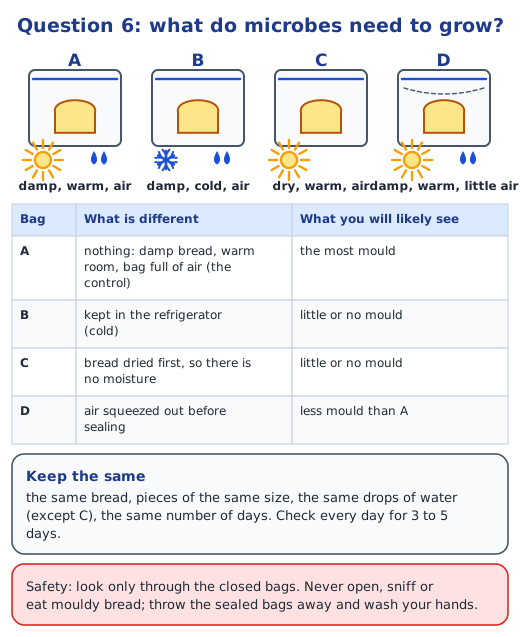
6. “Design an experiment to test that microorganisms need optimal temperature, air, and moisture for their growth.” Take four equal pieces of the same bread and seal each in a clear zip bag. Bag A (the control): sprinkle the bread with a few drops of water, keep it in a warm room and leave the bag full of air. Bag B: the same, but keep it in the refrigerator, to test temperature. Bag C: use bread dried first, with no water, kept warm, to test moisture. Bag D: damp and warm, but squeeze out as much air as you can before sealing, to test air. Keep everything else the same and look through the bags every day for 3 to 5 days. You will most likely see the most mould in A, little or none in B and C, and less in D than in A. So microbes need a suitable temperature, moisture and air to grow. Do not open the bags; throw them away sealed and wash your hands.
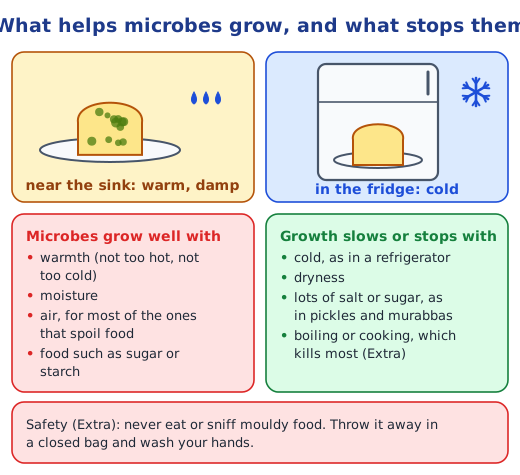
7. “Take 2 slices of bread. Place one slice in a plate near the sink. Place the other slice in the refrigerator. Compare after three days. Note your observations. Give reasons for your observations.” Observation: the slice near the sink most likely shows fuzzy white, green or black patches of mould and may smell stale; the slice in the refrigerator looks almost unchanged, though it may be dry. Reasons: tiny mould spores from the air settle on both slices, but near the sink it is warm and damp, so they grow fast; in the refrigerator the cold slows their growth. Never eat or sniff mouldy bread; throw it away.
8. “A student observes that when curd is left out for a day, it becomes more sour. What can be two possible explanations for this observation?” First, the Lactobacillus in the curd keeps feeding on the milk sugar that is left and keeps making lactic acid, so the curd becomes more acidic and more sour. Second, at room temperature the bacteria multiply faster than in a refrigerator, so even more acid is made in a day.
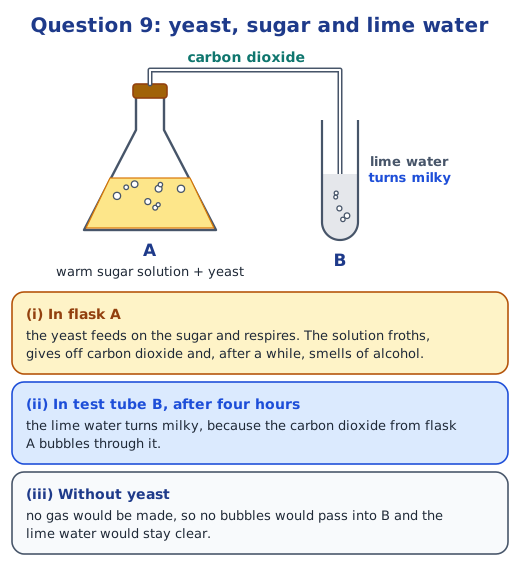
9. “Observe the set-up given in Fig. 2.15 and answer the following questions.” (i) “What happens to the sugar solution in flask A?” The yeast feeds on the sugar and respires. The solution froths with bubbles of carbon dioxide and, after some time, smells of alcohol. (ii) “What do you observe in test tube B after four hours? Why do you think this happened?” The lime water turns milky, because the carbon dioxide made in flask A passes through the tube and bubbles into it. (iii) “What would happen if yeast was not added in flask A?” No gas would be made, so nothing would bubble into B and the lime water would stay clear. The flask without yeast works as a control.
Prepare some questions of your own (page 26). For example: Why does curd set faster in summer than in winter? Do all legumes have root nodules? How long can yeast stay alive in a packet? What else, besides salt and sugar, keeps microbes away from food?
Discover, design, and debate (page 27)
India’s biogas programme. The book notes that one of our oldest biogas plants was set up in the late 1850s. The Ministry of New and Renewable Energy supports biogas plants that turn cattle dung and farm or kitchen waste into cooking fuel. Look up the ministry’s website (with an adult) for the present scheme, and note what a plant needs, who can set one up and what it gives a family.
Fermented foods of your area. Many regions have one: idli, dosa, dhokla, appam, curd, buttermilk and bhatura are common examples, and fermented soya beans and bamboo shoots are traditional foods in some parts of India. For each, note the ingredients, how it is made and how long it is left to ferment. Most are fermented by lactic acid bacteria such as Lactobacillus, often helped by yeasts. Fermented foods are also part of many festivals and family traditions.
Parts of a mushroom. With a magnifying glass you can see the cap, the thin gills under it and the stalk. Under a microscope, a thin slice shows long, thread-like cells packed together, and tiny spores from the gills. A mushroom is a fungus too, just a large one. (Extra: never eat a wild mushroom, because some are poisonous.)
Growing mushrooms. Ask a grower questions such as: which mushroom do you grow, and on what material (for example, straw)? How do you prepare it and keep it clean? How do you keep the room damp and at the right warmth? How long until the first harvest, and how do you sell it? Write the steps in order and the care the grower takes.
Practice
-
Which stain gives onion peel cells a pink colour?
Show answer
Answer: (b) safranin
-
Paramecium belongs to which group?
Show answer
Answer: (c) protozoa
-
Lime water turns milky when it reacts with:
Show answer
Answer: (c) carbon dioxide
-
Why is glycerin put on the onion peel before the coverslip?
Show answer
Answer: It stops the cells from drying out and makes them clearer to see under the microscope.
-
Give one reason why a refrigerator keeps food fresh for longer.
Show answer
Answer: The cold slows down the growth of microbes, so food spoils much more slowly.
Stuck on a question?
Take a photo and Lagnever AI explains it step by step. Try it for 7 days for ₹2.
Get it on Google Play Open in browser
For parents: after the trial, the plan renews monthly by UPI or card autopay. You can cancel anytime in the app.