
Class 8 Science Chapter 2: The Invisible Living World: Beyond Our Naked Eye Notes
This chapter in five lines
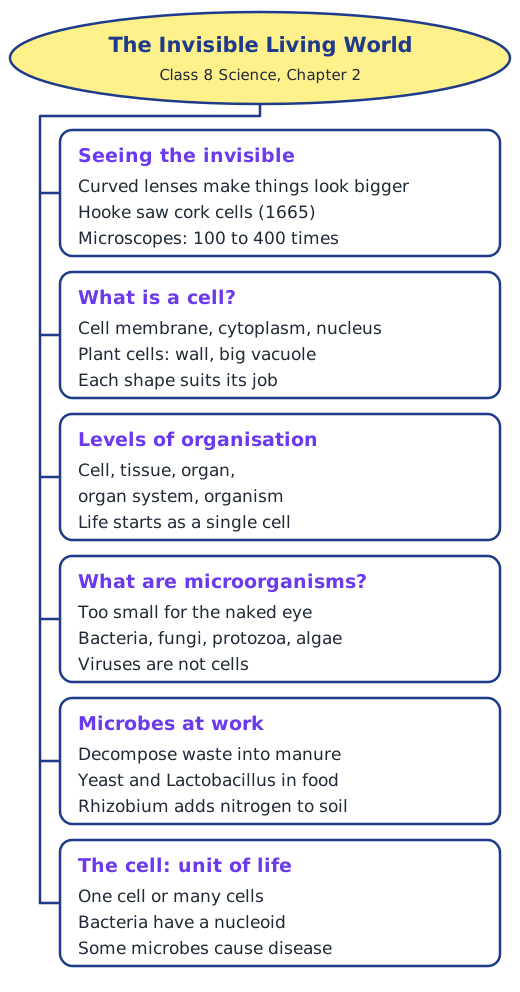
Every living thing is made of cells, the basic unit of life, which we can see only through a microscope. A cell has a membrane, cytoplasm and a nucleus; plant cells also have a cell wall. Cells build tissues, organs, organ systems and whole organisms. Microorganisms such as bacteria, fungi, protozoa and algae are too small to see, live almost everywhere, and help us by recycling waste, making curd and bread and adding nitrogen to soil.
What is this chapter about?
Our eyes can only see things above a certain size, so for most of history a whole world of tiny living things went unnoticed. This chapter opens that hidden world. It asks what all living things are made of, how tiny building blocks come together into a plant or an animal, and how living things too small to see shape our food, our soil and even the air we breathe.
How do we see what the eye cannot?
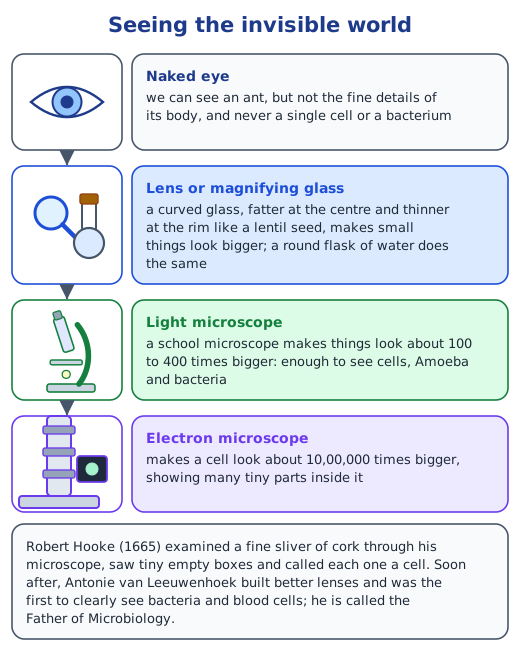
A curved piece of glass, fatter at the centre and thinner towards the rim, the shape of a lentil seed, makes small things look bigger. That shape gave the lens its name. Even a round glass flask full of water works as a magnifier. Better lenses led to microscopes. In 1665 Robert Hooke examined a fine sliver of cork, saw tiny empty boxes and called each one a cell. Soon after, Antonie van Leeuwenhoek built stronger lenses and became the first to clearly see bacteria and blood cells, so he is called the Father of Microbiology.
What is a cell made of?
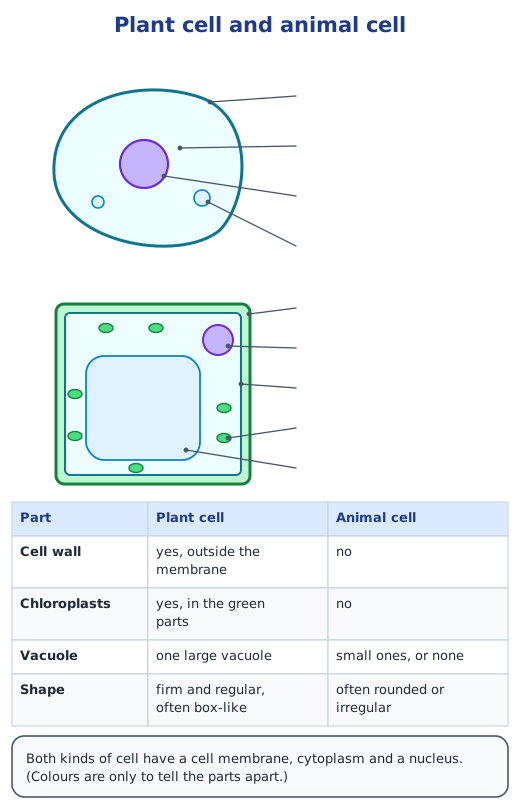
Look at a stained onion peel under a microscope and you see nearly rectangular cells packed tightly, like bricks in a wall. Cells scraped gently from the inside of your cheek look flat and many-sided. Both have three basic parts. The cell membrane is the thin outer layer; it lets in the materials the cell needs and lets waste out. The cytoplasm fills the cell, and most life processes happen in it. The nucleus controls all the cell’s activities and its growth. Plant cells also have a stiff cell wall, a large vacuole and, in green parts, chloroplasts. Read more in cells and levels of organisation.
Why do cells have different shapes?
A cell’s shape suits its job. Cheek cells are flat, thin sheets that line the mouth. Nerve cells are long and branched, so they can carry messages quickly around the body. Muscle cells are spindle-shaped and flexible: in the food pipe they tighten and loosen one after another, like a ripple, and push food down to the stomach. In plants, some cells join end to end into long tubes that carry water.
What are the levels of organisation?
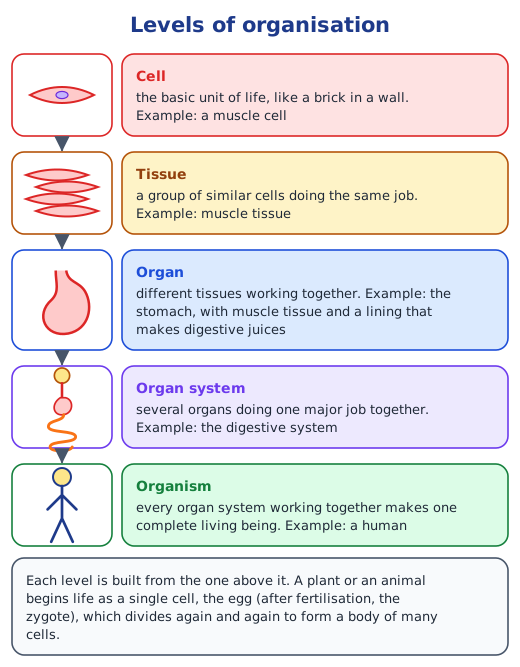
Similar cells grouped together make up a tissue. Different tissues together make an organ, such as the stomach. Several organs working on one major job form an organ system, such as the digestive system. When all the organ systems work together, they make up an organism. So the order is: cell → tissue → organ → organ system → organism. Every plant and animal begins life as a single cell, a fertilised egg, which divides again and again to build a body of many cells.
What are microorganisms?
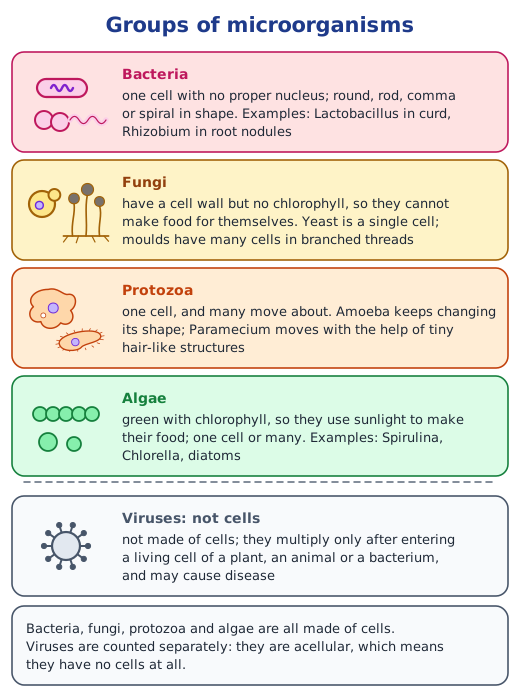
Living things too small to see with the naked eye are microorganisms, or microbes (micro means very small). A drop of pond water or a little soil mixed with water shows them moving under a microscope. They fall into groups: bacteria, fungi, protozoa and algae. Bacteria and protozoa are single cells; fungi and algae can have one cell or many. Viruses are different: they are not cells at all and multiply only inside living cells. Read types of microorganisms.
How do microbes help us?
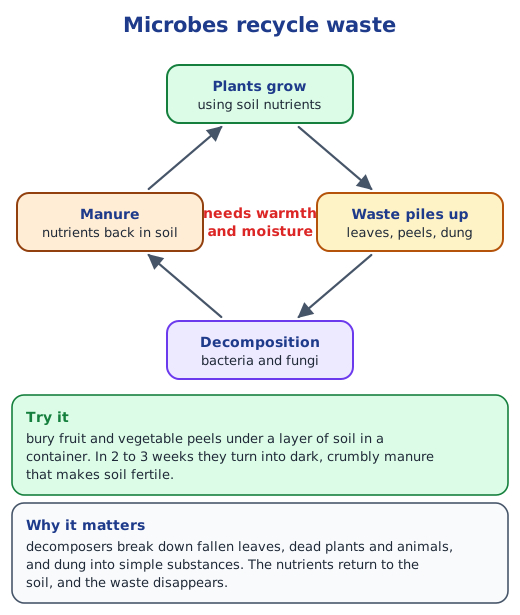
Bacteria and fungi in soil break down peels, fallen leaves, dung and dead bodies into nutrient-rich manure. This decomposition cleans the environment and returns nutrients to the soil. Bacteria that live without oxygen turn waste into biogas, a fuel. In the kitchen, yeast makes dough rise, and Lactobacillus turns milk into curd. Rhizobium bacteria in the root nodules of beans, peas and lentils trap nitrogen from the air for the plant. Microalgae make their own food with sunlight and release a large share of the Earth’s oxygen. Read microorganisms and their uses.
Before we move on
The cell is the basic unit of life, whether it works alone, as in a bacterium, or with countless others, as in your body. Some microbes also cause diseases in plants, animals and people; Chapter 3 turns to health and disease. Answers to every question are in the NCERT solutions for Chapter 2.
Key terms
| Term | Meaning |
|---|---|
| Cell | The basic unit of life: the tiny building block that makes up every living thing. |
| Microscope | An instrument with lenses that makes tiny things look many times bigger; a school microscope magnifies about 100 to 400 times. |
| Cell membrane | The thin outer layer of a cell, with tiny pores, that lets needed materials in and waste out. |
| Cytoplasm | The material filling the cell between the membrane and the nucleus, where most life processes take place. |
| Nucleus | The round body, wrapped in its own membrane, that controls the activities and growth of the cell. |
| Cell wall | A stiff layer outside the cell membrane in plant, fungal and bacterial cells, which gives strength. |
| Vacuole | A space inside a cell that stores substances; plant cells have one large vacuole, animal cells small ones or none. |
| Chloroplast | A green plastid in plant cells that holds chlorophyll and carries out photosynthesis. |
| Tissue | A group of similar cells that work together, such as muscle tissue. |
| Levels of organisation | Cell, tissue, organ, organ system and organism: each level built from the one before. |
| Microorganisms (microbes) | Living things too small to see with the naked eye, such as bacteria, fungi, protozoa and some algae. |
| Unicellular and multicellular | Made of a single cell (bacteria, Amoeba, yeast) or of many cells (moulds, plants, animals). |
| Nucleoid | The region of a bacterial cell that holds its genetic material, with no membrane around it; bacteria have no proper nucleus. |
| Virus | A tiny particle that is not made of cells and multiplies only inside the living cells of a host. |
| Decomposition | The breaking down of dead plants, animals and waste by microbes into simple, nutrient-rich substances. |
Topics in this chapter
Practice
-
Who first used the word “cell” for the tiny boxes he saw in cork?
Show answer
Answer: (b) Robert Hooke
-
Which part is found in a plant cell but not in an animal cell?
Show answer
Answer: (c) cell wall
-
Which is the correct order of levels of organisation?
Show answer
Answer: (c) cell, tissue, organ, organ system, organism
-
Which microorganism turns milk into curd?
Show answer
Answer: (c) Lactobacillus
-
Rhizobium bacteria live in the root nodules of:
Show answer
Answer: (b) beans and peas
-
Which of these is NOT made of cells?
Show answer
Answer: (a) a virus
Questions students ask
What are the main topics of Class 8 Science Chapter 2?
How lenses and microscopes reveal tiny things; the cell and its parts; plant and animal cells; how a cell’s shape suits its job; levels of organisation; what microorganisms are and where they live; and how microbes help us by recycling waste, making food and adding nitrogen to soil.
Is The Invisible Living World: Beyond Our Naked Eye in the new NCERT book?
Yes. It is Chapter 2 of Curiosity, the Class 8 science textbook (Reprint 2026-27), on pages 8 to 27. Chapter 3, Health: The Ultimate Treasure, follows on with the diseases some microbes cause.
Why is the cell called the basic unit of life?
Every living thing is made of one or more cells, and a single cell can carry out all the processes of life, as bacteria and Amoeba do. Bigger living things are built up from cells, just as a wall is built from bricks.
Are all microorganisms harmful?
No. Many are helpful: they turn waste into manure, make curd, help dough rise, add nitrogen to soil and help digestion in our gut. Some do cause diseases, which the next chapter covers; anyone who feels unwell should see a doctor.
Stuck on a question?
Take a photo and Lagnever AI explains it step by step. Try it for 7 days for ₹2.
Get it on Google Play Open in browser
For parents: after the trial, the plan renews monthly by UPI or card autopay. You can cancel anytime in the app.