
How do immunity, vaccines and antibiotics protect us?
Answer in short
Immunity is the body’s natural ability to fight diseases, carried out by the immune system. A vaccine trains the immune system to recognise a germ in advance, so it prevents disease but cannot cure it. Antibiotics kill bacteria, not viruses or protozoa. Misusing them lets resistant bacteria take over, so take them only as a doctor prescribes.
Stuck on a question? Take a photo and Lagnever AI explains it step by step. Try it for 7 days for ₹2. Get it on Google Play
What is immunity?
Have you noticed that some people fall sick more often than others, even when they live in the same place? The body’s natural ability to fight diseases is called immunity, and the body has a special system for it, the immune system. It recognises harmful germs and attacks them. Healthy habits such as good food, exercise and sleep help it work well.
How does a vaccine work?
As small children, most of us were given drops or injections to guard against measles, polio, hepatitis, tetanus and other diseases. Those drops and injections were vaccines. A vaccine trains the immune system to recognise and attack a harmful germ before it can make us ill. The protection we build after meeting a germ or a vaccine is called acquired immunity.
There are several kinds of vaccine: some use weakened or killed germs, some use harmless parts of a germ, or, in some newer vaccines, as instructions that make our own cells produce a harmless part of the germ for the immune system to learn. The tetanus injection that people often get after a wound holds an inactivated form of the poison (toxin) that tetanus bacteria make, so the body learns to block it without getting the disease.
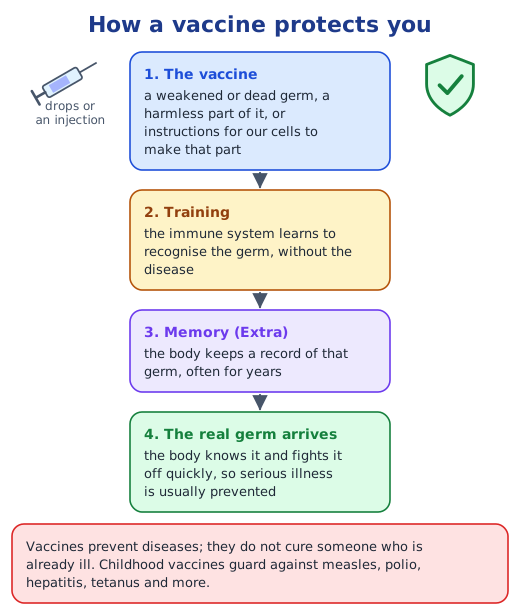
Vaccines protect people of all ages, from babies to the elderly, and save millions of lives every year. Remember: vaccines prevent diseases; they do not cure someone who is already sick. Scientists and doctors test vaccines carefully for safety, and a vaccinated person protects the people around them too.
Why is the body quicker the second time?
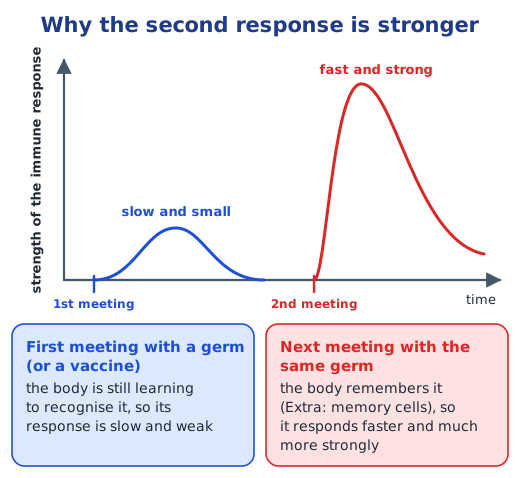
The first time the body meets a germ, its response is slow and weak, because it is still learning to recognise it. The next time, the same germ is recognised at once, and the response is much faster and stronger. (Extra: special memory cells keep a record of the germ.) Vaccines use this: they give the body its first meeting safely.
How was the first vaccine discovered?
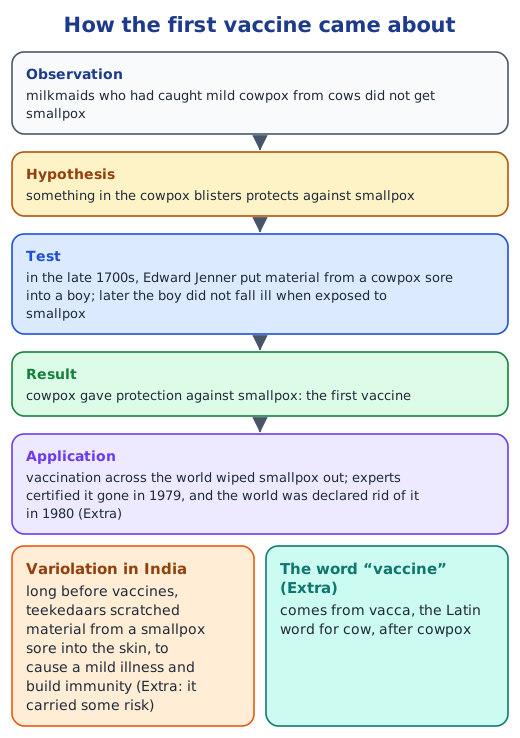
Smallpox was a killer disease that covered the body in blisters and took millions of lives. Cowpox, a far milder illness of cows, could also infect people. In the late 1700s, the English doctor Edward Jenner noticed that milkmaids who had caught cowpox did not get smallpox. He tested his idea by putting material from a cowpox sore into a boy, who later did not fall ill when exposed to smallpox. This was the first vaccine. Mass vaccination later wiped smallpox out across the world (Extra: it was certified gone in 1979 and declared so in 1980).
Long before this, India had variolation: people called teekedaars scratched material from a smallpox sore into the skin to cause a mild infection and build immunity.
India is today one of the world’s largest makers of vaccines, and Indian companies supplied many countries during the COVID-19 pandemic. The doctor and scientist Maharaj Kishan Bhan played a key role in developing a rotavirus vaccine, which protects children from diarrhoea.
What do antibiotics do?
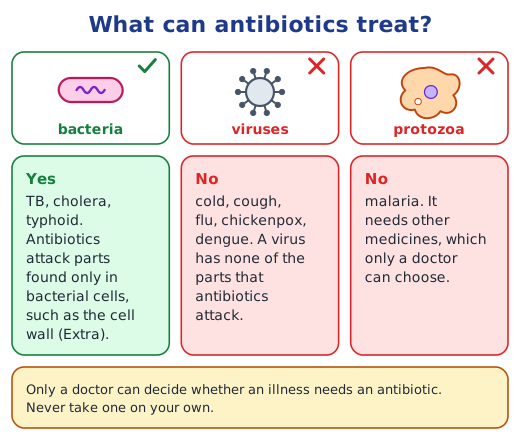
If the immune system cannot stop an infection, we fall ill and need a doctor. For an illness caused by bacteria, the doctor may prescribe an antibiotic, a medicine that kills bacteria. Antibiotics attack parts of a bacterial cell that our own cells do not have, so they do not work against viruses or protozoa. In 1928, Alexander Fleming, working in London, saw that a mould on a petri dish stopped harmful bacteria from growing. The substance it released became penicillin, the first antibiotic.
What is antibiotic resistance?
Antibiotics have saved millions of lives, but careless use is making them weaker. Antibiotic resistance means bacteria that an antibiotic used to kill now survive and multiply despite it. Among many bacteria, a few can survive; the antibiotic kills the rest, including helpful bacteria; the survivors take over and can pass their resistance to other bacteria. Taking antibiotics when they are not needed, not completing the course, or giving them to farm animals without need all speed this up. Infections then become harder to treat.
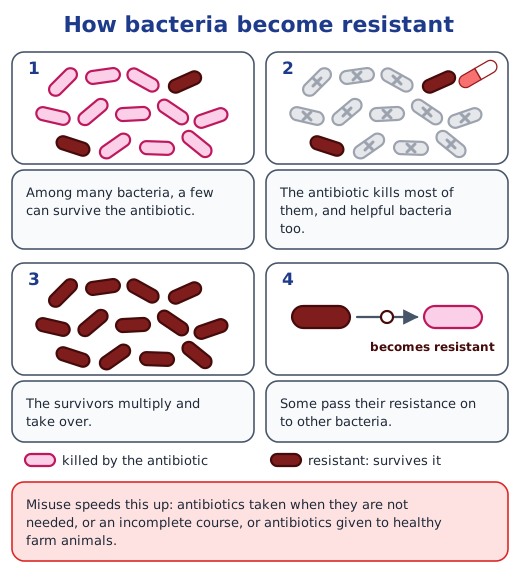
So take an antibiotic only when a doctor prescribes it, exactly as the doctor says and for as long as the doctor says.
What other care is there?
Traditional systems such as Ayurveda, Siddha and Unani use herbs, oils and minerals and stress a healthy lifestyle. They can help with some conditions and everyday well-being, but may not work for all diseases or at every stage. Non-communicable diseases are managed with medicines, lifestyle changes and rehabilitation, and early diagnosis and regular care stop them from getting worse.
Read on: the chapter notes, communicable and non-communicable diseases and the NCERT solutions.
Practice
-
The body’s natural ability to fight diseases is called:
Show answer
Answer: (a) immunity
-
Penicillin was discovered by:
Show answer
Answer: (b) Alexander Fleming
-
A vaccine may contain:
Show answer
Answer: (b) a weakened or dead germ, or a harmless part of it
-
What is antibiotic resistance?
Show answer
Answer: When bacteria that an antibiotic used to kill survive and keep multiplying despite treatment with it.
-
Why does a vaccine protect not only you but also people around you?
Show answer
Answer: If you do not catch the disease, you cannot pass it on, so the germ finds fewer people to spread to.
Questions students ask
How do vaccines work?
A vaccine carries a weakened or dead germ, a harmless part of it, or instructions for our cells to make that part. The immune system learns to recognise it, so when the real germ comes, the body fights it off quickly.
Who discovered the first vaccine?
The English doctor Edward Jenner, in the late 1700s. He saw that milkmaids who had caught cowpox did not get smallpox, and showed that material from cowpox sores protected people from smallpox.
Why don’t antibiotics work on viruses?
Antibiotics attack parts of bacterial cells that human and animal cells do not have. Viruses are not cells and do not have those parts, so antibiotics have nothing to act on.
How can we stop antibiotic resistance?
Take antibiotics only when a doctor prescribes them, exactly as the doctor says and for as long as the doctor says, never for colds or flu, and never without a prescription.
Stuck on a question?
Take a photo and Lagnever AI explains it step by step. Try it for 7 days for ₹2.
Get it on Google Play Open in browser
For parents: after the trial, the plan renews monthly by UPI or card autopay. You can cancel anytime in the app.