
NCERT Solutions Class 8 Science Chapter 4: Electricity: Magnetic and Heating Effects
Answers to Probe and ponder, the questions inside the chapter, Activities 4.1 to 4.6, all eleven Keep the curiosity alive questions and the Discover, design, and debate projects in Chapter 4, Electricity: Magnetic and Heating Effects, of Curiosity, the Grade 8 science textbook. Page numbers follow the 2026-27 reprint (pages 46–61). Short notes: Chapter 4 notes.
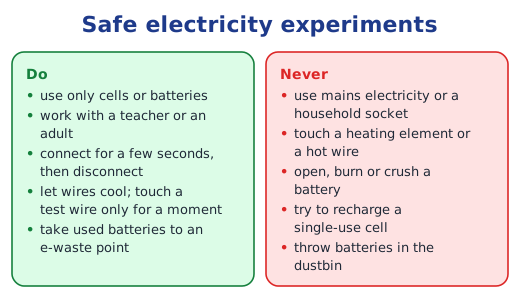
Stay safe. Every activity here uses only a cell or a small battery of cells. Never experiment with mains electricity or a household socket. Work with a teacher or another adult, connect cells only for a few seconds at a time, and remember that wires and heating elements get hot.
Probe and ponder (page 46)
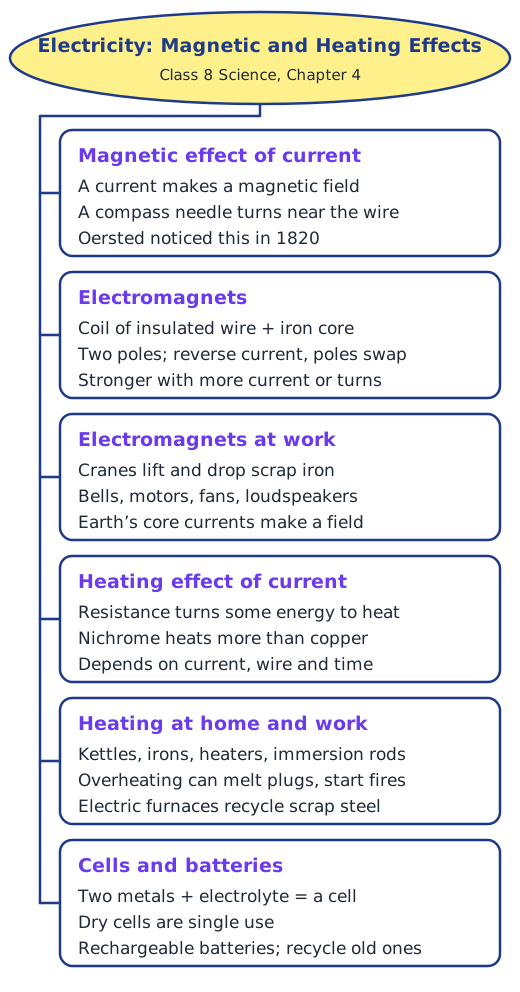
Without a lamp, how can we tell whether current is flowing in a circuit? Place a magnetic compass under or beside a wire of the circuit. If its needle turns when the circuit is closed and swings back when it is opened, current is flowing, because a current makes a magnetic field. (Extra: an LED in the circuit would also show it, by glowing.)
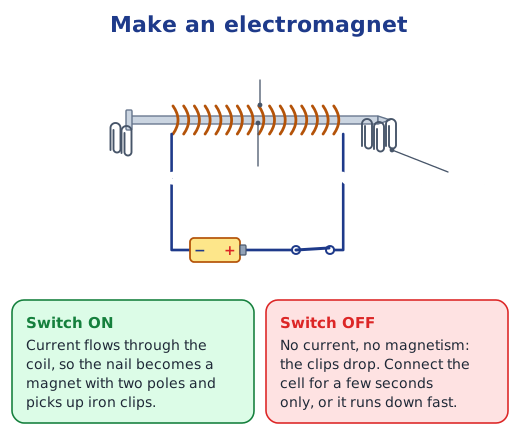
Can we make temporary magnets, and how? Yes. Wind insulated wire round an iron nail and pass current through it from a cell. The nail becomes an electromagnet while the current flows and stops being a magnet when the current stops.
How is heat made in electrical appliances? By the heating effect of current. Their heating element, a rod or coil of wire such as nichrome, resists the flow of current, and this turns electrical energy into heat.
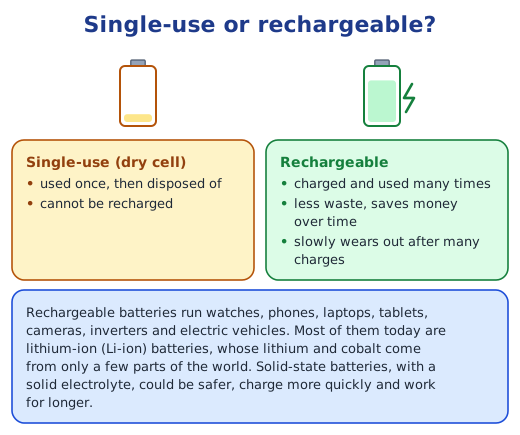
How do we know a cell or battery is dead, and can all of them be recharged? A dead cell can no longer light a lamp or LED or run a device, because the chemicals inside are used up. Not all can be recharged: dry cells are single use, while rechargeable batteries, such as those in phones and laptops, can be charged many times. (Extra: never try to recharge a single-use cell.)
Share your questions. For example: Why does a compass needle turn one way and not the other? How does a loudspeaker use an electromagnet? Why does a phone get warm while charging?
Inside the chapter (pages 47–58)
Activity 4.1: Let us investigate (pages 47–48). When the switch is ON, the compass needle under the wire turns away from its first direction. When the switch is OFF, it returns to its first direction. It does this every time. The needle is a small magnet, and the current sets up a magnetic field around the wire that pushes on it; once the current stops, the field is gone and the needle settles back.
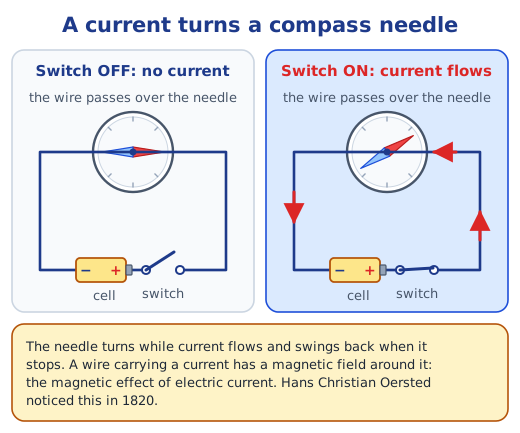
Be a scientist: Oersted (page 48). In 1820 Hans Christian Oersted, a professor in Denmark, noticed a compass needle move whenever a circuit was closed or opened. He checked carefully before publishing, and other scientists then repeated the experiment to test his result. This is how science works: observe, investigate, share, and let others check.
Can a current make a magnet? (page 49) Yes: a coil of wire carrying current is an electromagnet.
Activity 4.2: Let us explore (page 49). Yes, the clips hang from the ends of the nail while the coil is joined to the cell, and yes, they fall when the cell is disconnected. Keep the cell connected only for a few seconds, or it weakens quickly.
Activity 4.3: Let us experiment (pages 49–50). With the cell joined, both compass needles near the ends of the paper-tube coil turn. When the cell is disconnected, they return to their first positions. With an iron nail inside the tube, the needles turn much more, and the ends of the nail attract iron clips. So a coil carrying current behaves like a magnet, an electromagnet, and an iron core makes it much stronger.
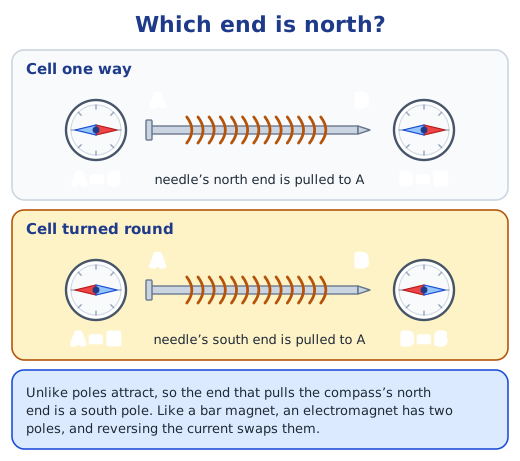
Activity 4.4: Let us investigate (pages 50–51). If the north end of the compass needle is attracted to end A, then A is a south pole, since unlike poles attract. At end B the south end of the needle is attracted, so B is a north pole: the polarity of B is opposite to that of A. So an electromagnet has two poles, just as a bar magnet does.
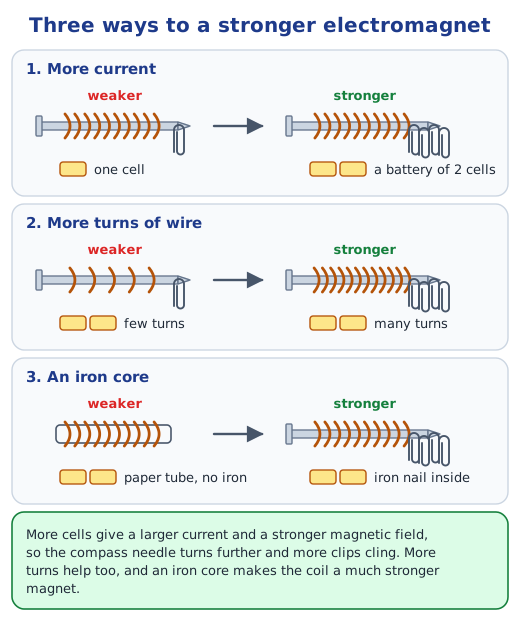
Think like a scientist (page 51). With 2 and then 4 cells and the same coil, the compass needle turns more and the coil picks up more clips, because more cells give a larger current and a stronger magnetic field. With 2 cells and more turns of wire, the coil is again a stronger magnet. When the direction of the current is reversed, the poles swap: the end that was north becomes south. So the strength depends on the current and the number of turns, and the poles depend on the direction of the current. Keep each test short, because the coil and cells warm up quickly with more cells.
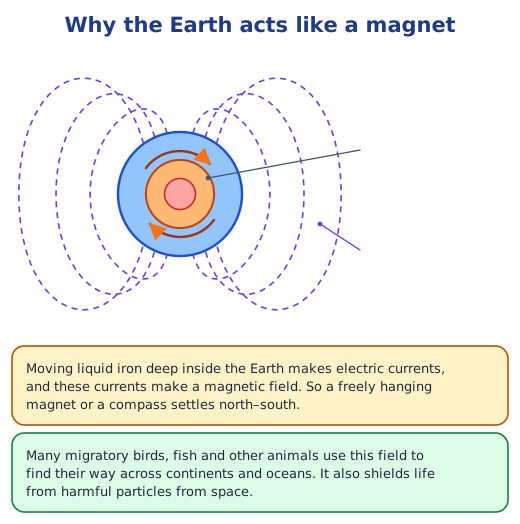
A step further: why the Earth acts like a magnet (page 51). Liquid iron moving deep in the Earth’s core makes electric currents, which make a magnetic field. Migratory birds, fish and other animals navigate by it, and it shields life from harmful particles from space.
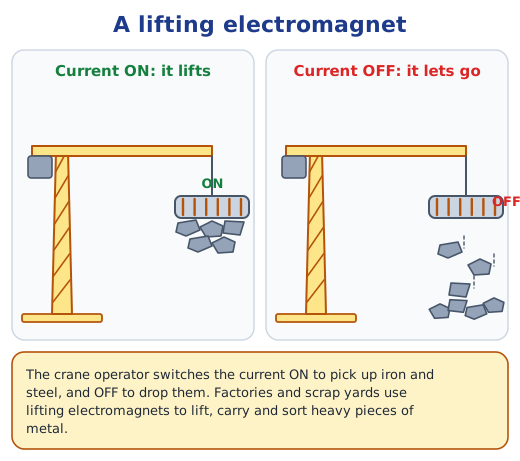
Do real cranes use electromagnets? (page 52) Yes. Lifting electromagnets hang from cranes in factories and scrap yards. With the current on they lift iron and steel; with the current off the field disappears and the load is released.
Why did the ends of the wire get warm? (page 52) Because of the heating effect of current: the wire resists the current, and this turns some electrical energy into heat.
Activity 4.5: Let us observe (pages 52–53). Before the switch is turned on, the nichrome wire feels normal, at room temperature. After about 30 seconds of current, it feels warm when touched for a moment, and repeating the test gives the same result. Nichrome resists the current more than copper does, and this resistance turns electrical energy into heat. Do this only with a teacher, do not hold the wire, and touch it only briefly after switching off.
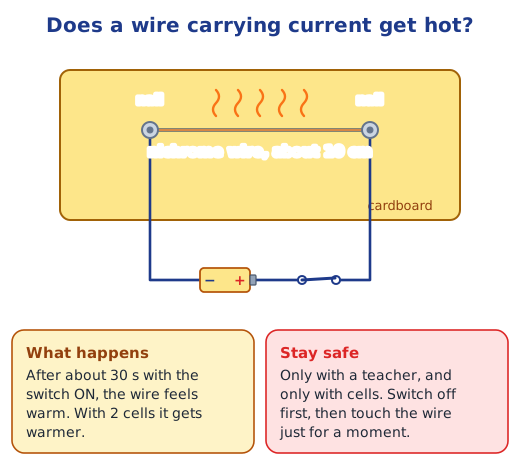
Think like a scientist (page 53). With a battery of 2 cells the wire heats up more than with 1 cell in the same time, because the heat depends on the size of the current. The heat also depends on the wire’s material, thickness and length, and on how long the current flows. This test, too, must be done only under a teacher’s supervision.
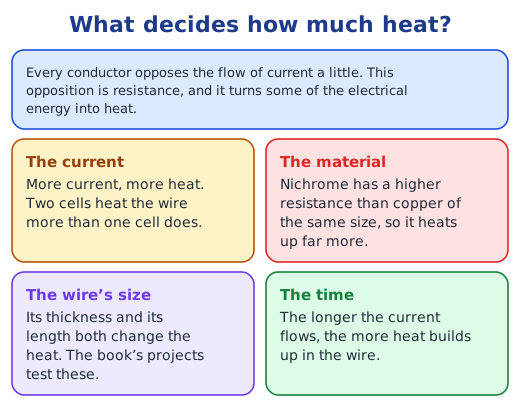
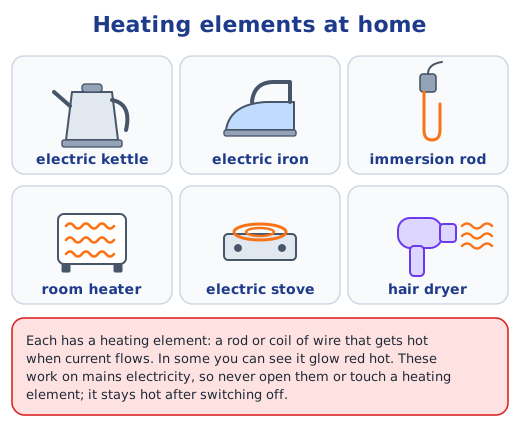
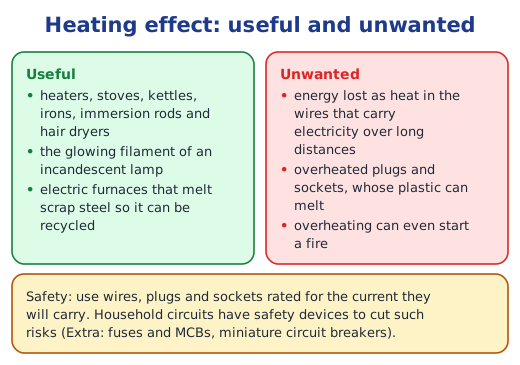
Heating appliances and their problems (pages 53–54). Room heaters, stoves, kettles, irons, immersion rods and hair dryers have heating elements. The same effect wastes energy in transmission wires and can overheat plugs and sockets, so wires and fittings must be rated for the current, and household circuits have safety devices. Electric furnaces melt scrap steel for recycling.
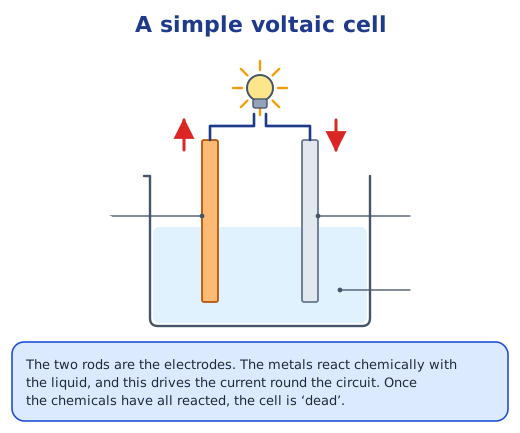
What inside a cell makes the electricity? (page 55) Chemicals. In a voltaic cell, two different metal electrodes sit in an electrolyte, and a chemical reaction between them produces the current. When the chemicals are used up, the cell is dead.
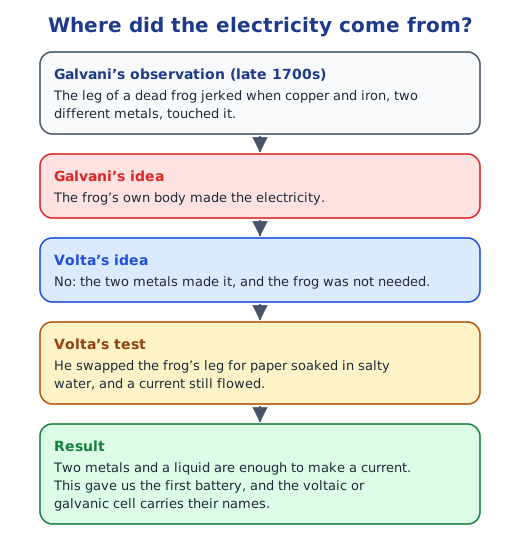
Ever heard of Galvani and Volta? (page 55) Galvani thought the twitching frog’s leg made the electricity; Volta showed, with salt-soaked paper instead of the leg, that two metals and a liquid produce it, which led to the first battery.
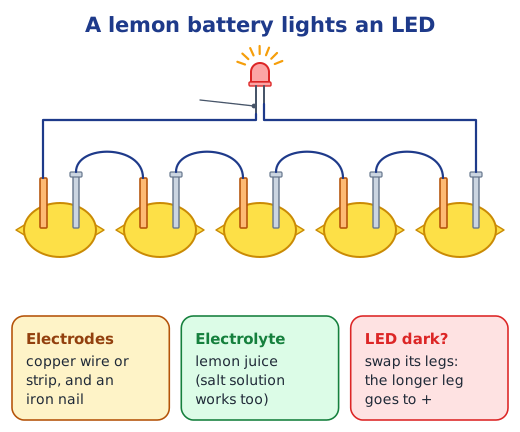
Activity 4.6: Let us construct (page 56). With five or six lemons joined copper to nail, the LED glows if its longer leg is joined to the copper in the first lemon, the positive side. If it does not glow, its legs are the wrong way round; reversing them makes it glow. The copper wires and iron nails are the electrodes and lemon juice is the electrolyte. Wash your hands afterwards and do not eat the lemons (Extra).
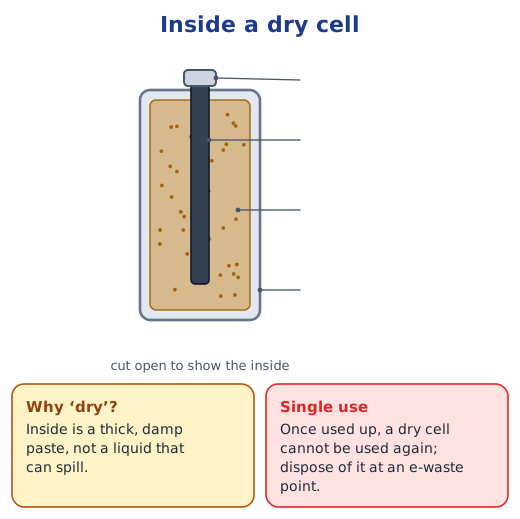
Dry cells and rechargeable batteries (pages 57–58). A dry cell has a zinc container (negative terminal), a carbon rod with a metal cap in the centre (positive terminal) and a moist paste as its electrolyte; it is single use. Rechargeable batteries can be reused many times but slowly wear out, which is why an older phone needs charging more often.
Keep the curiosity alive (pages 58–61)
1. “Fill in the blanks: (i) The solution used in a Voltaic cell is called ________. (ii) A current carrying coil behaves like a _______ .” (i) electrolyte. (ii) magnet (an electromagnet).
2. “Choose the correct option:”
(i) “Dry cells are less portable compared to Voltaic cells. (True/False)” False. Dry cells have a paste instead of a liquid, so they are easier to carry than voltaic cells.
(ii) “A coil becomes an electromagnet only when electric current flows through it. (True/False)” True. With no current there is no magnetic field.
(iii) “An electromagnet, using a single cell, attracts more iron paper clips than the same electromagnet with a battery of 2 cells. (True/False)” False. Two cells give a larger current and a stronger magnet, which attracts more clips.
3. “An electric current flows through a nichrome wire for a short time. (i) The wire becomes warm. (ii) A magnetic compass placed below the wire is deflected. Choose the correct option: (a) Only (i) is correct (b) Only (ii) is correct (c) Both (i) and (ii) are correct (d) Both (i) and (ii) are not correct” (c) Both (i) and (ii) are correct. A current in any wire has both effects: it heats the wire and makes a magnetic field around it.
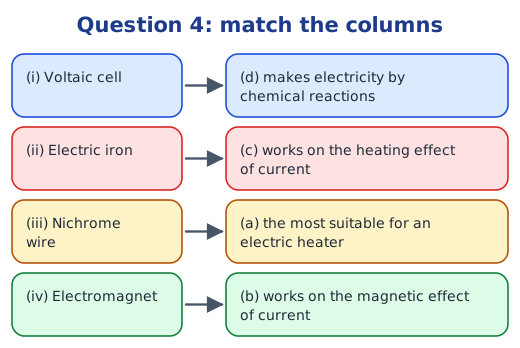
4. “Match the items in Column A with those in Column B.” (Column A: (i) Voltaic cell, (ii) Electric iron, (iii) Nichrome wire, (iv) Electromagnet. Column B: (a) the most suitable for an electric heater, reworded here; (b) Works on magnetic effect of electric current; (c) Works on heating effect of electric current; (d) Generates electricity by chemical reactions.)
- (i) Voltaic cell: (d), it makes electricity by chemical reactions.
- (ii) Electric iron: (c), it works on the heating effect of current.
- (iii) Nichrome wire: (a), it is the most suitable for an electric heater.
- (iv) Electromagnet: (b), it works on the magnetic effect of current.
5. “Nichrome wire is commonly used in electrical heating devices because it (i) is a good conductor of electricity. (ii) generates more heat for a given current. (iii) is cheaper than copper. (iv) is an insulator of electricity.” (ii) It generates more heat for a given current, because its resistance is higher than that of copper. It does conduct electricity, otherwise no current would flow, but it is not chosen for being a good conductor, and it is not an insulator.
6. “Electric heating devices (like an electric heater or a stove) are often considered more convenient than traditional heating methods (like burning firewood or charcoal). Give reason(s) to support this statement considering societal impact.” Electric devices give no smoke indoors, so the people who cook and the children nearby breathe cleaner air and are healthier. Nobody has to spend hours collecting firewood, so fewer trees are cut. They heat at the press of a switch, their heat can be controlled, and they leave no ash or soot to clean. (Extra: much electricity is still made by burning fuels such as coal in power stations, so it should not be wasted.)
7. “Look at the Fig. 4.4a. If the compass placed near the coil deflects: (i) Draw an arrow on the diagram to show the path of the electric current. (ii) Explain why the compass needle moves when current flows. (iii) Predict what would happen to the deflection if you reverse the battery terminals.”
(i) In Fig. 4.4a the cell lies below the coil with its positive terminal on the right. The current leaves the positive terminal, goes up the right-hand wire to the coil at end B, round the turns of the coil towards end A, and down the left-hand wire to the negative terminal.
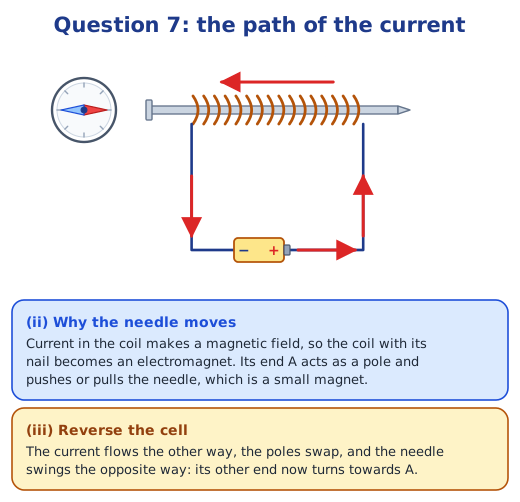
(ii) The current in the coil makes a magnetic field, so the coil with its iron nail becomes an electromagnet with poles at A and B. The compass needle is a small magnet, so the pole at A attracts one end of it and repels the other, and the needle turns.
(iii) The current would flow the other way, so the poles of the electromagnet would swap. The needle would turn the opposite way, with its other end now pointing towards A.
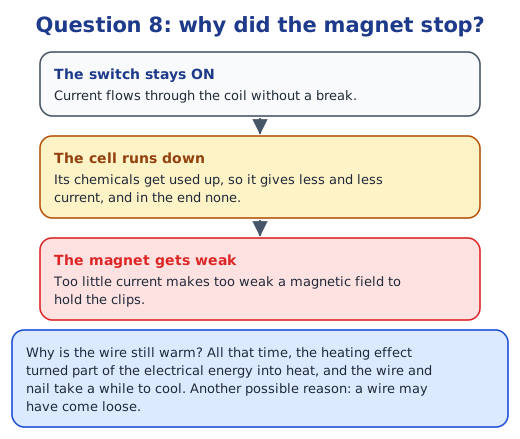
8. “Suppose Sumana forgets to move the switch of her lifting electromagnet model to OFF position (in introduction story). After some time, the iron nail no longer picks up the iron paper clips, but the wire wrapped around the iron nail is still warm. Why did the lifting electromagnet stop lifting the clips? Give possible reasons.” With the switch left on, current flowed all the time, so the battery’s chemicals were used up and it ran down. A weak or dead battery gives too little current, and too little current makes too weak a magnetic field to hold the clips. The wire is still warm because, all that time, the heating effect turned part of the electrical energy into heat, which takes a while to fade. Another possible reason is a connection that has worked loose.
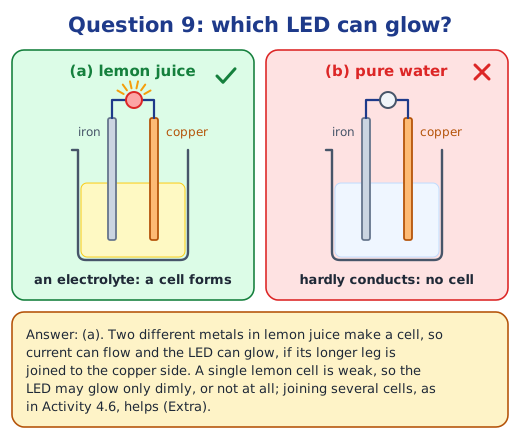
9. “In Fig. 4.12, in which case the LED will glow when the switch is closed?” (Fig. 4.12 shows an iron nail and a copper strip dipped (a) in lemon juice and (b) in pure water.) In (a). Lemon juice is an electrolyte, so the two different metals in it make a cell and current flows. Pure water hardly conducts electricity, so no useful cell forms in (b). The LED must be joined with its longer leg to the copper side. (Extra: a single lemon cell is weak, so the LED may glow only dimly, or not at all, unless several such cells are joined, as in Activity 4.6.)
10. “Neha keeps the coil exactly the same as in Activity 4.4 but slides the iron nail out, leaving only the coiled wire. Will the coil still deflect the compass? If yes, will the deflection be more or less than before?” Yes, the coil still deflects the compass, because a coil carrying current is a magnet even without a core. But the deflection is less than before, because the iron core made the electromagnet much stronger.
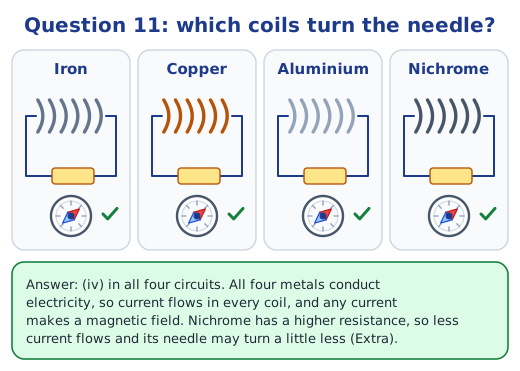
11. “We have four coils, of similar shape and size, made up from iron, copper, aluminium, and nichrome as shown in Fig. 4.13. When current is passed through the coils, compass needles placed near the coils will show deflection. (i) Only in circuit (a) (ii) Only in circuits (a) and (b) (iii) Only in circuits (a), (b), and (c) (iv) In all four circuits” (iv) In all four circuits. Iron, copper, aluminium and nichrome all conduct electricity, so current flows in every coil, and any current makes a magnetic field. (Extra: nichrome has the highest resistance, so less current flows in it and its needle may turn a little less.)
Prepare some questions of your own (pages 59–60). For example: Does the shape of the coil change the strength of an electromagnet? Why do heaters use nichrome but wires in the wall use copper? Which fruit makes the strongest cell? How long does a phone battery last before it wears out?
Discover, design, and debate (page 61)
Coils of 25, 50, 75 and 100 turns. Keep the same cell, the same nail and the same compass position, and note the deflection for each coil, joining each for a few seconds only. You should find that the deflection grows as the number of turns grows. Conclusion: the more turns, the stronger the electromagnet. A table with two columns, number of turns and deflection, makes a neat report.
Thin and thick, short and long nichrome wires. Use one cell, a switch and a teacher’s help, run the current for 30 seconds each time, and touch each wire only for a moment after switching off. You will probably find that the thinner wire (0.3 mm) feels hotter than the thicker one (0.6 mm), and that with equal thickness the shorter wire feels hotter than the longer one. (Extra: the thin wire resists the current more and has less metal to warm up; the longer wire lets less current through from the same cell and spreads its heat over more length.) Record what you actually feel, as warmer or cooler, in your report.
Cells from fruits and vegetables. Try lemons, oranges, tomatoes or potatoes, each with copper and another metal such as zinc or iron, and see which lights an LED or turns a compass needle near a wire. Report which pairs and which fruits worked. Wash your hands afterwards and do not eat anything used as a cell (Extra).
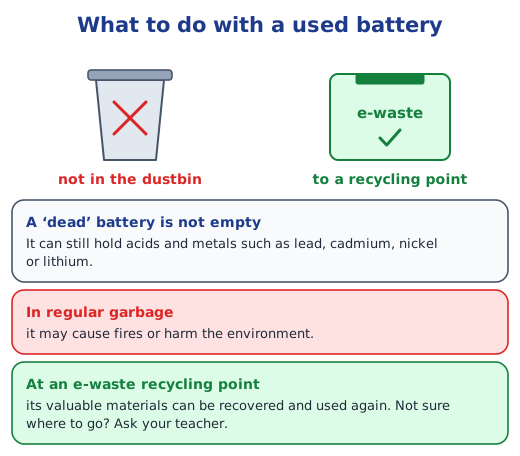
A step further: used batteries. A battery that no longer works may still contain acids and metals such as lead, cadmium, nickel or lithium; thrown into ordinary rubbish, it can start a fire or harm the environment. Take used batteries to an e-waste recycling point, where valuable materials can be recovered; ask your teacher if you are not sure where to go.
Practice
-
A coil on a paper tube is joined to a cell. What happens to a compass near one end?
Show answer
Answer: (b) its needle turns a little
-
In a lemon cell, which metal acts as the positive electrode?
Show answer
Answer: (b) the copper wire
-
The heating element of an electric kettle is usually a:
Show answer
Answer: (b) coil or rod of wire
-
Why does a crane use an electromagnet, not a bar magnet, to move scrap iron?
Show answer
Answer: An electromagnet can be switched off to drop the scrap; a bar magnet would never let go.
-
Name the three parts of a dry cell that the chapter describes, besides the metal cap.
Show answer
Answer: The zinc container (negative terminal), the carbon rod in the centre (positive terminal, with the metal cap) and the moist paste that acts as the electrolyte.
Stuck on a question?
Take a photo and Lagnever AI explains it step by step. Try it for 7 days for ₹2.
Get it on Google Play Open in browser
For parents: after the trial, the plan renews monthly by UPI or card autopay. You can cancel anytime in the app.