
Class 8 Science Chapter 4: Electricity: Magnetic and Heating Effects Notes
This chapter in five lines
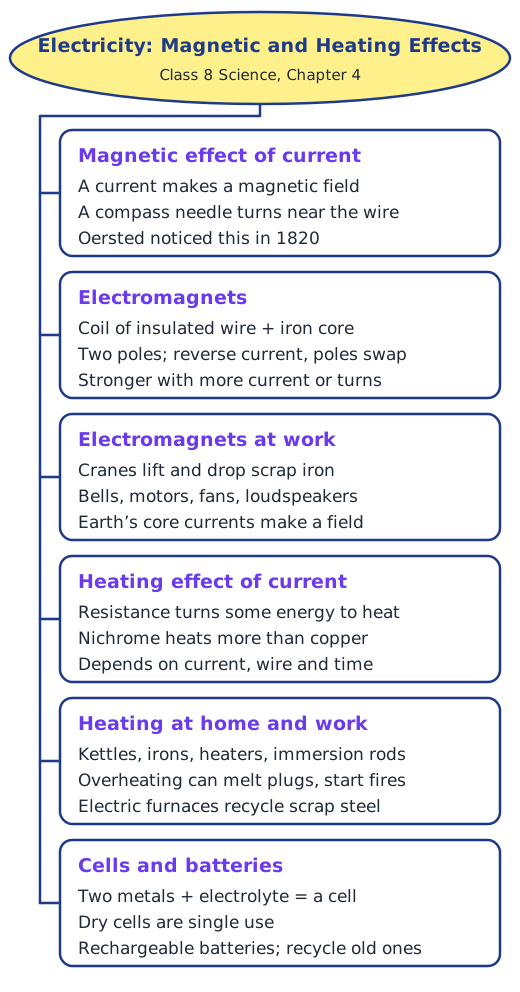
A wire carrying electric current has a magnetic field around it, so it turns a nearby compass needle. A coil of wire carrying current acts as a magnet, an electromagnet, and an iron core makes it stronger. Current also heats a wire, because the wire resists its flow; heaters and kettles use this. Cells and batteries make electricity through chemical reactions.
What is this chapter about?
At a science exhibition, Mohini and Aakarsh stop at a lifting electromagnet model, built by their senior Sumana, that really works. An iron nail wrapped in wire and joined to a battery picks up iron paper clips when she closes the circuit, and drops them when she opens it. There is no magnet in sight, only a circuit. The chapter explores this link between electricity and magnetism, then asks why wires carrying current get warm, and finally what goes on inside cells and batteries. It builds on magnets from Grade 6 and electric circuits from Grade 7.
How do we stay safe in these activities?
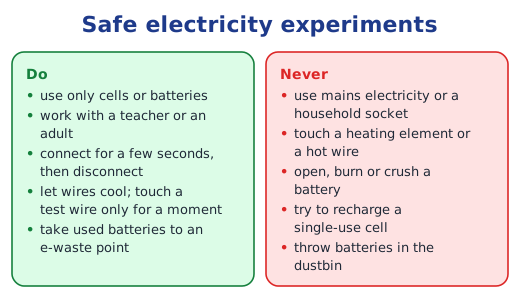
Every activity in this chapter uses only a cell or a small battery of cells. Never experiment with mains electricity or a household socket: it can give a dangerous, even deadly, shock. Work with a teacher or another adult, connect a cell only for a few seconds at a time, and remember that wires and heating elements can get hot. Take used batteries to an e-waste collection point instead of the dustbin.
Can an electric current act like a magnet?
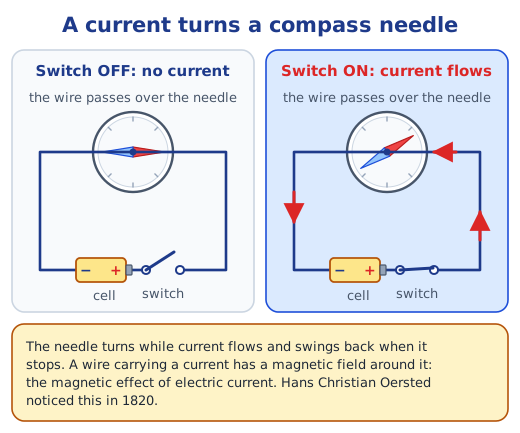
Yes. Place a magnetic compass under a wire in a simple circuit with a cell and a switch. When you switch the current on, the needle turns away from its first direction; when you switch it off, the needle swings back. A compass needle is itself a small magnet, so the wire must be pushing and pulling on it as a magnet would. The space near a magnet, or near a wire carrying current, where a compass needle gets pushed or pulled is called a magnetic field. A current always sets up such a field, which vanishes once the current stops; this is the magnetic effect of electric current. The Danish professor Hans Christian Oersted (1777–1851) noticed this during a demonstration in 1820, checked it carefully and published it, and other scientists then repeated his experiment.
What is an electromagnet?
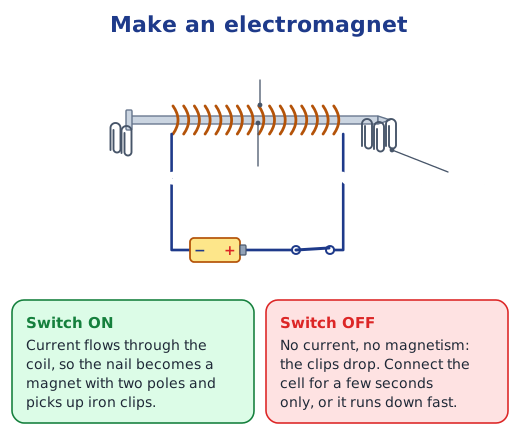
Wrap insulated wire tightly round an iron nail and join its ends to a cell for a few seconds: the nail picks up iron paper clips, and drops them when the current stops. A coil of wire carrying current behaves like a magnet; this is an electromagnet. Even a coil on a paper tube turns a compass needle, but with an iron nail inside as its core it becomes a far stronger magnet, so the electromagnets used in real machines nearly always have iron cores. Like a bar magnet, an electromagnet has a north and a south pole, and reversing the direction of the current swaps them. Read electromagnets.
How can we make an electromagnet stronger, and where is it used?
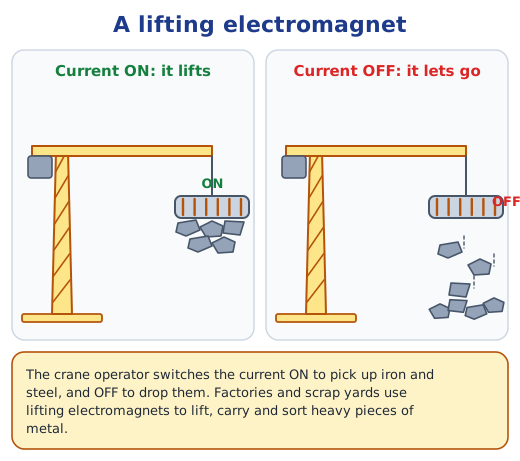
One cell pushes only a small current through the coil, and the field it makes is weak. With more cells the current grows, the field gets stronger, the needle turns further and more clips cling. Winding more turns of wire helps as well. Lifting electromagnets hang from cranes in factories and scrap yards: switched on, they pick up iron and steel; switched off, they let go. The magnetic effect of current also runs electric bells, motors, fans and loudspeakers. Even the Earth behaves like a giant magnet because liquid iron moving in its core makes electric currents.
Does a wire carrying current get hot?
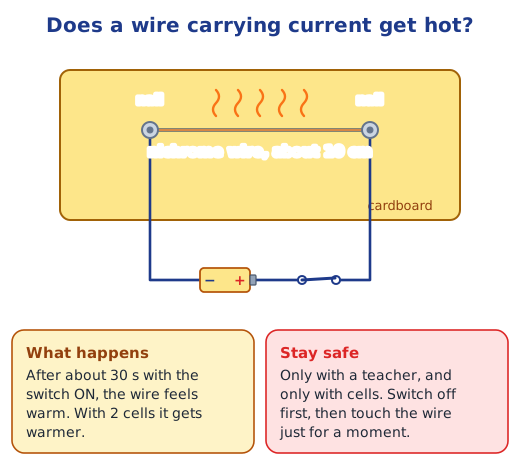
Yes. Stretch a thin nichrome wire between two nails, join it to a cell and a switch, and switch on for about 30 seconds: the wire feels warm. Every conductor holds back the current a little; this is its resistance, and pushing current through it changes part of the electrical energy into heat. A nichrome wire resists far more than a copper wire just as long and just as thick, so it gets much warmer. This is the heating effect of electric current. With two cells the wire gets warmer, because more current makes more heat. The heat also depends on the wire’s material, thickness and length, and on how long the current flows. Read heating effect of electric current.
Where is the heating effect useful, and where is it a problem?
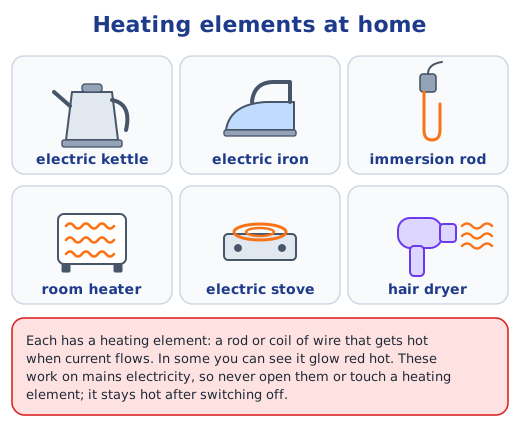
Room heaters, electric stoves, kettles, irons, immersion rods and hair dryers all contain a heating element, a rod or coil of wire that gets hot, sometimes red hot, when current flows. The filament of an incandescent lamp glows for the same reason. In industry, electric furnaces melt scrap steel so that it can be recycled. But the heating effect also wastes energy in the wires that carry electricity over long distances, and overheating can melt the plastic of plugs and sockets or even start a fire. That is why wires, plugs and sockets must be rated for the current they carry, and household circuits have safety devices.
How does a battery make electricity?
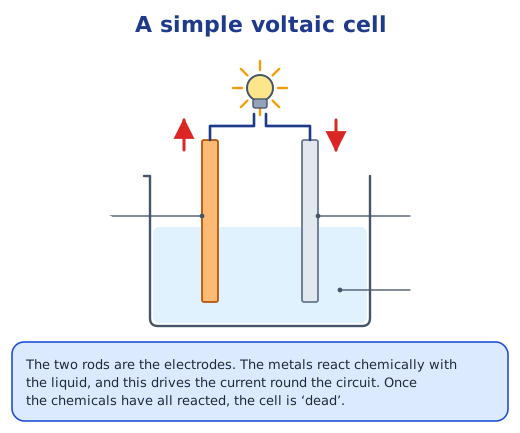
A simple voltaic cell (or galvanic cell) is a jar of liquid, the electrolyte, often a weak acid or salty water, with two rods of different metals, the electrodes, standing partly in it. The metals react chemically with the liquid, and this drives a current out of the positive terminal, round the circuit and back in at the negative terminal. Once the chemicals have all reacted, the cell is ‘dead’. The names honour Luigi Galvani and Alessandro Volta, whose work in the late 1700s led to the first battery. You can make a cell from lemons, copper wire and iron nails; five or six lemons joined together can light an LED. Read cells and batteries.
What are dry cells and rechargeable batteries?
In a dry cell, the electrolyte is a thick, damp paste instead of a liquid, which is where the name comes from. Its zinc case is the negative terminal, and the carbon rod down the middle, capped with metal, is the positive terminal. A dry cell works only once and must then be thrown away safely. Rechargeable batteries can be charged and used many times, which cuts waste and saves money; they run watches, phones, laptops, cameras, inverters and electric vehicles. They still wear out slowly, which is why an old phone needs charging more often. Today most rechargeable batteries are lithium-ion (Li-ion) batteries. Even a ‘dead’ battery holds acids and metals, so it belongs at an e-waste recycling point, not in the dustbin.
Before we move on
Electricity can make magnets, make heat and come from chemicals inside a cell. Respect it: experiment only with cells, with an adult nearby, and never with mains sockets. Answers to every question are in the NCERT solutions for Chapter 4.
Key terms
| Term | Meaning |
|---|---|
| Magnetic field | The space near a magnet, or near a wire carrying current, where a compass needle gets pushed or pulled. |
| Magnetic effect of electric current | Current in a conductor sets up a magnetic field around it, which vanishes once the current stops. |
| Electromagnet | A coil of wire that behaves as a magnet only while current flows in it; an iron core inside makes it far stronger. |
| Core | The piece of iron, such as a nail, placed inside the coil of an electromagnet. |
| Lifting electromagnet | A strong electromagnet hung from a crane to pick up iron and steel when switched on and drop them when switched off. |
| Resistance | The opposition a conductor offers to the flow of current; it turns some electrical energy into heat. |
| Heating effect of electric current | The heating of a conductor when current flows through it. |
| Nichrome | A material with a higher resistance than copper, used for the wires that heat up in heating devices. |
| Heating element | The rod or coil of wire in a heater, kettle, iron or stove that gets hot when current flows. |
| Electrode | Each of the two metal rods or plates in a cell, dipped in the electrolyte. |
| Electrolyte | The liquid or paste in a cell, such as a weak acid or a salt solution, that reacts with the electrodes. |
| Voltaic cell | An early cell made of two different metals in an electrolyte; also called a galvanic cell. |
| Dry cell | A single-use cell whose electrolyte is a moist paste, with a zinc container and a carbon rod. |
| Rechargeable battery | A battery that can be charged and used many times, such as the lithium-ion battery in a phone. |
Topics in this chapter
Practice
-
When current flows through a wire placed over a compass, the needle:
Show answer
Answer: (b) turns away from its first direction
-
Which of these makes an electromagnet stronger?
Show answer
Answer: (c) more current from more cells
-
Heaters and electric irons work on the:
Show answer
Answer: (b) heating effect of current
-
In a voltaic cell, the liquid in which the two metals are dipped is called the:
Show answer
Answer: (b) electrolyte
-
Which of these is a single-use cell?
Show answer
Answer: (a) a dry cell
-
Who first showed that an electric current affects a compass needle?
Show answer
Answer: (c) Hans Christian Oersted
Questions students ask
What are the main topics of Class 8 Science Chapter 4?
The magnetic effect of electric current and Oersted’s discovery; electromagnets, their poles and strength, and lifting electromagnets; the heating effect of current and heating appliances; and how cells and batteries make electricity: voltaic cells, lemon cells, dry cells and rechargeable batteries.
Is Electricity: Magnetic and Heating Effects in the new NCERT book?
Yes. It is Chapter 4 of Curiosity, the Class 8 science textbook (Reprint 2026-27), on pages 46 to 61. It builds on the chapters on magnets in Grade 6 and on electric circuits in Grade 7.
What is the difference between a magnet and an electromagnet?
A bar magnet is always magnetic. An electromagnet is magnetic only while current flows through its coil, so it can be switched on and off, made stronger with more current or more turns, and have its poles swapped by reversing the current.
Are the activities in this chapter safe?
Yes, if done as the book shows: with one or a few cells, for a few seconds at a time, and with a teacher or an adult. Never experiment with mains electricity or a household socket, and remember that wires and heating elements can get hot.
Stuck on a question?
Take a photo and Lagnever AI explains it step by step. Try it for 7 days for ₹2.
Get it on Google Play Open in browser
For parents: after the trial, the plan renews monthly by UPI or card autopay. You can cancel anytime in the app.