
What is the heating effect of electric current?
Answer in short
When current flows through a conductor, the conductor opposes it a little. This opposition, called resistance, turns some electrical energy into heat, so the wire gets warm: the heating effect of electric current. Nichrome heats up more than copper. Heaters, kettles, irons and immersion rods use this effect, but overheating can melt plugs or cause fires.
Stuck on a question? Take a photo and Lagnever AI explains it step by step. Try it for 7 days for ₹2. Get it on Google Play
Does a wire carrying current really get hot?
While making an electromagnet, you may have noticed the ends of the wire getting warm. To test this, the book uses a special wire called nichrome. Fix two nails about 5 cm apart on a piece of cardboard, tie a thin nichrome wire about 10 cm long between them, and join it to a cell and a switch. Touch the wire with the switch off: it feels normal. Switch on for about 30 seconds, switch off, and touch the wire just for a moment: it feels warm. Repeat to make sure.
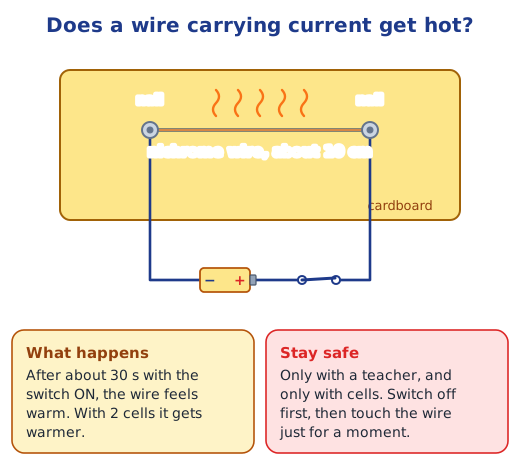
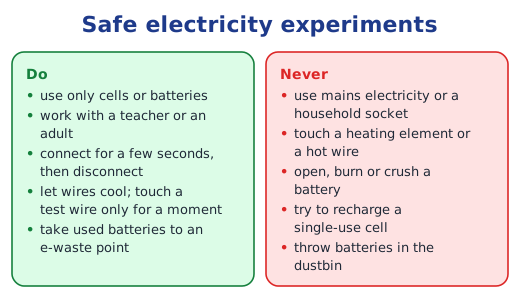
Stay safe. Do this only with a teacher, only with a cell or a small battery, and never with a household socket or mains electricity. Do not hold the wire, and touch it only briefly after switching off, because it can get hot enough to hurt.
Why does the wire get warm?
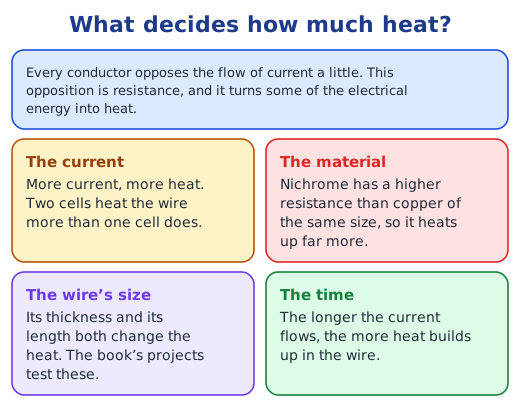
Every conductor holds back the current a little as it passes. This holding back is called resistance, and it is not the same for all materials: a nichrome wire resists far more than a copper wire just as long and just as thick. While the current pushes through against the resistance, part of the electrical energy changes into heat, and the wire warms up. We call this the heating effect of electric current.
What decides how much heat is made?
Repeat the test with a battery of two cells, under a teacher’s eye. For the same time, the wire gets warmer than with one cell, because the heat depends on the size of the current: more current, more heat. The heat made in a wire also depends on its material, its thickness, its length and the time for which the current flows. The projects at the end of the chapter let you compare thin and thick nichrome wires, and short and long ones.
Which appliances use the heating effect?
In Grade 7 you saw that the thin filament of an incandescent lamp glows because the current heats it; that is also why a torch lamp sometimes feels warm. Many things at home use the same idea: kettles, irons, immersion rods for heating water, room heaters, electric stoves and hair dryers. Each contains a rod or coil of wire called a heating element, and in some you can see it glowing red hot.
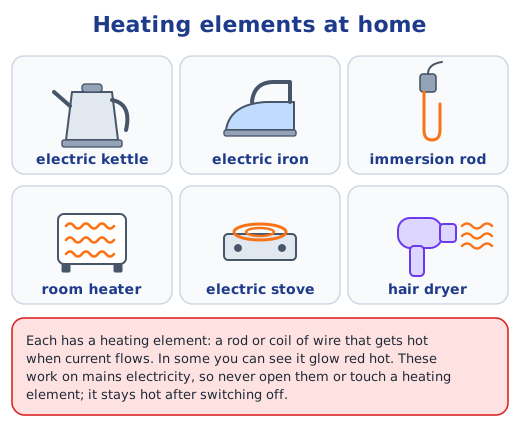
These appliances run on mains electricity, which is far more dangerous than a cell. Use them only as an adult shows you, never open them, and never touch a heating element, even after switching off.
Is the heating effect ever a problem?
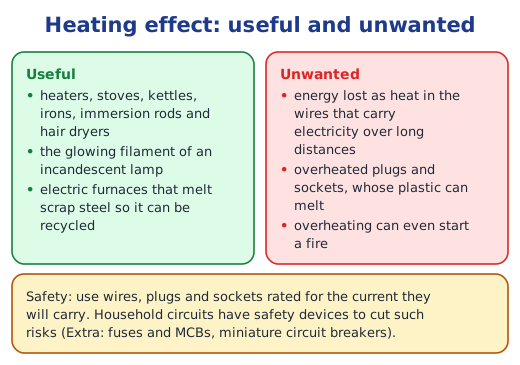
Yes. Some energy is lost as heat in the wires that carry electricity over long distances. In homes, appliances that overheat can damage plugs and sockets, melt their plastic parts or even start a fire. To prevent this, wires, plugs and sockets should be rated for the current they will carry, and household circuits have safety devices that cut such risks (Extra: fuses and miniature circuit breakers, MCBs, which switch off the supply when too much current flows).
How does industry use the heating effect?
Steel plants use specially designed furnaces, enclosed spaces built to make great heat, in which electric current produces the heat. These furnaces melt scrap steel and turn it back into usable steel, so old iron and steel can be recycled.
Cells and batteries have powered every activity so far. What is inside them? Read on: cells and batteries, the chapter notes and the NCERT solutions.
Practice
-
Which wire gets hotter with the same current flowing for the same time?
Show answer
Answer: (b) a nichrome wire of the same size
-
The opposition a conductor offers to the flow of current is called:
Show answer
Answer: (a) resistance
-
Which of these does not use a heating element?
Show answer
Answer: (c) a loudspeaker
-
A nichrome wire is joined to one cell, then to a battery of two cells, for the same time. When does it get hotter, and why?
Show answer
Answer: With two cells, because the larger current makes more heat.
-
Why must plugs and sockets be rated for the current they carry?
Show answer
Answer: Too much current makes them overheat, which can melt their plastic parts or even start a fire.
Questions students ask
Why does a wire get hot when current flows through it?
Every conductor opposes the flow of current a little; this is its resistance. Overcoming it turns some electrical energy into heat, so the wire warms up.
Why is nichrome used in heaters?
Nichrome has a higher resistance than a copper wire of equal length and thickness, so it makes more heat for the same current. That is why the heating elements of many appliances are made of it.
What does the heat produced in a wire depend on?
On the current, the wire’s material, thickness and length, and how long the current flows. More current, for example from two cells instead of one, makes more heat.
Is the heating effect of current always useful?
No. It is useful in heaters and kettles, but it also wastes energy in the wires that carry electricity over long distances, and overheating can damage plugs and sockets or cause fires.
Stuck on a question?
Take a photo and Lagnever AI explains it step by step. Try it for 7 days for ₹2.
Get it on Google Play Open in browser
For parents: after the trial, the plan renews monthly by UPI or card autopay. You can cancel anytime in the app.