
How does a cell or battery make electricity?
Answer in short
A cell makes electricity through a chemical reaction. Two different metals, the electrodes, sit in an electrolyte such as a weak acid, salt solution or lemon juice; current leaves the positive terminal and returns at the negative one. When the chemicals run out, the cell is dead. Dry cells are single use; rechargeable batteries can be recharged.
Stuck on a question? Take a photo and Lagnever AI explains it step by step. Try it for 7 days for ₹2. Get it on Google Play
What is inside a simple cell?
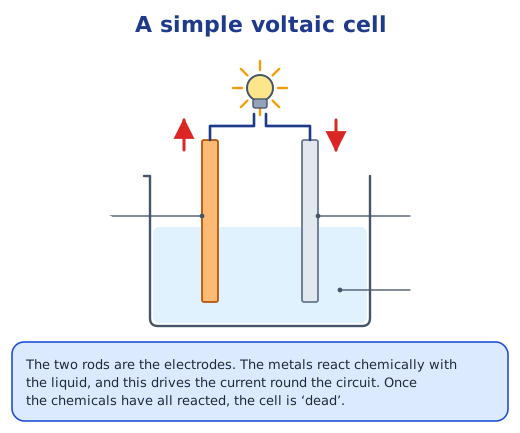
Among the first cells ever built is the voltaic cell, also called a galvanic cell. Picture a jar of liquid with two rods of different metals standing in it, each only partly under the surface. The rods are the electrodes. The liquid, often a weak acid or salty water, is the electrolyte. The metals react chemically with the liquid, and this reaction is what drives electricity round a circuit. Outside the cell, the current travels out of the positive terminal, through the lamp or other device, and back in at the negative terminal. Once the chemicals have all reacted, nothing is left to drive the current, and we say the cell is ‘dead’.
How was the first battery invented?
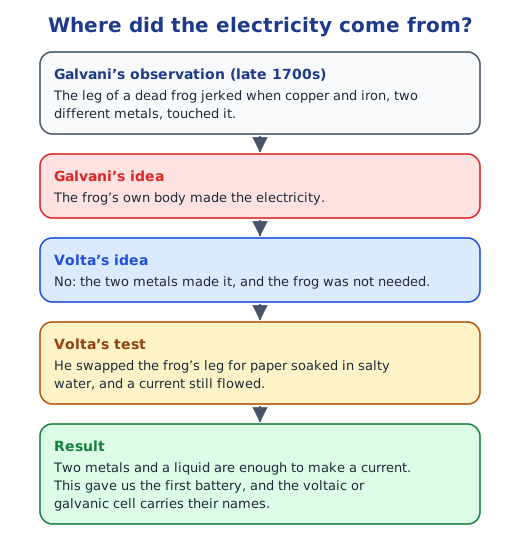
The cell is named after two Italian scientists. In the late 1700s, Luigi Galvani noticed that the leg of a dead frog jerked when copper and iron, two different metals, touched it. Scientists already knew that electricity can make muscles move, so Galvani believed the frog’s own body was the source. Alessandro Volta suspected the metals instead. He tested this by swapping the frog’s leg for a piece of paper soaked in salty water, and a current still flowed. The frog was not needed: two metals and a liquid were enough. That idea gave the world its first battery.
Can we make a cell at home?
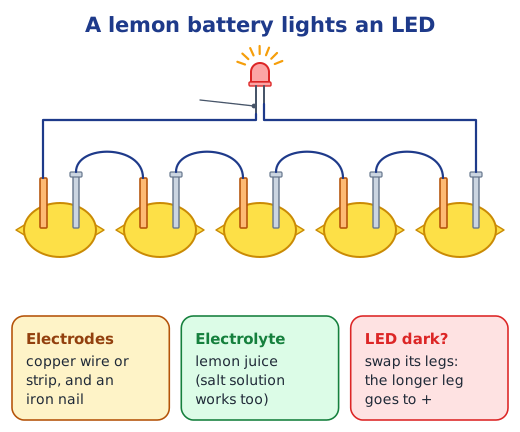
Yes, with an adult’s help. Push a copper wire or strip and an iron nail into a juicy lemon, keeping them a little apart. Prepare five or six lemons like this and wire them in a row, each lemon’s copper to the next lemon’s nail. Finally connect an LED: one leg to the copper in the first lemon, the other to the nail in the last. An LED lets current through only one way, with its longer leg on the positive side, so if it stays dark, turn it round. When it glows, your lemon battery is working. Here copper and iron are the electrodes and lemon juice is the electrolyte; salty water also works.
Many other pairs of metals work too, for example zinc with copper or silver, and aluminium, iron, magnesium or lead with copper. Copper usually becomes the positive electrode and zinc the negative one; which metal plays which part depends on its chemical properties, a topic for higher classes. (Extra: do not eat a fruit after using it as a cell.)
What is a dry cell?
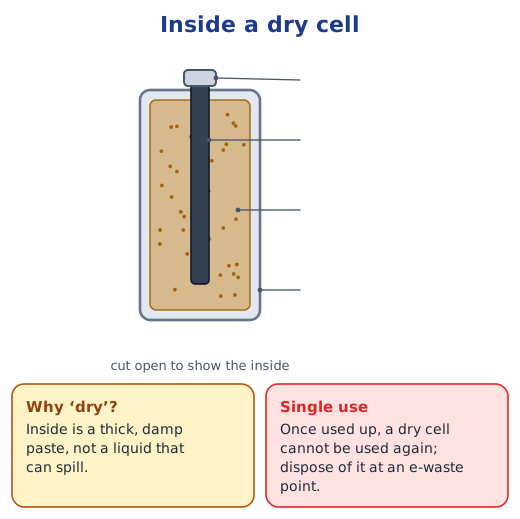
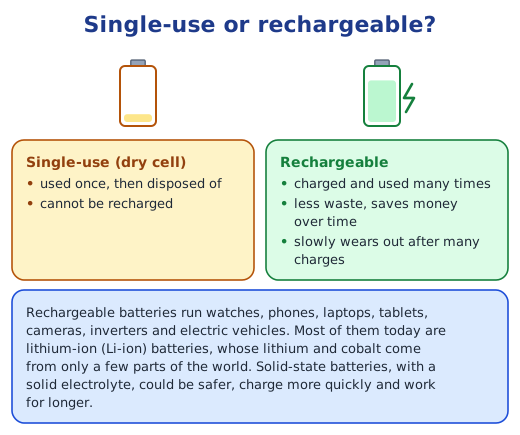
The voltaic cell was a great step forward, but nobody wants to carry a jar of liquid around. Today dry cells are used far more. The name comes from the electrolyte: instead of a liquid it is a thick, damp paste. The outer case is made of zinc and serves as the negative terminal. Down the middle runs a carbon rod topped with a metal cap, the positive terminal, and the paste fills the space around the rod. A dry cell works only once: when it runs down, it cannot be reused and must be thrown away safely.
What are rechargeable batteries?
A rechargeable battery can be charged again and reused many times, so fewer batteries are thrown away and money is saved in the long run. Different kinds power watches and phones, laptops and tablets, cameras, inverters and electric vehicles. Even these batteries age: every round of charging and use wears them down a little, which is why a phone a year or two old runs out of charge sooner. The commonest rechargeable battery today is the lithium-ion (Li-ion) battery. It needs metals such as lithium and cobalt, which come from mines and processing plants in only a few parts of the world, so countries are trying to make their supply safe, to recycle old batteries and to invent better ones. Scientists are also developing solid-state batteries, whose electrolyte is a solid; these could be safer, charge more quickly and work for longer.
What should we do with a used battery?
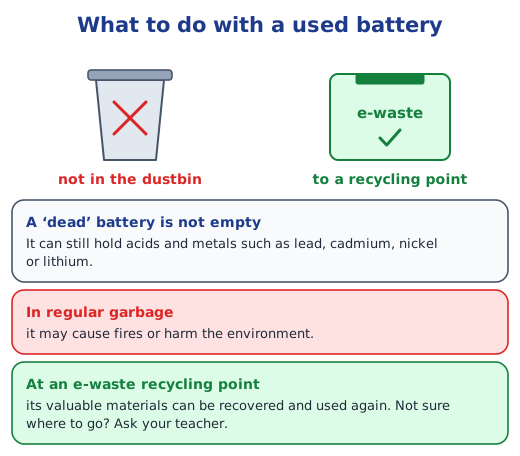
A battery that no longer works is not truly empty. Inside, there may still be acids and metals such as lead, cadmium, nickel or lithium. Thrown into ordinary rubbish, it can start a fire or harm the environment. Many of these materials are also valuable and can be recovered. Take used batteries to an e-waste recycling point, and ask your teacher if you are not sure where one is. (Extra: never open, burn or crush a battery, and never try to recharge a single-use cell.)
Read on: the chapter notes and the NCERT solutions, or go back to electromagnets.
Practice
-
In a lemon cell, the lemon juice is the:
Show answer
Answer: (b) electrolyte
-
In a dry cell, the negative terminal is the:
Show answer
Answer: (c) zinc container
-
Volta replaced the frog’s leg with:
Show answer
Answer: (b) paper soaked in salt water
-
Why does a cell stop working after some time?
Show answer
Answer: The chemicals inside it get used up in the reaction that makes the current, so it can no longer supply electricity.
-
Give two reasons why rechargeable batteries are useful.
Show answer
Answer: They can be charged and used many times, so they cut waste and save money over time, and they power phones, laptops, inverters and electric vehicles.
Questions students ask
What is an electrolyte?
The liquid or paste in a cell that reacts with the two electrodes, such as a weak acid, a salt solution or lemon juice. In a dry cell it is a thick moist paste.
Why is a dry cell called dry?
Because its electrolyte is a thick moist paste, not a liquid. Its zinc case is the negative terminal, and the metal-capped carbon rod in the middle is the positive one.
Can all batteries be recharged?
No. Dry cells are single use and must be disposed of once used up. Rechargeable batteries, such as the lithium-ion batteries in phones, can be charged many times, though they slowly wear out.
How should we dispose of used batteries?
Not in regular garbage, where they may cause fires or harm the environment. Take them to an e-waste recycling point, where their valuable materials can be recovered. If unsure, ask your teacher.
Stuck on a question?
Take a photo and Lagnever AI explains it step by step. Try it for 7 days for ₹2.
Get it on Google Play Open in browser
For parents: after the trial, the plan renews monthly by UPI or card autopay. You can cancel anytime in the app.