
What is an electromagnet and how does it work?
Answer in short
An electromagnet is a coil of insulated wire that acts as a magnet while electric current flows through it. Current always makes a magnetic field around a wire. An iron core makes the coil a much stronger magnet. It has two poles, which swap when the current is reversed, and it gets stronger with more current or more turns.
Stuck on a question? Take a photo and Lagnever AI explains it step by step. Try it for 7 days for ₹2. Get it on Google Play
Can an electric current affect a magnet?
Yes. Make a simple circuit with a cell, a switch and a long wire, and lay a magnetic compass under part of the wire. With the switch off, the needle rests in its usual direction. Switch on, and the needle turns. Switch off, and it swings back. A compass needle is itself a small magnet, so the wire must be pushing and pulling on it the way a magnet would.
The space near a magnet, or near a wire carrying current, where a compass needle gets pushed or pulled is called a magnetic field. Whenever current flows through a conductor, a magnetic field forms around it, and the field vanishes as soon as the current stops. We call this the magnetic effect of electric current.
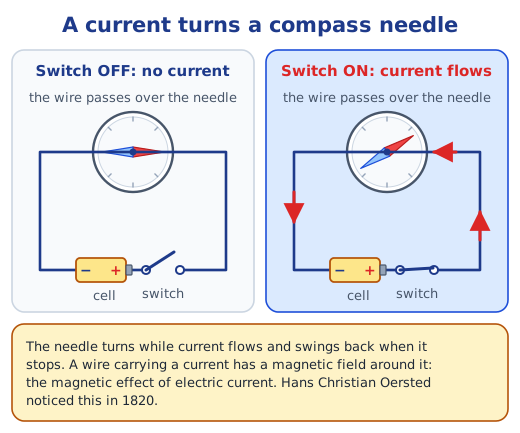
In 1820 the Danish professor Hans Christian Oersted noticed, during a demonstration, that a compass needle lying nearby moved whenever his circuit was closed or opened. He investigated until he was sure that a current makes a magnetic field, and then published his result. Other scientists repeated his experiment and went on to explore the link between electricity and magnetism.
How do you make an electromagnet?
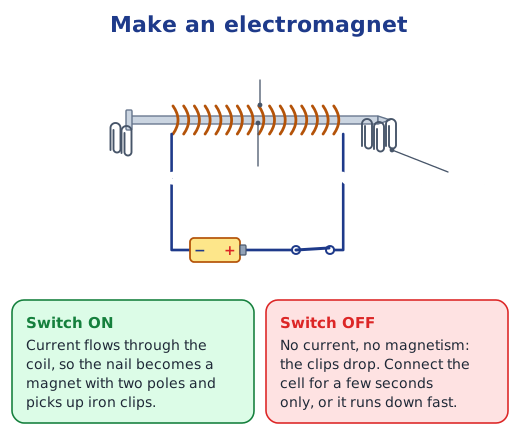
Take an iron nail and about 50 cm of flexible insulated wire. Wrap the wire tightly round the nail as a coil, tape it in place and join its two ends to a cell. Hold the nail near some iron paper clips: they cling to it. Disconnect the cell and the clips fall. Keep the cell connected only for a few seconds, or it will run down quickly.
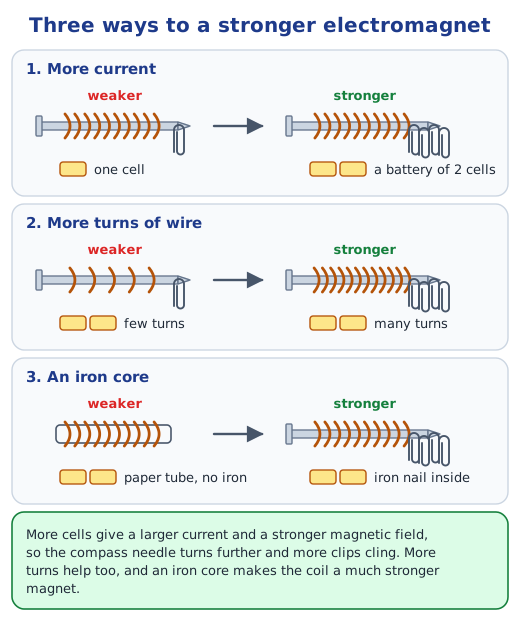
A coil of wire that acts as a magnet while current flows through it is an electromagnet. A coil wound on a paper tube also turns a compass needle, but weakly. Slide an iron nail into the tube as a core and the needle turns much more, and the coil now picks up clips. So most electromagnets used in practice have an iron core.
Does an electromagnet have poles?
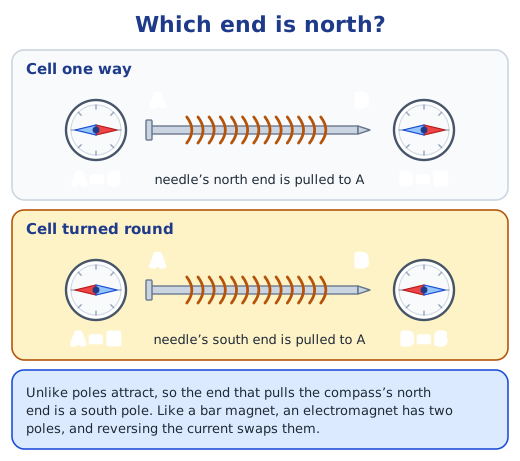
Yes. Label the ends of the coil A and B and bring a compass near end A while the current flows. Unlike poles attract, so if the north end of the needle is pulled towards A, then A is a south pole. Test end B the same way and you find the opposite pole there. Just like a bar magnet, an electromagnet has a north pole and a south pole. Turn the cell round so that the current flows the other way, and the poles swap.
How can you make an electromagnet stronger?
One cell drives only a small current through the coil, which gives a weak field: the needle turns a little and only a few clips cling. With two or more cells, the current is bigger, the field is stronger and more clips cling. Winding on more turns of wire strengthens it too. So you can change the strength of an electromagnet by changing the current, the number of turns, or both, and you can reverse its poles by reversing the current.
Where are electromagnets used?
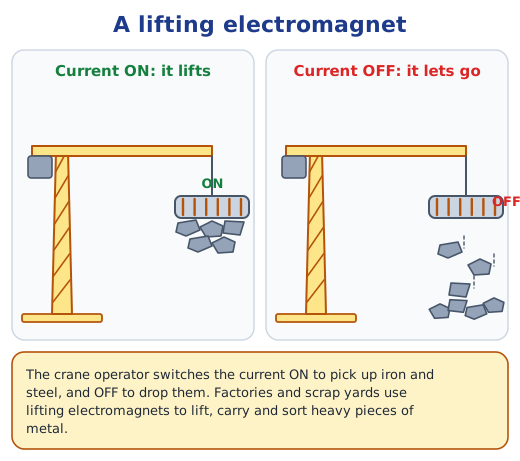
Lifting electromagnets are strong electromagnets hung from cranes. The operator switches the current on to pick up iron and steel objects and switches it off to drop them, because the magnetic field disappears. Factories and scrap yards use them to lift, carry and sort heavy pieces of metal. The magnetic effect of current also works inside electric bells, motors, fans and loudspeakers. In higher classes you will learn the reverse too: a moving magnet can produce an electric current, which is the idea behind power generators.
Why does the Earth act like a magnet?
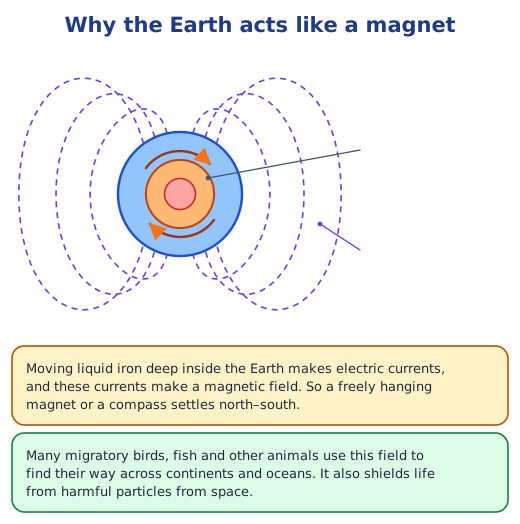
A magnet hung on a thread comes to rest pointing north–south because the whole Earth acts like a huge magnet. Far below our feet, liquid iron flows in the Earth’s core; this moving iron sets up electric currents, and the currents produce a magnetic field. Birds that migrate, many fish and some other animals find their way across continents and oceans with its help, and the field also guards life against harmful particles arriving from space.
Stay safe: build your electromagnet only with a cell or a small battery, with a teacher or an adult, and never with a household socket. Did you notice the wire getting warm? That is the next topic: the heating effect of electric current. See also the chapter notes and the NCERT solutions.
Practice
-
What happens to a compass needle under a wire when the current is switched off?
Show answer
Answer: (b) it swings back to its first direction
-
The iron nail inside the coil of an electromagnet is called its:
Show answer
Answer: (b) core
-
The north pole of a compass needle is pulled towards end A of an electromagnet. End A is a:
Show answer
Answer: (b) south pole
-
Give two ways to make an electromagnet stronger.
Show answer
Answer: Pass more current through it, for example with a battery of more cells, or wind more turns of wire on the coil. An iron core also makes it much stronger.
-
Why do scrap yards use electromagnets rather than ordinary magnets on their cranes?
Show answer
Answer: An electromagnet can be switched on to pick up iron and steel and switched off to drop it. An ordinary magnet would not let go of the scrap.
Questions students ask
What is the magnetic effect of electric current?
When current flows through a conductor such as a wire, it makes a magnetic field around it. A compass needle near the wire turns while the current flows and swings back when it stops.
Who discovered that electricity and magnetism are linked?
Hans Christian Oersted, a professor in Denmark, in 1820. During a demonstration he noticed a nearby compass needle move whenever the circuit was closed or opened, investigated it and published his findings.
Does an electromagnet have poles?
Yes. Like a bar magnet, it has a north pole and a south pole, one at each end. A compass can show which is which, and reversing the direction of the current swaps them.
Where are electromagnets used?
In lifting electromagnets on cranes in factories and scrap yards, and in electric bells, motors, fans and loudspeakers, which all use the magnetic effect of current.
Stuck on a question?
Take a photo and Lagnever AI explains it step by step. Try it for 7 days for ₹2.
Get it on Google Play Open in browser
For parents: after the trial, the plan renews monthly by UPI or card autopay. You can cancel anytime in the app.