
Class 6 Science Chapter 4: Exploring Magnets Notes
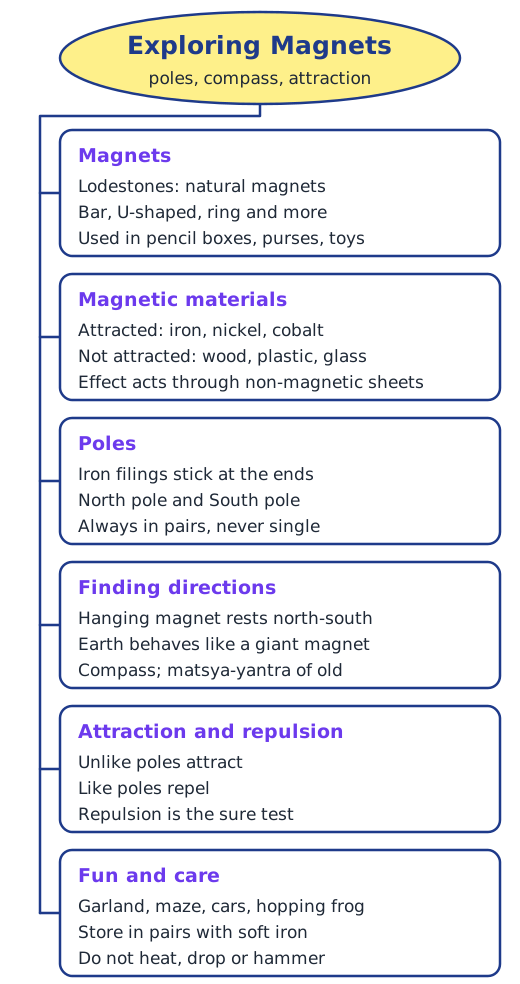
This chapter in five lines
A magnet attracts magnetic materials such as iron, nickel and cobalt, but not non-magnetic ones such as wood, plastic and glass. Its attraction is strongest at its two ends, the North and South poles, which always come in pairs. A freely suspended magnet rests along the north-south direction because the Earth behaves like a giant magnet, and a magnetic compass uses this to find directions. Unlike poles attract and like poles repel, and the magnetic effect acts through non-magnetic materials.
Reshma’s story
Reshma, who lives in a coastal town of Kerala, is writing a story about a ship carrying spices from Kerala in olden days. Sailors found directions at night from the stars, but in her story a storm hides the stars. How could the sailors find their way? She learns that travellers used a magnetic compass. Reshma has seen magnets in pencil boxes, purses and the duster of her school’s writing board, and now she wants to know more.
Natural and artificial magnets
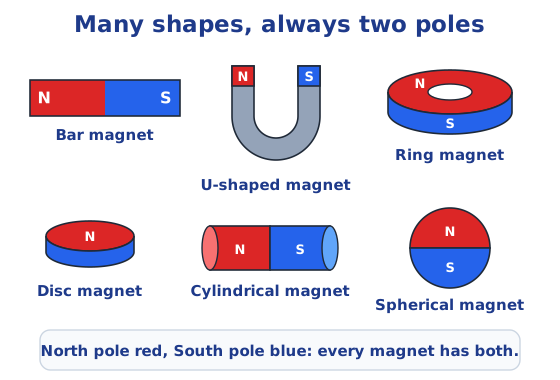
The magnets of early sailors were based on natural magnets called lodestones, discovered in ancient times. Later, people learnt to make magnets from pieces of iron. Today, magnets are made of many materials, and the magnets in school laboratories, pencil boxes, stickers and toys are all artificial magnets. They come in many shapes.
Read more in what is a magnet.
Magnetic and non-magnetic materials
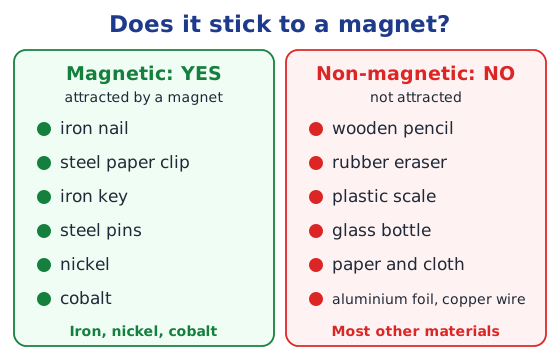
In Activity 4.1, a magnet is brought near objects made of different materials. Some stick to it and others do not. Materials attracted towards a magnet are magnetic materials: iron, and also the metals nickel and cobalt, and some of their mixtures with other metals. Materials not attracted are non-magnetic materials, such as wood, rubber, plastic and glass. Read more in magnetic and non-magnetic materials.
Poles of a magnet
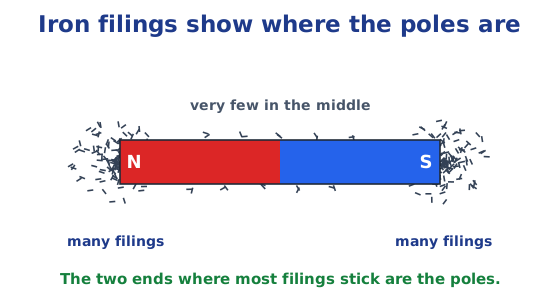
In Activity 4.2, a bar magnet placed over iron filings collects most of them near its two ends, and very few in the middle. These ends are the poles of the magnet: the North pole and the South pole. Most filings stick to the poles of a magnet of any shape. A magnet with a single pole is not possible: break a magnet into pieces and each piece still has a North and a South pole. Read more in poles of a magnet.
Finding directions
In Activity 4.3, a bar magnet hung from a thread tied at its middle always comes to rest along the north-south direction. The end pointing north is the North-seeking pole (North pole), and the other the South-seeking pole (South pole). This happens because the Earth itself behaves like a giant magnet. An iron bar hung the same way can rest in any direction, which gives a way to test whether a piece of metal is a magnet.
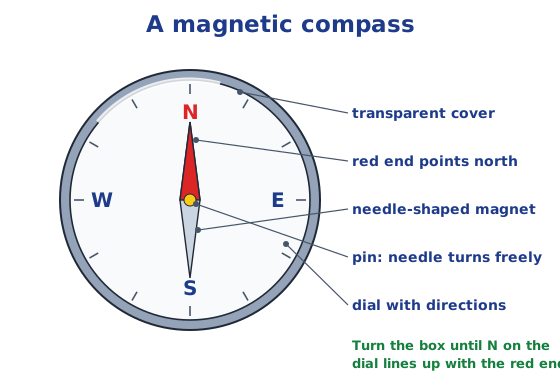
A magnetic compass uses this property. It has a needle-shaped magnet balanced on a pin so it can turn freely, over a dial marked with directions; its north end is usually painted red. In Activity 4.4 you make your own compass by magnetising a sewing needle and floating it on a cork in water. Long ago, Indian sailors used the matsya-yantra, a magnetised fish-shaped iron piece kept in a vessel of oil. Read more in how a compass works.
Attraction and repulsion
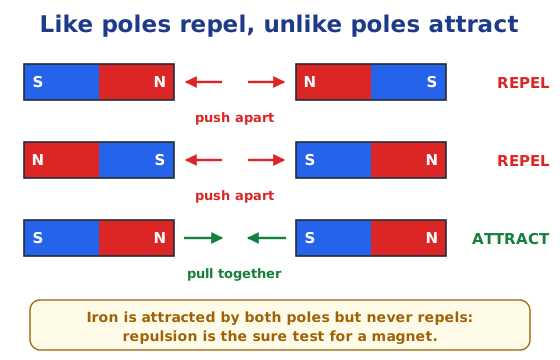
In Activity 4.5, one magnet rests on round pencils so it can roll. When another magnet is brought near, unlike poles (North and South) attract and like poles (North and North, or South and South) repel. An iron bar is attracted by both poles but never repels, so a magnet can be identified by repulsion. In Activity 4.6, a magnet makes a compass needle swing away or towards it, and in Activity 4.7 a sheet of wood, cardboard, plastic or glass between them makes no noticeable difference: the magnetic effect acts through non-magnetic materials. Read more in attraction and repulsion.
Fun with magnets and keeping them safe
Reshma sets up games at her school fair: a garland of pins hanging from a magnet, steel balls guided through a maze by a magnet under the tray, a paper clip lifted out of water without wetting fingers, and two matchbox cars that race apart when like poles face each other. Magnets can move some objects without touching them. Poles may be marked N and S, a white dot for North, or red for North and blue for South.
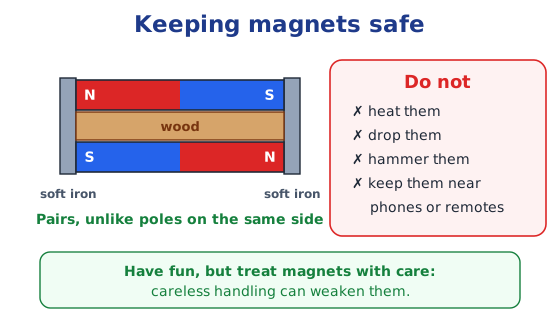
Treat magnets with care. Store them in pairs with unlike poles on the same side, a piece of wood between them and two soft iron pieces across the ends. Do not heat, drop or hammer them, and keep them away from mobile phones and remote controls.
Answers to every activity and question are in the NCERT solutions for Chapter 4.
Key terms
| Term | Meaning |
|---|---|
| Magnet | An object that attracts iron and some other metals and, when freely suspended, rests along the north-south direction. |
| Lodestone | A naturally occurring magnet, discovered in ancient times and used by early sailors. |
| Magnetic materials | Materials that are attracted towards a magnet, such as iron, nickel, cobalt and some of their mixtures with other metals. |
| Non-magnetic materials | Materials that are not attracted towards a magnet, such as wood, rubber, plastic, glass and paper. |
| Poles of a magnet | The two ends of a magnet where most iron filings stick: the North pole and the South pole. They always exist in pairs. |
| North pole of a magnet | The end of a freely suspended magnet that points towards the north; also called the North-seeking pole. |
| South pole of a magnet | The end of a freely suspended magnet that points towards the south; also called the South-seeking pole. |
| Magnetic compass | A small device with a freely rotating needle-shaped magnet over a dial, used to find directions. |
| Attraction | A pull between unlike poles (North and South) of two magnets, or between a magnet and a magnetic material. |
| Repulsion | A push between like poles (North and North, or South and South) of two magnets; it happens only between magnets. |
| Matsya-yantra | An early Indian navigation device: a magnetised fish-shaped iron piece kept in a vessel of oil, also called machchh-yantra. |
Topics in this chapter
Practice
-
Which of these is a magnetic material?
Show answer
Answer: (b) Iron
-
Where do most iron filings stick on a bar magnet?
Show answer
Answer: (b) Near the two ends
-
A freely suspended bar magnet comes to rest along which direction?
Show answer
Answer: (b) North-south
-
The North poles of two magnets are brought close. They will:
Show answer
Answer: (b) repel
-
Which test shows for sure that a bar is a magnet?
Show answer
Answer: (c) It repels a pole of another magnet
Questions students ask
What are the main topics of Class 6 Science Chapter 4?
Natural and artificial magnets and their shapes, magnetic and non-magnetic materials, the poles of a magnet, finding directions with a suspended magnet and a magnetic compass, making a compass, attraction and repulsion between magnets, fun activities with magnets, and keeping magnets safe.
Is Exploring Magnets in the new Curiosity book?
Yes. Exploring Magnets is Chapter 4 of Curiosity, the Class 6 Science textbook (Reprint 2026-27). It comes after Chapter 3, Mindful Eating: A Path to a Healthy Body.
How many questions does Chapter 4 have at the end?
The “Let us enhance our learning” section has 11 questions, followed by Learning further tasks. Our NCERT solutions page answers all of them, along with Activities 4.1 to 4.7 and the in-text questions.
Stuck on a question?
Take a photo and Lagnever AI explains it step by step. Try it for 7 days for ₹2.
Get it on Google Play Open in browser
For parents: after the trial, the plan renews monthly by UPI or card autopay. You can cancel anytime in the app.