
Poles of a magnet
Answer in short
The poles of a magnet are its two ends, where its attraction is strongest and most iron filings stick. They are the North pole, which points north when the magnet hangs freely, and the South pole. Poles always come in pairs: if a magnet is broken, each piece still has both a North and a South pole.
Stuck on a question? Take a photo and Lagnever AI explains it step by step. Try it for 7 days for ₹2. Get it on Google Play
Does every part of a magnet attract equally?
In Activity 4.2, iron filings (very small pieces of iron) are spread on a sheet of paper, and a bar magnet is placed over them. The paper is tapped, and the magnet is examined carefully.
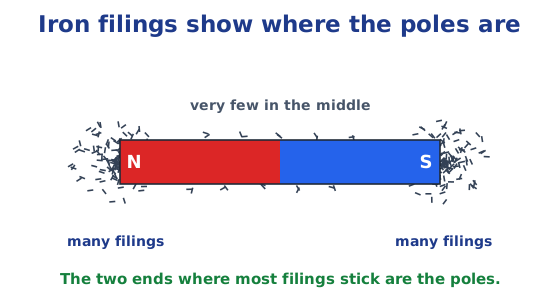
The filings do not stick uniformly. Most of them stick near the two ends of the bar magnet, and very few stick to the rest of it. The attraction of a magnet is strongest at these ends.
North pole and South pole
The two ends of a magnet where its attraction is strongest are its poles: the North pole and the South pole. Repeat the activity with magnets of other shapes and you find the same thing: most filings stick to the poles, whatever the shape.
How do we know which pole is which? Hang a bar magnet freely from a thread tied at its middle. It comes to rest along the north-south direction. The end that points towards the north is the North-seeking pole, or North pole; the end that points towards the south is the South-seeking pole, or South pole. Read more in how a compass works.
Poles always come in pairs
Can we get a magnet with a single pole? No. If a magnet is broken into smaller pieces, North and South poles always exist in pairs, even in the smallest piece. A single North pole or a single South pole cannot exist.
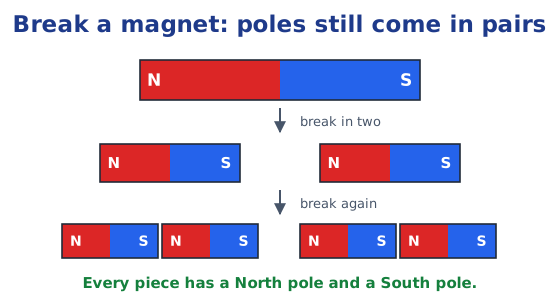
This is true for every shape: bar, U-shaped, ring, disc, cylindrical or spherical. The poles of a ring or disc magnet are usually on its two flat faces (Extra), while a U-shaped magnet has its poles at the two tips.
How poles behave with each other
When two magnets are brought close, like poles repel (North-North or South-South) and unlike poles attract (North-South). This is how we can find the poles of an unmarked magnet using one with marked poles: if an end is repelled by the marked North pole, that end is a North pole too. Read more in attraction and repulsion.
Marking the poles
Magnets are marked in different ways:
- N and S letters on the two ends.
- A white dot to show the North pole.
- Red paint for the North pole and blue for the South pole.
A compass needle follows the same idea: its north-pointing end is usually painted red.
Finding the poles of an unmarked magnet
- Without another magnet: hang it freely from a thread. The end that settles towards the north is its North pole.
- With a marked magnet: bring the marked North pole near one end. Repulsion means that end is a North pole; attraction means it is a South pole (confirm with repulsion from the other end).
- With iron filings: these show where the poles are, but not which is North and which is South.
For what magnets attract, read magnetic and non-magnetic materials. For the textbook’s questions, see the Chapter 4 NCERT solutions; for the whole chapter, see the Chapter 4 notes.
Practice
-
When a bar magnet is placed over iron filings, most filings stick:
Show answer
Answer: (b) near the two ends
-
A magnet is broken into three pieces. How many poles does each piece have?
Show answer
Answer: (b) Two
-
On some magnets, the North pole is marked by:
Show answer
Answer: (a) a white dot
-
Why is the North pole of a magnet called the North-seeking pole?
Show answer
Answer: Because when the magnet is freely suspended, this end always turns to point towards the north.
-
How can you find the poles of a magnet using iron filings?
Show answer
Answer: Place the magnet over iron filings and tap the paper. The places where most filings stick are the poles, near the two ends of the magnet.
Questions students ask
What are the poles of a magnet?
The two ends of a magnet where its attraction is strongest and where most iron filings stick. They are called the North pole and the South pole.
Can a magnet have only one pole?
No. Poles always exist in pairs. If a magnet is broken into smaller pieces, each piece, even the smallest, has both a North pole and a South pole.
How are the poles of a magnet marked?
In some magnets the poles are marked N and S. In others the North pole is shown by a white dot, and sometimes the North pole is painted red and the South pole blue.
Stuck on a question?
Take a photo and Lagnever AI explains it step by step. Try it for 7 days for ₹2.
Get it on Google Play Open in browser
For parents: after the trial, the plan renews monthly by UPI or card autopay. You can cancel anytime in the app.