
NCERT Solutions Class 6 Science Chapter 4: Exploring Magnets
Answers to Activities 4.1 to 4.7, the in-text questions, the fun activities and all 11 questions of “Let us enhance our learning” in Chapter 4, Exploring Magnets, of Curiosity (Reprint 2026-27). The page numbers match the book. Activities you do yourself have sample answers. Short notes: Chapter 4 notes.
Magnets around us (pages 61–62)
Do magnets stick to objects made of certain materials only? Yes. They stick only to objects made of magnetic materials, such as iron, nickel and cobalt, and not to wood, plastic or glass.
Activity 4.1: magnetic and non-magnetic materials (pages 62–64)
Table 4.1, sample entries:
| Object | Material | Prediction | Observation |
|---|---|---|---|
| Pencil | Wood | No | No |
| Eraser | Rubber | No | No |
| Nail | Iron | Yes | Yes |
| Paper clip | Steel | Yes | Yes |
| Key | Iron | Yes | Yes |
| Scale | Plastic | No | No |
| Bottle | Glass | No | No |
| Wire | Copper | Yes (a metal) | No |
Was the prediction correct? Not always: many people expect every metal to stick, but copper, aluminium and brass do not. Which materials stuck? Iron and steel objects. Conclusion: only some materials, the magnetic materials, are attracted by a magnet. Non-magnetic materials in the table: wood, rubber, plastic, glass and copper.
Do all parts of a magnet attract equally? No: see Activity 4.2.
Activity 4.2: poles of a magnet (pages 64–65)
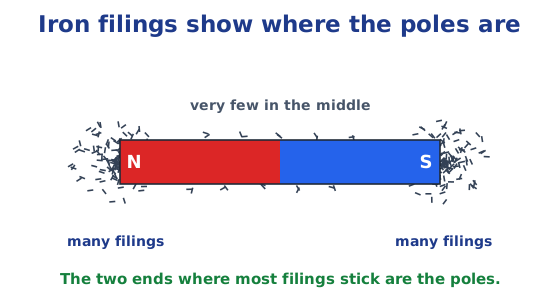
Most iron filings stick near the two ends of the bar magnet and very few in the middle; the filings do not stick uniformly. With magnets of other shapes, the result is the same: most filings stick at the poles. Can we find a magnet with a single pole? No: even the smallest piece of a broken magnet has both a North and a South pole.
Activity 4.3: finding directions (pages 65–66)
Does the magnet rest along the same line? Yes, every time it comes to rest along the same line. What direction does the line show? North-south. Find it from the Sun: face the place where the Sun rises (east); north is on your left. An iron bar in place of the magnet can rest along any direction, so only magnets settle north-south.
Activity 4.4: make your own compass (page 67)
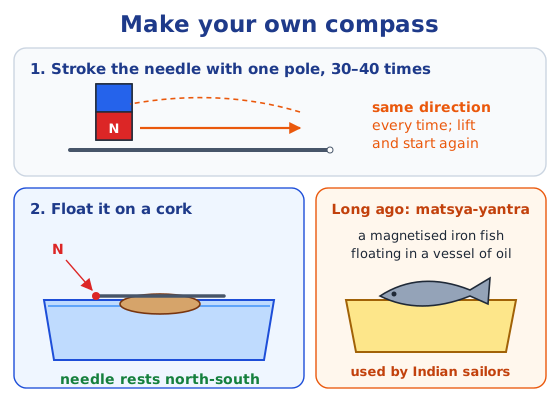
After 30 to 40 strokes with the same pole in the same direction, the needle attracts steel pins: it has become a magnet. Floated on the cork, its ends always point in the same directions, north and south, however often the cork is turned. How can we make our own compass? Exactly this way.
Activity 4.5: two magnets (pages 68–69)
What happens when we bring two magnets closer? Magnet A on the pencils rolls towards B when unlike poles face each other and away when like poles face each other. It does not always move towards the approaching magnet. These observations suggest that unlike poles attract and like poles repel. With an iron bar in place of one magnet, both ends of the iron bar are attracted by both poles: a magnet is identified by repulsion.
Activity 4.6: a magnet and a compass (pages 69–70)
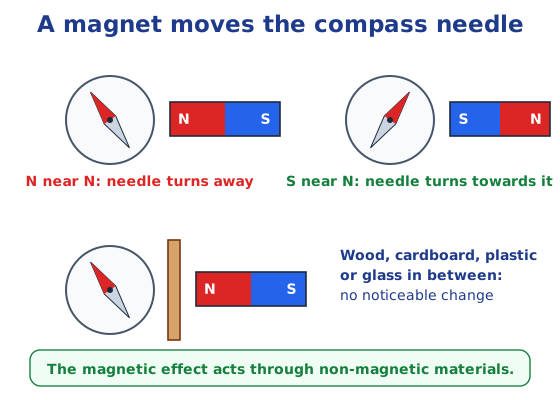
Does the needle deflect? Yes. With the North pole of the bar magnet near the North end of the needle, the needle’s North end moves away. With the South pole, it moves closer. The compass needle is also a magnet, so it behaves the same way.
Activity 4.7: magnetism through materials (pages 70–71)
Table 4.2:
| Material in between | Observation |
|---|---|
| Wood | No noticeable change in deflection |
| Cardboard | No noticeable change |
| Plastic | No noticeable change |
| Glass | No noticeable change |
The magnetic effect acts through non-magnetic materials.
Fun with magnets (pages 71–72)
- Garland: yes. Hang a steel pin or clip from a magnet, then another from it, and so on; each one attracts the next.
- Maze: yes. A magnet moved under the cardboard tray pulls the steel balls along, because its effect acts through cardboard.
- Paper clip in water: hold the magnet against the outside of the glass near the clip and slide it up to the rim; nothing gets wet.
- Matchbox cars: with like poles facing, the cars run away from each other.
Let us enhance our learning (pages 74–76)
1. Fill in the blanks
(i) Unlike poles of two magnets attract each other, whereas like poles repel each other. (ii) The materials that are attracted towards a magnet are called magnetic materials. (iii) The needle of a magnetic compass rests along the north-south direction. (iv) A magnet always has two poles.
2. True or false
(i) False: breaking a magnet always gives pieces with both poles. (ii) True: similar (like) poles repel each other. (iii) False: iron filings stick mostly near the ends (poles), not in the middle. (iv) True.
3. Column I and Column II
| Column I | Column II |
|---|---|
| N – N | Repulsion |
| N – S | Attraction |
| S – N | Attraction |
| S – S | Repulsion |
4. Atharv’s U-clips
Option (i): 10, 2, 10. Positions A and C are the two ends (poles) of the bar magnet, where attraction is strongest, and B is the middle, where very few clips stick.
5. Reshma’s three bars
Bring the bars near each other in pairs, end to end, and turn them around. If two bars repel each other in some position, both are magnets. The bar that is attracted at every end and never repels is the piece of iron.
6. Finding the poles of an unmarked magnet
Bring the North pole of the marked magnet near one end of the unmarked magnet. If that end is repelled, it is a North pole; if it is attracted, it is a South pole. Check the other end with the marked South pole: repulsion confirms it is a South pole.
7. Finding the North pole without another magnet
Tie a thread to the middle of the bar magnet and hang it freely, away from iron objects (or float it on a piece of wood in water). When it comes to rest, the end pointing towards the north (use the rising Sun in the east to find north) is its North pole.
8. The poles of the Earth’s magnet
The North pole of a compass needle points towards the geographic north. Since unlike poles attract, the Earth’s magnet must have its South pole near the geographic north and its North pole near the geographic south.
9. The mechanic’s screwdriver
Magnetise the tip of the screwdriver by stroking it many times in one direction with one pole of a magnet, as with the sewing needle, or fix a small magnet to it. Steel screws are magnetic, so they will cling to the screwdriver instead of falling.
10. The two ring magnets
Magnet X stays above Y because their facing sides are like poles, which repel each other, so X floats. To bring X into contact with Y without pushing, lift X off, turn it upside down and put it back: now unlike poles face each other and attract, so X moves down onto Y.
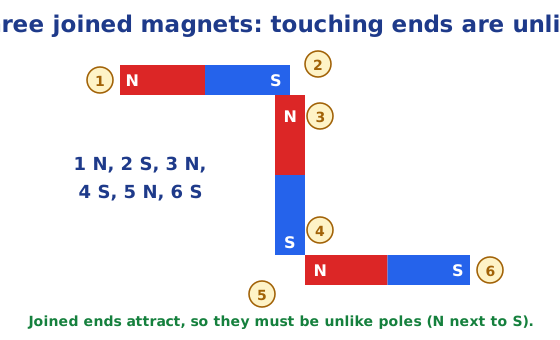
11. Three bar magnets
Magnets that stay joined end to end attract, so the touching ends are unlike poles. End 5 is N, so 4 is S, the other end of that magnet 3 is N, 2 is S, and 1 is N. End 6, the other end of the magnet with end 5, is S.
Learning further (pages 76–77)
Different magnets lifting pins: they pick up different numbers because their strength differs, depending on the material, size and shape of the magnet and how strongly it was magnetised; a magnet that has been dropped or heated also gets weaker.
Hopping frog: with ring magnets fixed along the scale in alternate North-South order, the frog’s ring magnet is pushed up when it passes over a like pole and pulled down over an unlike pole, so the frog seems to hop.
Extra: the starting points below go beyond the book; check the details in books or reliable websites.
Maglev train: ‘maglev’ means magnetic levitation. Powerful magnets lift the train slightly above its track and push it forward, so there is very little friction and it can travel very fast. A model can use ring magnets on a track and on a light card ‘train’ with like poles facing.
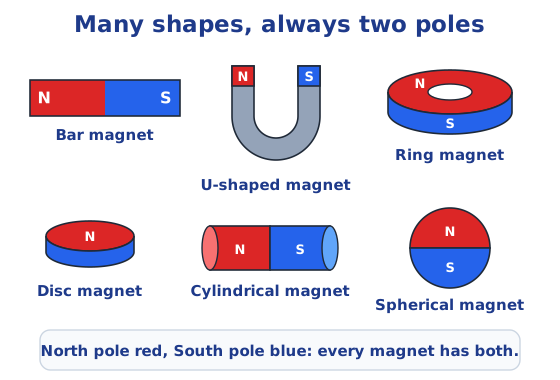
Why different shapes? Each job needs a different shape: U-shaped magnets bring both poles together to lift things, ring magnets are used in loudspeakers, disc magnets in fridge magnets and bag clasps, and bar magnets in experiments.
Magnets in medicine: MRI scanners use very strong magnets to make pictures of the inside of the body, and doctors have used magnets to pull tiny iron pieces out of injured eyes.
For more practice, read what is a magnet, poles of a magnet, magnetic and non-magnetic materials, how a compass works and attraction and repulsion.
Practice
-
Which of these metals is magnetic?
Show answer
Answer: (c) Cobalt
-
Soft iron pieces placed across the ends of stored magnets help to:
Show answer
Answer: (b) keep them strong
-
In the hopping frog toy, the ring magnets on the scale are fixed:
Show answer
Answer: (c) alternately North and South
-
Why does a magnetised needle on a cork turn to point north-south?
Show answer
Answer: The needle has become a magnet, and a magnet that can turn freely rests along the north-south direction because the Earth behaves like a giant magnet.
-
Name two places where magnets are used in medicine.
Show answer
Answer: Extra: MRI scanners in hospitals use very strong magnets to make pictures of the inside of the body, and doctors have used magnets to pull tiny iron pieces out of injured eyes.
Stuck on a question?
Take a photo and Lagnever AI explains it step by step. Try it for 7 days for ₹2.
Get it on Google Play Open in browser
For parents: after the trial, the plan renews monthly by UPI or card autopay. You can cancel anytime in the app.