
How does a magnetic compass work?
Answer in short
A magnetic compass works because a freely suspended magnet always comes to rest along the north-south direction, as the Earth behaves like a giant magnet. Its needle is a small magnet balanced on a pin so it turns freely. When the needle rests, the box is turned until N and S on the dial line up with it.
Stuck on a question? Take a photo and Lagnever AI explains it step by step. Try it for 7 days for ₹2. Get it on Google Play
A magnet that points the way
In Reshma’s story, sailors caught in a storm cannot see the stars. How can they find directions? The answer lies in a special property of magnets.
In Activity 4.3, a bar magnet is hung from a thread tied to its middle so that it balances horizontally. It is gently turned and allowed to come to rest, and the positions of its ends are marked on the ground and joined with a line. Turn it again and again: it always comes to rest along the same line.
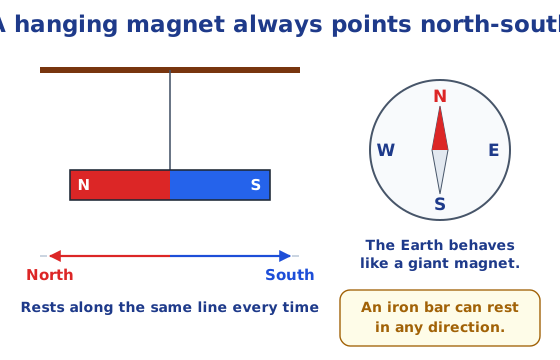
Which direction is this line? If you know where the Sun rises (east) or sets (west), you can work it out: the magnet rests along the north-south direction. The end pointing north is the North pole of the magnet, and the other end is the South pole.
Why north-south?
A freely suspended magnet rests along the north-south direction because the Earth itself behaves like a giant magnet. Repeat the activity with a plain iron bar and it can rest in any direction. So only magnets settle north-south, and this gives a simple test of whether a piece of metal is a magnet.
Parts of a magnetic compass
The north-south property is used in a small device, the magnetic compass, developed long ago for finding directions.
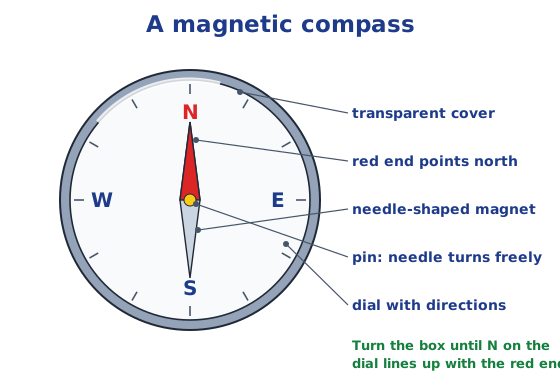
- A small circular box with a transparent cover.
- A needle-shaped magnet, mounted on a pin so that it can rotate freely.
- The north-pointing end of the needle is usually painted red.
- Below the needle, a dial with directions marked on it.
How to use a compass
- Keep the compass flat at the place where you want to know the directions.
- Wait until the needle comes to rest along the north-south direction.
- Gently rotate the box until N and S on the dial line up with the needle.
- Now all directions at that place are as shown on the dial.
Keep magnets, iron objects and phones away while using it, as they disturb the needle.
Make your own compass
In Activity 4.4, you need a cork, an iron sewing needle, a bar magnet, a glass bowl and water.
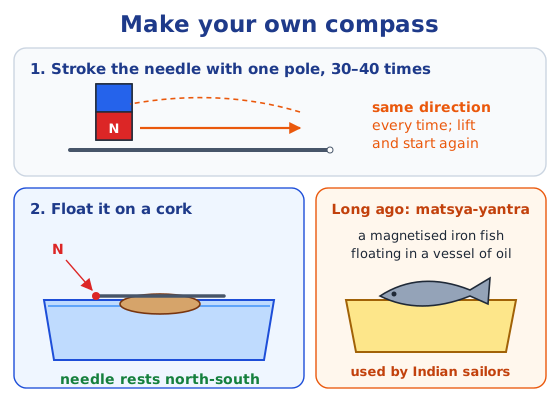
- Lay the needle on a wooden table. Put one pole of the magnet at one end of the needle and move it along the needle to the other end, then lift it.
- Bring the same pole back to the same starting end and repeat, at least 30 to 40 times.
- Bring iron filings or steel pins near the needle: if they are attracted, it has become a magnet.
- Pass the needle through a cork horizontally and float the cork in a bowl of water, with the needle above the water.
When the needle rests, note where its ends point. Turn the cork gently and let it settle again: the ends always point the same way, north and south.
The matsya-yantra
Long before the modern compass became common, Indians used a similar device for navigation at sea: a magnetised fish-shaped iron piece kept in a vessel of oil, called matsya-yantra or machchh-yantra.
Can a magnet near a compass change where the needle points? Read attraction and repulsion. For the textbook’s questions, see the Chapter 4 NCERT solutions; for the whole chapter, see the Chapter 4 notes.
Practice
-
A freely suspended magnet comes to rest along the:
Show answer
Answer: (b) north-south direction
-
The end of a compass needle that points north is usually painted:
Show answer
Answer: (a) red
-
The matsya-yantra used by Indian sailors had a magnetised iron fish kept in a vessel of:
Show answer
Answer: (b) oil
-
How do you set up a compass to read directions?
Show answer
Answer: Keep it at the place where you want the directions and wait for the needle to rest. Then gently rotate the box until N and S on the dial line up with the needle. All directions at that place are now as shown on the dial.
-
How can you check that a sewing needle has become a magnet after rubbing it with a magnet?
Show answer
Answer: Bring iron filings or steel pins near it. If they are attracted, the needle has become a magnet. Floated on a cork in water, it will also settle along the north-south direction.
Questions students ask
Why does a freely suspended magnet point north-south?
Because the Earth itself behaves like a giant magnet. A magnet that can turn freely lines up along the north-south direction, with its North pole pointing north.
What are the parts of a magnetic compass?
A small round box with a transparent cover, a needle-shaped magnet balanced on a pin so that it can rotate freely, and a dial with directions marked on it below the needle. The north-pointing end of the needle is usually painted red.
What was the matsya-yantra?
An early Indian navigation device used at sea long before the modern compass became common. It was a magnetised fish-shaped iron piece kept in a vessel of oil, also called machchh-yantra.
Stuck on a question?
Take a photo and Lagnever AI explains it step by step. Try it for 7 days for ₹2.
Get it on Google Play Open in browser
For parents: after the trial, the plan renews monthly by UPI or card autopay. You can cancel anytime in the app.