
Magnetic and non-magnetic materials
Answer in short
Magnetic materials are attracted towards a magnet: iron, nickel, cobalt and some of their mixtures with other metals, so most steel objects stick. Non-magnetic materials, such as wood, rubber, plastic, glass, paper, aluminium and copper, are not attracted. A magnet's effect also passes through non-magnetic materials like wood, cardboard, plastic and glass.
Stuck on a question? Take a photo and Lagnever AI explains it step by step. Try it for 7 days for ₹2. Get it on Google Play
Do magnets stick to everything?
Do magnets stick only to objects made of certain materials? In Activity 4.1, you collect objects made of different materials, such as a pencil, an eraser, a key, a nail, a plastic scale, a glass bottle and a paper clip. First you predict which ones will stick to a magnet, then you bring a magnet near each one and observe, recording both in Table 4.1.
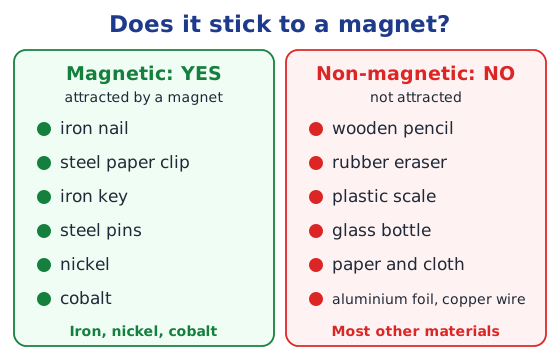
Magnetic materials
Some objects stick to the magnet. Materials that are attracted towards a magnet are called magnetic materials.
- Iron is a magnetic material. Most steel objects, such as pins, paper clips and nails, are attracted too, because steel is mostly iron.
- Nickel and cobalt are other metals that are also magnetic.
- Some combinations (mixtures) of these metals with other metals are also attracted towards magnets.
Extra: some stainless steel spoons and utensils are only weakly attracted or not at all, because of the other metals mixed in, so test before you predict.
Non-magnetic materials
Materials that are not attracted towards a magnet are called non-magnetic materials. Wood (pencil), rubber (eraser), plastic, glass, paper and cloth are non-magnetic. Many metals are non-magnetic too: aluminium, copper and brass are not attracted. So you cannot say that a magnet attracts all metals.
Sample Table 4.1
| Object | Material | Attracted? |
|---|---|---|
| Pencil | Wood | No |
| Eraser | Rubber | No |
| Nail | Iron | Yes |
| Paper clip | Steel | Yes |
| Scale | Plastic | No |
| Bottle | Glass | No |
| Wire | Copper | No |
Why sort materials with a magnet?
Knowing which materials are magnetic is useful. A magnet can quickly pick up pins or needles spilt on the floor. Extra: in scrap yards and recycling plants, large magnets separate iron and steel from other waste such as plastic, glass and aluminium. A magnet can also tell you whether a metal object contains iron: if a ‘metal’ spoon is not attracted, it may be made of aluminium or a kind of stainless steel. Remember that a magnet pulls hardest at its poles, so bring an end of the magnet, not its middle, near the object you are testing.
Magnetism through non-magnetic materials
What if a sheet of some material is placed between a magnet and a compass needle? In Activity 4.7, a magnet first deflects a compass needle. Then, without moving them, a piece of wood is placed between them, followed by cardboard, a thin plastic sheet and a thin glass sheet.
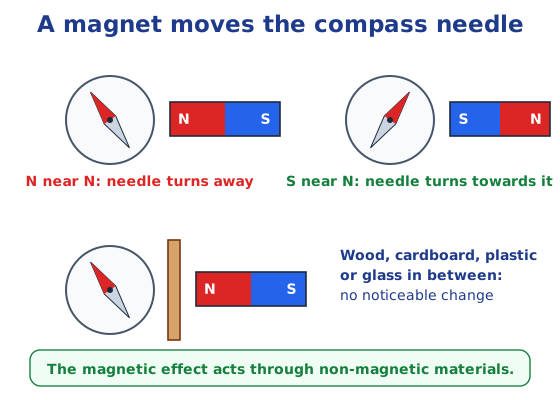
There is no appreciable change in the needle’s deflection. We conclude that the magnetic effect can act through non-magnetic materials.
Fun uses of this idea
- Steel balls in a maze: move a magnet under the cardboard tray and the balls follow it through the maze.
- A paper clip in water: hold a magnet against the outside of the glass and slide it up; the clip follows, and neither your fingers nor the magnet get wet.
- A garland: hang steel pins one below another from a magnet; each pin attracts the next.
Magnets can move some objects without touching them. To find where a magnet pulls hardest, read poles of a magnet. For the textbook’s questions, see the Chapter 4 NCERT solutions; for the whole chapter, see the Chapter 4 notes.
Practice
-
Which metal is NOT attracted by a magnet?
Show answer
Answer: (d) Copper
-
A steel paper clip is attracted by a magnet because steel is mostly:
Show answer
Answer: (b) iron
-
A sheet of glass is placed between a magnet and a compass. The needle's deflection:
Show answer
Answer: (b) does not change noticeably
-
How can you pick a steel paper clip out of a glass of water without wetting your fingers or the magnet?
Show answer
Answer: Hold the magnet against the outside of the glass near the clip and slide it upwards. The magnetic effect acts through the glass and water, so the clip follows the magnet up to the rim.
-
Sort these into magnetic and non-magnetic: iron nail, rubber band, steel spoon, plastic comb, iron key, wooden ruler.
Show answer
Answer: Magnetic: iron nail, iron key and, usually, the steel spoon. Non-magnetic: rubber band, plastic comb, wooden ruler.
Questions students ask
What are magnetic materials?
Materials that are attracted towards a magnet. The metal iron is magnetic, and so are nickel and cobalt and some of their combinations with other metals.
What are non-magnetic materials?
Materials that are not attracted towards a magnet, such as wood, rubber, plastic, glass, paper and cloth, and metals such as aluminium and copper.
Can a magnet act through other materials?
Yes. When a sheet of wood, cardboard, plastic or glass is placed between a magnet and a compass needle, the needle's deflection does not change noticeably, so the magnetic effect acts through non-magnetic materials.
Stuck on a question?
Take a photo and Lagnever AI explains it step by step. Try it for 7 days for ₹2.
Get it on Google Play Open in browser
For parents: after the trial, the plan renews monthly by UPI or card autopay. You can cancel anytime in the app.