
Attraction and repulsion between magnets
Answer in short
When two magnets are brought close, unlike poles (North and South) attract each other and like poles (North and North, or South and South) repel. An iron bar is attracted by both poles of a magnet but is never repelled, so repulsion is the sure way to identify a magnet. A magnet also turns a compass needle.
Stuck on a question? Take a photo and Lagnever AI explains it step by step. Try it for 7 days for ₹2. Get it on Google Play
What happens when two magnets meet?
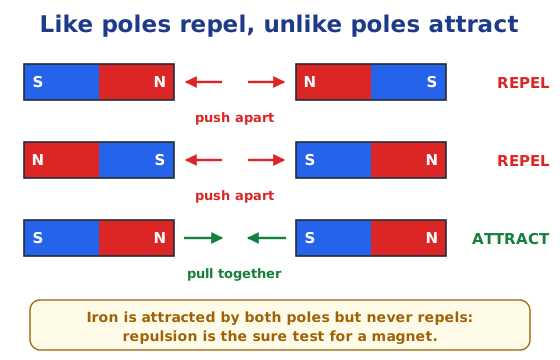
In Activity 4.5, you take two bar magnets, A and B, with their poles marked. Magnet A is laid over 5 or 6 round pencils so that it can roll easily. Then one end of magnet B is brought near one end of magnet A, without touching. Next, the other end of B is brought near the same end of A.
Sometimes magnet A rolls towards magnet B, and sometimes it rolls away. The poles decide what happens:
- Unlike poles attract: the North pole of one magnet and the South pole of another pull each other.
- Like poles repel: two North poles, or two South poles, push each other away.
The iron bar test
Repeat the activity with an iron bar in place of one magnet. This time, both ends of the iron bar are attracted by both the North and South poles of the magnet. Iron is never repelled. So:
- Attraction happens between a magnet and iron, and also between unlike poles.
- Repulsion happens only between two magnets.
That is why a magnet can be identified by its property of repulsion. Reshma could use this to sort three identical bars: the two that push each other away in some position are the magnets.
A magnet and a compass needle
The compass needle is also a magnet, so it behaves the same way. In Activity 4.6, a compass is kept flat and its needle allowed to rest.
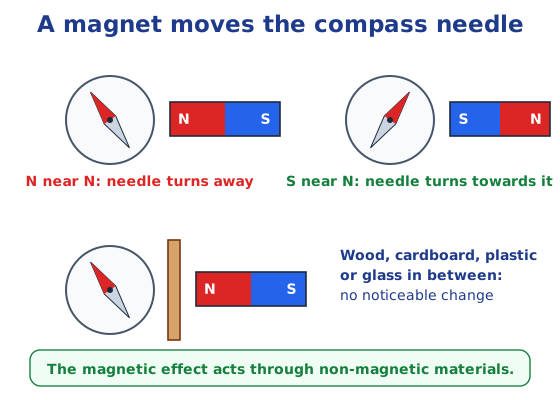
- Bring the North pole of a bar magnet slowly towards the North end of the needle: the needle’s North end moves away.
- Bring the South pole instead: the needle’s North end moves closer.
In Activity 4.7, a sheet of wood, cardboard, plastic or glass is placed between them, and the deflection hardly changes: the magnetic effect acts through non-magnetic materials.
Fun with attraction and repulsion
- Racing cars: fix magnets on two matchbox cars with like poles facing. Push them together and they run away from each other.
- Floating ring magnets: place two ring magnets on a pencil with like poles facing, and the upper one floats above the lower one. Flip it over and the two snap together.
- Hopping frog: fix ring magnets along a scale with poles alternating North and South, and slide a frog with its own ring magnet over them. Over a like pole it is pushed up, over an unlike pole pulled down, so it seems to hop.
- Maglev trains use magnetic repulsion and attraction to float just above their track and move with very little friction (Extra).
Keeping magnets strong
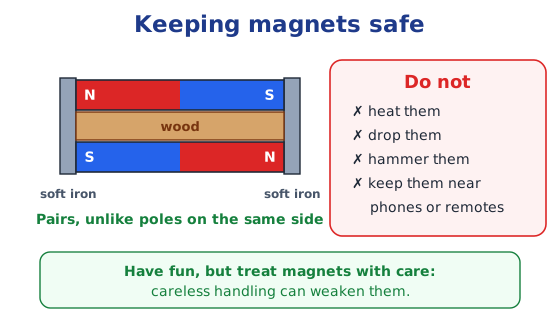
Store bar magnets in pairs with unlike poles on the same side, with a piece of wood between them and two pieces of soft iron across their ends. Do not heat, drop or hammer magnets, and keep them away from mobile phones and remote controls.
For where the poles are, read poles of a magnet. For the textbook’s questions, see the Chapter 4 NCERT solutions; for the whole chapter, see the Chapter 4 notes.
Practice
-
The South pole of one magnet is brought near the North pole of another. They will:
Show answer
Answer: (b) attract
-
Which pair repels?
Show answer
Answer: (c) S and S
-
The North pole of a bar magnet is brought near the North end of a compass needle. The needle's North end will:
Show answer
Answer: (a) move away
-
Why is repulsion a surer test of a magnet than attraction?
Show answer
Answer: A magnet attracts both a piece of iron and the unlike pole of another magnet, so attraction cannot tell them apart. Only two magnets can repel each other, so repulsion proves that a bar is a magnet.
-
Two matchbox cars carry magnets with like poles facing each other. What happens when they are pushed close?
Show answer
Answer: The like poles repel, so the cars move away from each other instead of crashing together.
Questions students ask
Do like poles of magnets attract or repel?
Like poles repel. Two North poles push each other away, and so do two South poles. Unlike poles, a North and a South, attract each other.
How can you tell a magnet from a piece of iron?
Bring each end near a pole of a known magnet. Iron is attracted at both ends and never pushed away. If one end is repelled, the bar is a magnet.
Can a magnet affect a compass needle?
Yes. The compass needle is itself a magnet. The North pole of a magnet pushes the North end of the needle away, and the South pole pulls it closer.
Stuck on a question?
Take a photo and Lagnever AI explains it step by step. Try it for 7 days for ₹2.
Get it on Google Play Open in browser
For parents: after the trial, the plan renews monthly by UPI or card autopay. You can cancel anytime in the app.