
What is a magnet?
Answer in short
A magnet is an object that attracts iron and a few other metals such as nickel and cobalt. Its pull is strongest at its two ends, the North and South poles, and a freely hanging magnet rests along the north-south direction. Natural magnets are lodestones; most magnets we use are artificial and come in many shapes.
Stuck on a question? Take a photo and Lagnever AI explains it step by step. Try it for 7 days for ₹2. Get it on Google Play
Magnets around us
Look around: a pencil box or purse that snaps shut, the duster that sticks to your class writing board, stickers on a fridge, magnetic toys. All of these have magnets. In the chapter, Reshma had seen such magnets many times but never looked at them carefully, until a story she was writing needed a way for sailors to find directions without stars.
A magnet is an object that attracts iron and a few other metals. It also has a remarkable property: when it can turn freely, it always comes to rest along the north-south direction.
Natural and artificial magnets
The magnets used by sailors in olden days were based on naturally occurring magnets, called lodestones, which were discovered in ancient times. Later, people found that magnets could also be made from pieces of iron. Nowadays, magnets are made of many different materials. The magnets in your school laboratory, and those used in pencil boxes, stickers and toys, are all artificial magnets.
Shapes of magnets
People make magnets in different shapes and sizes as their needs require.
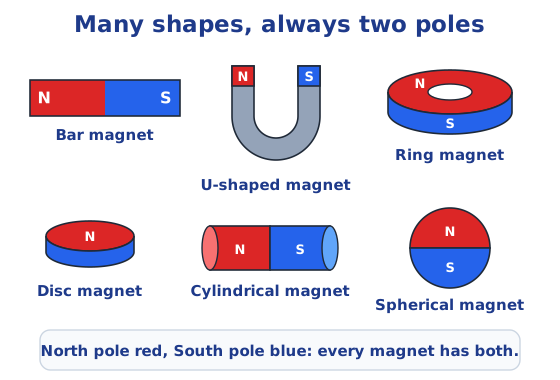
- Bar magnet: a rectangular bar, common in laboratories.
- U-shaped magnet: bent like the letter U, with both poles side by side.
- Ring magnet: a flat ring with a hole in the middle.
- Disc, cylindrical and spherical magnets: flat coins, rods and balls.
As the magnet in the book says, its poles always occur in pairs, no matter its shape. Extra: in a ring or disc magnet, the two poles are usually on its two flat faces.
What does a magnet attract?
A magnet attracts magnetic materials: iron, and also the metals nickel and cobalt and some of their mixtures with other metals. It does not attract non-magnetic materials such as wood, rubber, plastic, glass and paper. Many everyday steel objects, such as pins and paper clips, are attracted because steel is mostly iron. Read more in magnetic and non-magnetic materials.
The two poles
A magnet’s attraction is not the same everywhere. Iron filings stick mostly near its two ends, the poles: the North pole and the South pole. Poles always come in pairs; even the tiniest piece of a broken magnet has both. Read more in poles of a magnet.
How to tell if something is a magnet
Two tests work well:
- Hang it freely. A magnet always comes to rest along the north-south direction; an iron bar can rest in any direction.
- Look for repulsion. A magnet repels a like pole of another magnet. An iron bar is attracted by both poles of a magnet but is never repelled, so attraction alone cannot tell a magnet from iron.
Why magnets matter
Magnets help us find directions with a compass, hold things shut, pick up steel pins, and move objects without touching them. Extra: they are also used in loudspeakers, electric motors and hospital scanning machines. Magnets lose strength if they are heated, dropped or hammered, so store them carefully.
To learn how magnets help us find directions, read how a compass works. For the textbook’s questions, see the Chapter 4 NCERT solutions; for the whole chapter, see the Chapter 4 notes.
Practice
-
Naturally occurring magnets are called:
Show answer
Answer: (a) lodestones
-
Which of these is NOT a common shape of magnet?
Show answer
Answer: (d) Liquid
-
The magnets in pencil boxes and toys are:
Show answer
Answer: (b) artificial magnets
-
Give two ways to tell that an object is a magnet.
Show answer
Answer: Freely suspended, it always rests along the north-south direction; and it repels a pole of another magnet. Attracting iron alone is not enough, since an iron bar is also attracted by a magnet.
-
Name three everyday objects that use magnets.
Show answer
Answer: Pencil boxes and purses that close with a magnet, the duster of a writing board, fridge stickers, magnetic toys and the compass.
Questions students ask
What is a magnet?
An object that attracts iron and some other metals, such as nickel and cobalt. It has two poles, North and South, where its attraction is strongest, and when freely suspended it rests along the north-south direction.
What is a lodestone?
A naturally occurring magnet, discovered in ancient times. The magnets used by sailors in olden days were based on lodestones; later, people learnt to make magnets from pieces of iron.
What shapes do magnets come in?
Bar, U-shaped, ring, disc, cylindrical and spherical magnets are common. Whatever the shape, the poles always occur in pairs, a North pole and a South pole.
Stuck on a question?
Take a photo and Lagnever AI explains it step by step. Try it for 7 days for ₹2.
Get it on Google Play Open in browser
For parents: after the trial, the plan renews monthly by UPI or card autopay. You can cancel anytime in the app.