
NCERT Solutions Class 8 Science Chapter 6: Pressure, Winds, Storms, and Cyclones
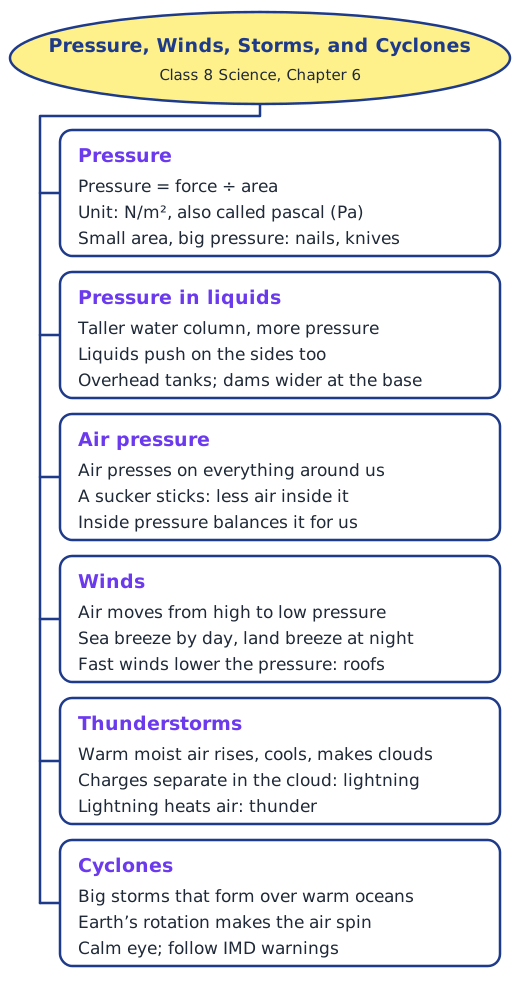
Answers to Probe and ponder, the questions inside the chapter, Activities 6.1 to 6.6, all thirteen Keep the curiosity alive questions and the Discover, design, and debate projects in Chapter 6, Pressure, Winds, Storms, and Cyclones, of Curiosity, the Grade 8 science textbook. Page numbers follow the 2026-27 reprint (pages 80–97). Short notes: Chapter 6 notes.
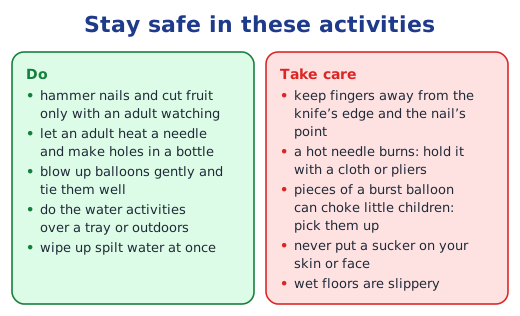
Stay safe. Hammer nails and cut fruit only with an adult watching. Let an adult heat the needle and make the holes in the bottle. Blow up balloons gently and pick up the pieces of any that burst. Wipe up spilt water at once.
Probe and ponder (page 80)
Why is it windier on some days than on others? Wind is air moving from a region of high pressure to one of low pressure. On some days the pressure difference between nearby places is large, and the air rushes across fast; on calm days the difference is small.
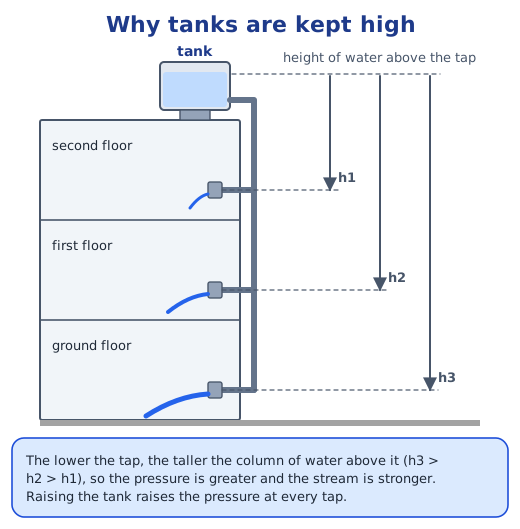
Why do we keep water tanks up high? The pressure of water at a tap depends on the height of the water column above it. A tank placed high gives a tall column, so water reaches the taps at a greater pressure and flows out strongly.
Could the pressure of the air crush us? Air pressure is large: over a 15 cm × 15 cm square, the air pushes with about 2250 N. It does not crush us because the pressure inside our bodies is equal to it and balances it.
What makes storms and cyclones, and would cyclones form if the Earth did not spin? Storms form when warm, moist air rises, leaving low pressure, and cooler air rushes in; the rising air forms clouds and rain. Over warm oceans the heat released by condensing vapour drives the air even higher, and the Earth’s rotation makes the inrushing air spin into a cyclone. Without the rotation, air would still rush into the low-pressure area and large storms could still form, but the air would not be set spinning, so no cyclone would form as the book describes it. (Extra: this is also why cyclones hardly ever form right at the Equator, where the spinning effect of the Earth’s rotation is weakest.)
Share your questions. For example: Why does a pressure cooker have a weight on its lid? Why do my ears feel blocked in a fast lift? Why do cyclones get names?
Inside the chapter (pages 81–93)
Does the wind push on leaves and trees? (page 81) Yes. Wind exerts a force on fallen leaves, trees, doors, windows and clothes on a line, and that force acting on their surfaces is wind pressure. That is why leaves rise, trees bend, doors slam and clothes flutter.
Do the straps really matter? (page 81) Yes. Both bags weigh the same, but narrow straps press that weight onto a small area of the shoulders, giving a large pressure that hurts. Broad straps spread it over a larger area, so the pressure is smaller and the bag is comfortable.
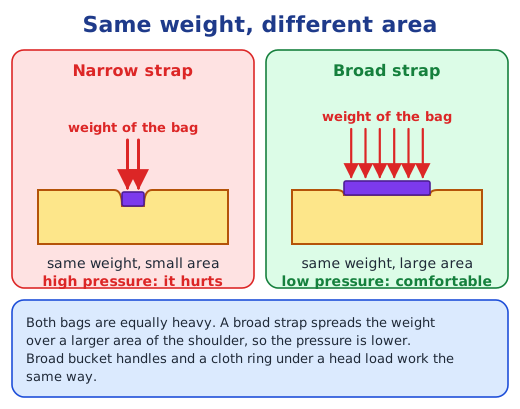
Why is a bucket easier to lift by a broad handle, and why do people put a cloth ring under a head load? (page 82) In both cases the weight acts on a larger area, of the hand or of the head, so the pressure is less and it hurts less.
Pressure on a cardboard (page 82). Pressure = force ÷ area = 100 N ÷ 2 m² = 50 N/m², or 50 Pa.
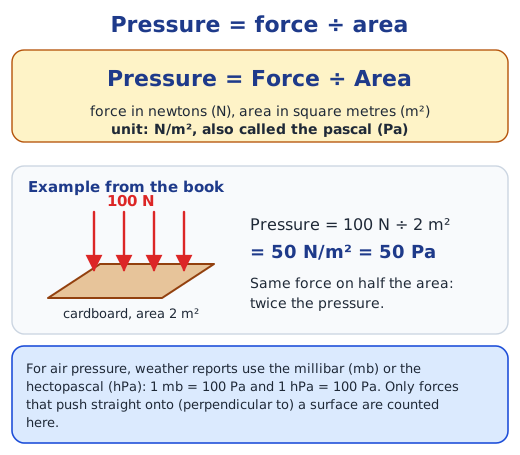
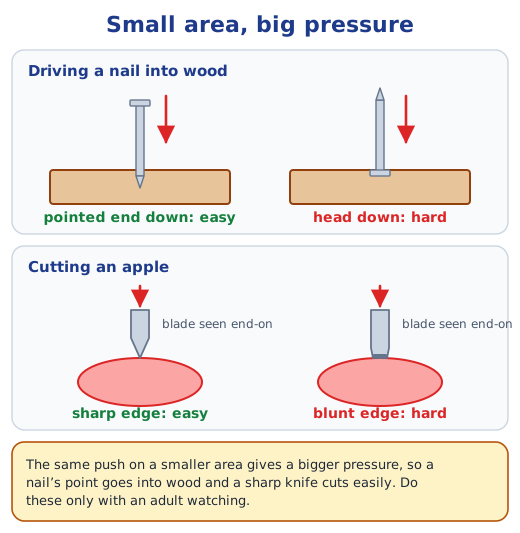
Table 6.1: Record your observations (pages 82–83). Do these only under an adult’s supervision.
| Activity and mode of action | Easy or difficult? | Reason |
|---|---|---|
| Nail, driven by its head | Difficult | The force acts on a large area, so the pressure is small |
| Nail, driven by its pointed end | Easy | The force acts on a tiny area, so the pressure is large |
| Apple, cut with the sharp edge | Easy | A thin edge means a small area and a large pressure |
| Apple, cut with the blunt edge | Difficult | A broad edge spreads the push, so the pressure is small |
Conclusion: the smaller the area on which a force acts, the greater the pressure, and the easier it is to pierce or cut.
Why are overhead tanks always placed at a height? (page 83) Activity 6.1 answers this: liquid pressure grows with the height of the liquid column, so a high tank gives the taps a good stream.
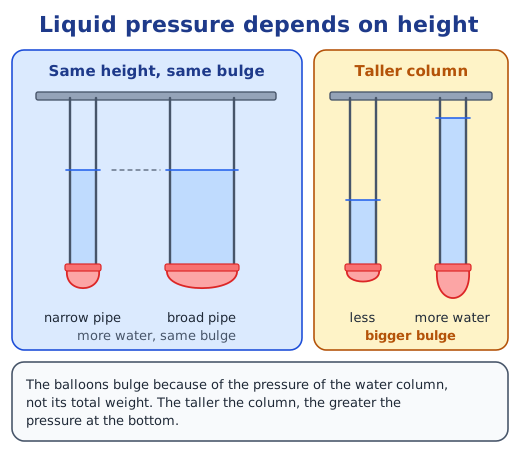
Activity 6.1: Let us try and find out (page 83). Yes, both balloons bulge, and they bulge to the same extent. The water in the wider pipe weighs more, so its weight cannot decide the bulge. The pressure of the water column, which depends on its height, does: equal heights give equal pressures and equal bulges.
What if the water column is made taller? (page 84) The balloon bulges more each time water is added. A taller column gives a greater pressure at the bottom.
You on the second floor, your friend on the first floor: who gets the more powerful stream? (page 84) Your friend on the first floor. The first-floor tap is lower, so the column of water between the tank and that tap is taller, and the pressure there is greater.
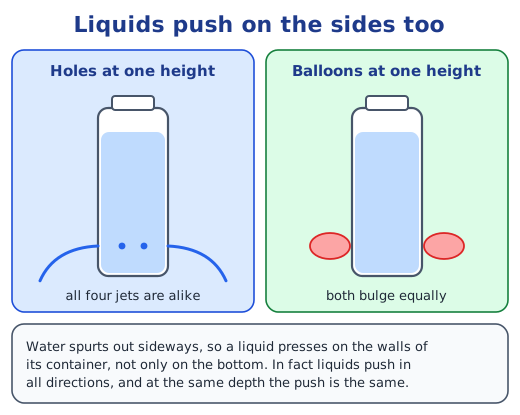
Activity 6.2: Let us find out (pages 84–85). Water flows out through all four holes in the sides of the bottle, in similar jets, since all the holes are equally high. So water presses on the walls of its container as well as the bottom; liquids exert pressure in all directions. Let an adult heat the needle and make the holes.
Why does water spray out of a leaking pipe? (page 85) Yes, it is the pressure of the water on the walls of the pipe. Where there is a gap, that pressure pushes water out as a jet.
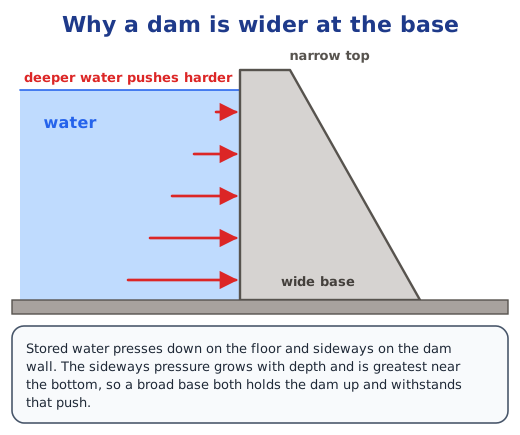
Ever heard of … a dam’s broad base (page 85). The stored water presses sideways on the dam wall, and this push is greatest near the bottom, where the water is deepest. A broad base supports the dam and withstands that push.
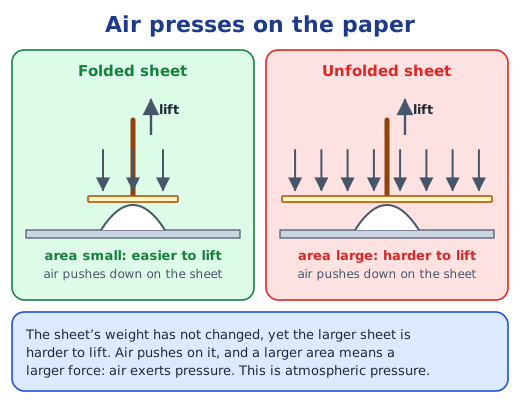
Activity 6.3: Let us explore (pages 85–86). Lifting is easier with the folded chart paper. The unfolded sheet has the same weight but a larger area, and it needs more effort, so air must be pushing on it, with a force that grows with the area. Air exerts pressure on all objects: atmospheric pressure.
Why does a balloon inflate, and why does the air escape from it? (page 86) The air blown in presses on the balloon’s walls from inside, in all directions, so it swells in all directions. With its mouth open, the air inside, at a higher pressure than the air outside, rushes out.
Activity 6.4: Let us perform (page 87). Yes, the sucker sticks, and yes, it is hard to pull off. Pressing pushes most of the air out of its cup, so the pressure inside is low, and the higher air pressure outside holds it on. Pulling it off needs a force big enough to beat that difference.
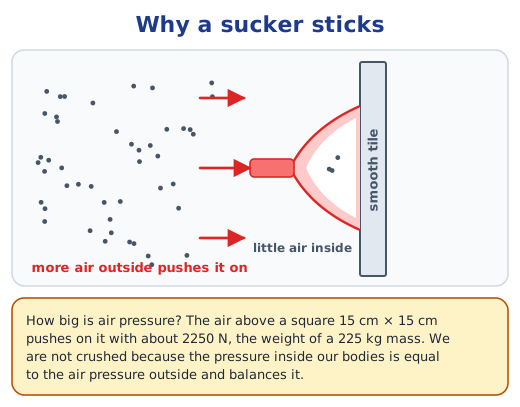
How large is atmospheric pressure? (page 87) On a 15 cm × 15 cm square, about 2250 N, the force of gravity on a 225 kg mass. We are not crushed because the pressure inside our bodies is equal and balances it.
A step further: units of air pressure (page 87). The practical units are the millibar (mb) and the hectopascal (hPa); each equals 100 Pa.
Does escaping air go from high to low pressure? (page 87) Yes. Air escaping from an open balloon or a punctured bicycle tube moves from the high pressure inside to the lower pressure outside.
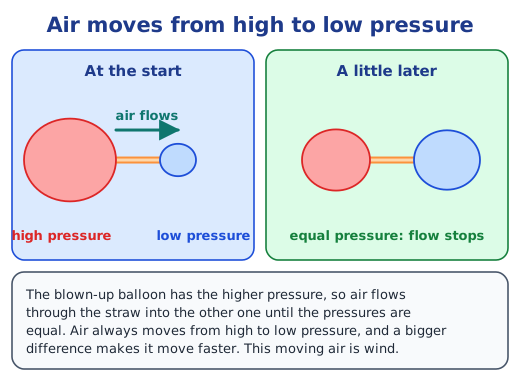
Activity 6.5: Let us observe (page 88). Prediction: air will flow from the inflated balloon into the uninflated one. Observation: the inflated balloon shrinks and the other one grows until both are about the same size, and then the flow stops. The pressure in the inflated balloon was higher, and air flowed until the pressures were equal. So air moves from high to low pressure.
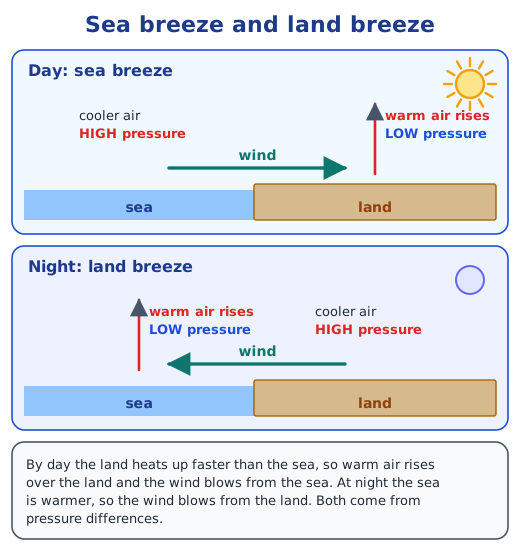
Sea breeze and land breeze (pages 88–89). By day the land heats faster than the sea; warm air over the land rises, leaving low pressure, and air from the higher-pressure sea blows in: a sea breeze. At night the sea is warmer, low pressure forms over it, and the wind blows from the land: a land breeze. A bigger pressure difference would make the air move faster.
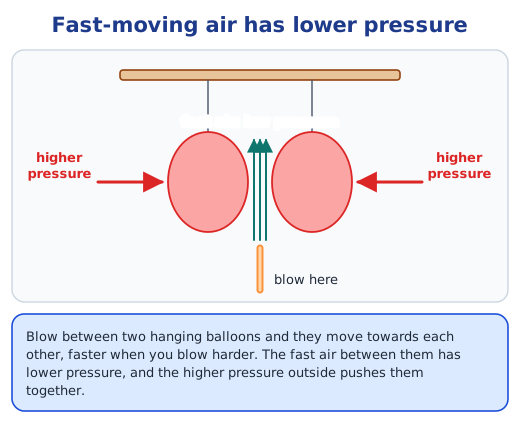
Activity 6.6: Let us observe (page 89). The balloons move towards each other, and faster when you blow harder. Blowing makes fast-moving air with low pressure between them, and the higher pressure outside pushes them together. So high-speed winds come with reduced air pressure.
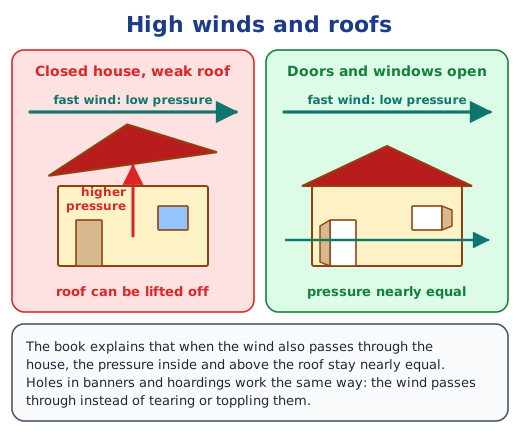
How can high-speed winds blow off roofs? (pages 89–90) A fast wind over a house lowers the pressure above the roof, while the pressure below it, inside the house, stays higher. If the difference is large and the roof is weak, the roof is pushed up and blown away. The book explains that open doors and windows let the wind pass through the house too, so the pressure difference across the roof becomes much smaller.
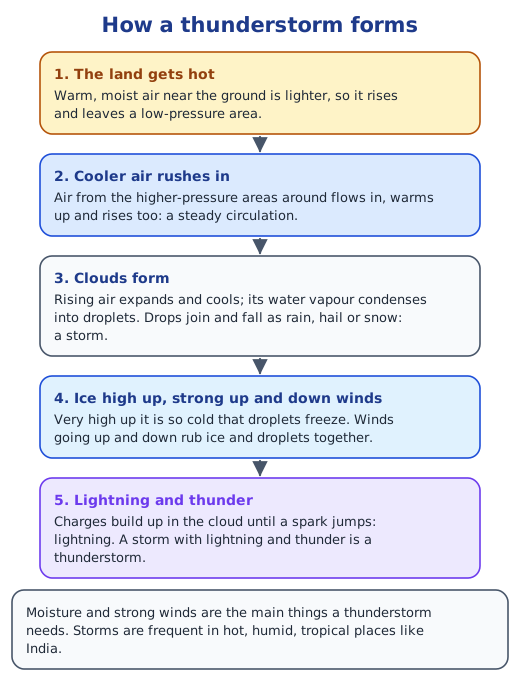
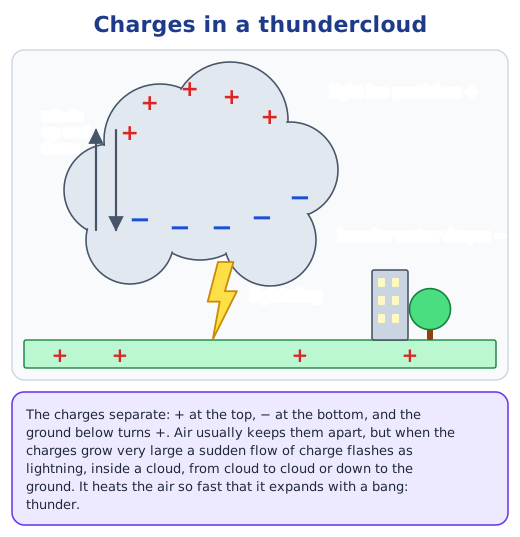
Storms, thunderstorms and lightning (pages 90–91). Heated land makes warm, moist air rise and leave low pressure; cooler air flows in, warms and rises, and the circulation goes on. Rising air cools and forms clouds, and drops fall as rain, hail or snow; strong winds with rain are a storm. High up, droplets freeze into ice. Winds going up and down rub ice and water drops together and charge them: positive ice rises to the top of the cloud, negative drops gather at the bottom, and the ground below becomes positive. When the charges grow very large, the air’s insulation breaks down and charge flows suddenly: lightning, inside a cloud, from cloud to cloud or to the ground. The heated air expands with a loud sound, thunder.
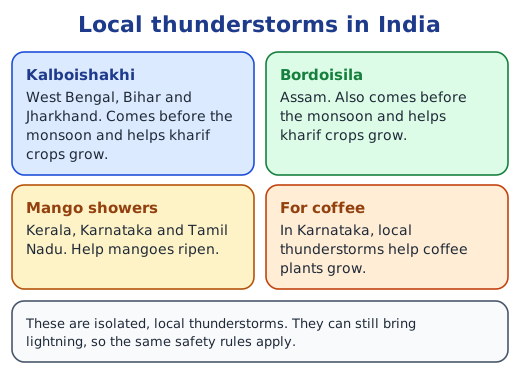
A step further: local thunderstorms (page 91). Kalboishakhi (West Bengal, Bihar and Jharkhand) and Bordoisila (Assam) come before the monsoon and help kharif crops grow; mango showers (Kerala, Karnataka and Tamil Nadu) help mangoes ripen; local thunderstorms in Karnataka help coffee plants grow.
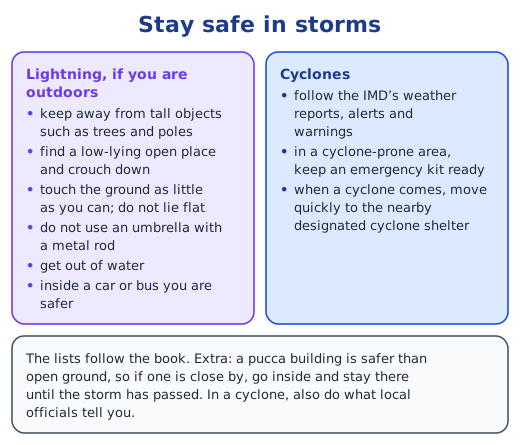
Protecting ourselves from lightning (page 91). Outdoors: keep away from tall things, crouch down in a low-lying open spot, keep your contact with the ground small, and never lie flat. Do not carry an umbrella with a metal rod, leave the water if you are in it, and remember that a car or bus is comparatively safer.
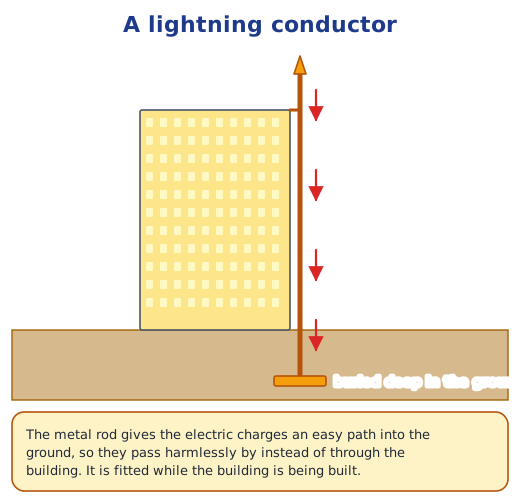
Ever heard of … a lightning conductor (page 92). A metal rod fitted along a building’s wall during construction, pointed at the top above the highest point and buried deep in the ground at the bottom, gives charges an easy path into the ground.
Cyclones (pages 92–93). Over warm oceans, rising moist air condenses and releases heat, rises higher and lowers the pressure further; air rushes in, rises and is set spinning by the Earth’s rotation. The cycle repeats into a cyclone, with a calm eye of lowest pressure, strong winds and heavy rain around it. It weakens over land, but its winds (Amphan, 2020: 270 km/h), a sea surge 3–12 m high, floods, landslides, salt water, blocked roads and power cuts can cause damage that takes months or years to repair.
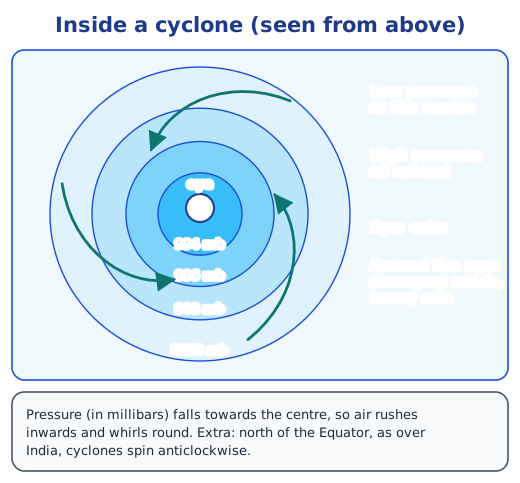
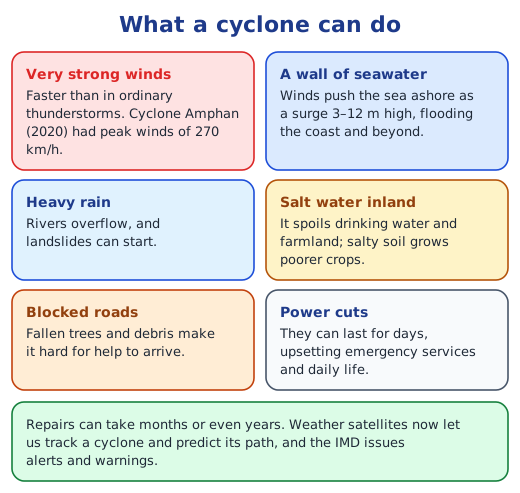
How do we stay safe in a cyclone? (page 93) Keep up with weather reports and with the alerts and warnings that the India Meteorological Department (IMD) issues. People in cyclone-prone areas should keep an emergency kit with essentials ready, and when a cyclone strikes, head quickly for the designated cyclone shelter close by.
Let us wrap up! (page 93) Warm air rises and leaves low pressure; cool air rushes in; the rising air cools and its vapour condenses into clouds; big drops fall as rain, hail or snow; up and down winds charge the cloud; meeting charges make lightning; and under some conditions a storm grows into a cyclone.
Keep the curiosity alive (pages 94–96)
1. “Choose the correct statement.”
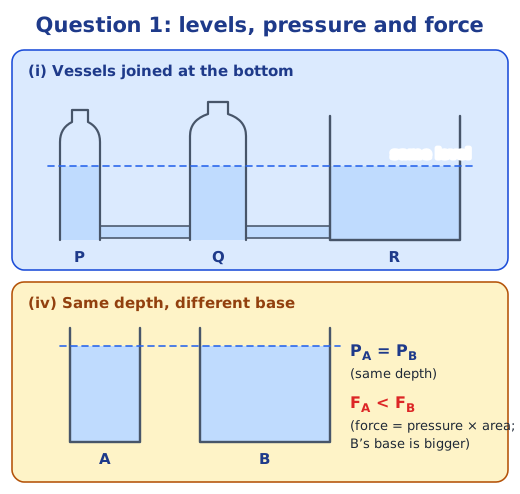
(i) “Look at Fig. 6.21 carefully. Vessel R is filled with water. When pouring of water is stopped, the level of water will be ______. (a) the highest in vessel P (b) the highest in vessel Q (c) the highest in vessel R (d) equal in all three vessels” (d) equal in all three vessels. The vessels are joined at the bottom, so water flows between them until the pressure at the bottom is the same everywhere, which happens only when the water stands at the same height in all three, whatever their shapes.
(ii) “A rubber sucker (M) is pressed on a flat smooth surface and an identical sucker (N) is pressed on a rough surface: (a) Both M and N will stick to their surfaces. (b) Both M and N will not stick to their surfaces. (c) M will stick but N will not stick. (d) M will not stick but N will stick.” (c) M will stick but N will not. On a rough surface, air leaks in through the gaps under the cup, so the pressure inside stays equal to the pressure outside and nothing holds N on.
(iii) “A water tank is placed on the roof of a building at a height ‘H’. To get water with more pressure on the ground floor, one has to (a) increase the height ‘H’ at which the tank is placed. (b) decrease the height ‘H’ at which the tank is placed. (c) replace the tank with another tank of the same height that can hold more water. (d) replace the tank with another tank of the same height that can hold less water.” (a) increase the height H. Pressure depends on the height of the water column, not on how much water the tank holds.
(iv) “Two vessels, A and B contain water up to the same level as shown in Fig. 6.22. PA and PB is the pressure at the bottom of the vessels. FA and FB is the force exerted by the water at the bottom of the vessels A and B. (a) PA = PB, FA = FB (b) PA = PB, FA < FB (c) PA < PB, FA = FB (d) PA > PB, FA > FB” (b). The water is equally deep in both, so the pressure at the bottom is the same: PA = PB. Since force = pressure × area and B has the bigger base in Fig. 6.22, the force on B’s base is bigger: FA < FB.
2. “State whether the following statements are True [T] or False [F].”
(i) “Air flows from a region of higher pressure to a region of lower pressure.” True. This is how winds form.
(ii) “Liquids exert pressure only at the bottom of a container.” False. Liquids press on the walls too, in all directions, as the jets from holes in the side of a bottle show.
(iii) “Weather is stormy at the eye of a cyclone.” False. The eye is calm; the stormy winds and heavy rain are in the region around it.
(iv) “During a thunderstorm, it is safer to be in a car.” True. The book says that inside a car or a bus you are comparatively safer.
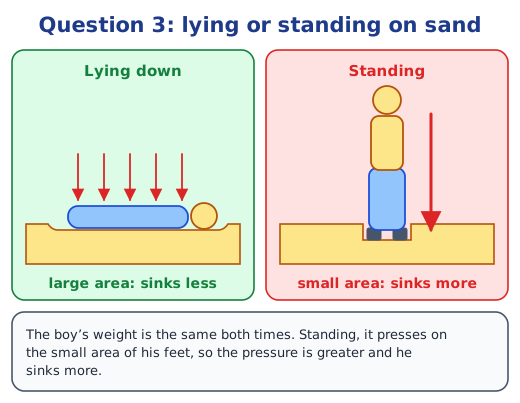
3. “Fig. 6.23 a shows a boy lying horizontally, and Fig. 6.23 b shows the boy standing vertically on a loose sand bed. In which case does the boy sink more in sand? Give reasons.” He sinks more when standing (Fig. 6.23 b). His weight is the same in both cases. Lying down, it is spread over a large area of his body, so the pressure on the sand is small. Standing, the same weight rests only on the small area of his feet, so the pressure is much greater and his feet sink deeper.
4. “An elephant stands on four feet. If the area covered by one foot is 0.25 m², calculate the pressure exerted by the elephant on the ground if its weight is 20000 N.”
Total area of four feet = 4 × 0.25 m² = 1 m²
Pressure = force ÷ area = 20000 N ÷ 1 m²
= 20000 N/m², or 20000 Pa
5. “There are two boats, A and B. Boat A has a base area of 7 m², and 5 persons are seated in it. Boat B has a base area of 3.5 m², and 3 persons are seating in it. If each person has a weight of 700 N, find out which boat will experience more pressure on its base and by how much?” Counting the weight of the persons, as the question gives:
Boat A: force = 5 × 700 N = 3500 N
Pressure on A = 3500 N ÷ 7 m² = 500 N/m²
Boat B: force = 3 × 700 N = 2100 N
Pressure on B = 2100 N ÷ 3.5 m² = 600 N/m²
Difference = 600 N/m² − 500 N/m² = 100 N/m²
Boat B experiences more pressure, by 100 N/m² (100 Pa), even though it carries fewer people, because its base is half as large.
6. “Would lightning occur if air and clouds were good conductors of electricity? Give reasons for your answer.” No. Lightning happens because air is normally an insulator: it keeps the separated charges apart until they become very large, and then they flow all at once in a sudden flash. If clouds were good conductors, the positive and negative charges could not stay separated in them, and if air were a good conductor, charges would keep flowing away bit by bit as they formed. No large build-up would form, so there would be no sudden discharge, no lightning and no thunder.
7. “What will happen to the two identical balloons A and B as shown in Fig. 6.24 when water is filled into the bottle up to a certain height. Will both the balloons bulge? If yes, will they bulge equally? Explain your answer.” Yes, both balloons bulge, and they bulge equally. Water presses on the walls of the bottle as well as the bottom, in all directions. In Fig. 6.24 the two balloons are fixed at the same height near the bottom, so the depth of water above them, and therefore the pressure on them, is the same. Adding more water would make both bulge more.
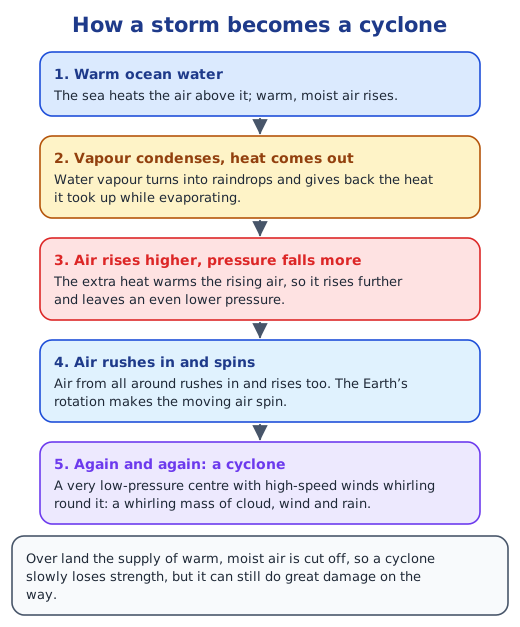
8. “Explain how a storm becomes a cyclone.” It happens over warm ocean water. Warm, moist air rises from the sea, and its water vapour condenses into raindrops. Condensation gives back the heat that the water took up while evaporating, and this heat warms the rising air further, so it rises even higher and the pressure at the surface falls even lower. Air from all around rushes in and starts rising too, and the Earth’s rotation makes this moving air spin. As the cycle repeats, a very low-pressure centre forms with high-speed winds whirling round it: the storm has become a cyclone, a whirling mass of cloud, wind and rain.
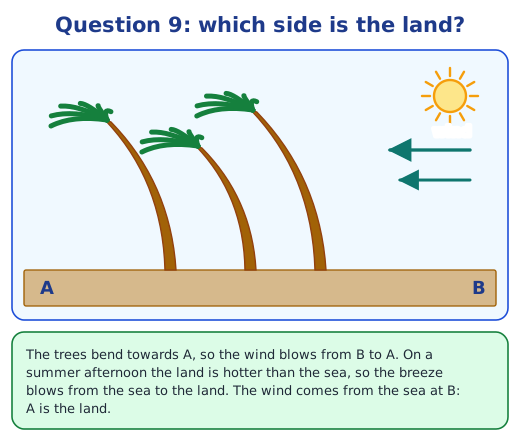
9. “Fig. 6.25 shows trees along the sea coast in a summer afternoon. Identify which side is land — A or B. Explain your answer.” A is the land. In Fig. 6.25 the trees bend towards A, so the wind is blowing from B towards A. On a summer afternoon the land is much hotter than the sea; warm air rises over the land and leaves low pressure, so a sea breeze blows from the sea to the land. The wind comes from B, so B is the sea and A is the land.
10. “Describe an activity to show that air flows from a region of high pressure to a region of low pressure.” Take two similar thin balloons and a drinking straw. Tie one end of the straw into the first balloon, which stays empty. Blow up the second balloon and pinch its neck so no air escapes, fit the other end of the straw into it and tie it tightly. Let go. The inflated balloon shrinks and the empty one swells, until both are about the same size and the flow stops. The air in the inflated balloon was at a higher pressure, so it flowed into the empty balloon, at lower pressure, until the pressures became equal. So air flows from high to low pressure.
11. “What is a thunderstorm? Explain the process of its formation.” A thunderstorm is a storm that comes with lightning and thunder. It forms like this. Heated land warms the moist air above it, and this warm air rises, leaving an area of low pressure. Cooler air flows in from the higher-pressure areas nearby, warms up and rises in turn, so the air keeps circulating. The rising air expands and cools, and its moisture condenses into droplets that form clouds; the drops grow and fall as rain, hail or snow, and strong winds with rain make a storm. When the warm air rises very high, the cold turns droplets into ice. Strong winds blowing up and down rub ice and droplets together, and charges build up in the cloud. When they become very large, lightning flashes and thunder follows. Moisture and strong winds are the main requirements.
12. “Explain the process that causes lightning.” Inside a thundercloud, strong winds moving up and down rub ice particles and water droplets together, and they become charged. The lighter, positively charged ice particles move to the upper part of the cloud, and the heavier, negatively charged droplets gather in the lower part. When the negative lower part comes near the ground, the ground and objects on it, such as trees and buildings, become positively charged. Air is an insulator and normally keeps the opposite charges apart, but when the charges build up a great deal, the air’s insulating property breaks down and charge flows suddenly through it as a bright flash: lightning. It can flash inside one cloud, from cloud to cloud, or from a cloud to the ground.
13. “Explain why holes are made in banners and hoardings.” Wind blowing against a solid banner pushes on its whole surface, and fast wind flowing past it lowers the pressure on the other side, so a large pressure difference acts across it. This can tear the banner or knock the hoarding down. Holes let the wind pass through, so the pressure on both sides stays nearly equal and the force on the banner is much smaller. It is the same idea as keeping doors and windows open so that a roof is not lifted off.
Prepare some questions of your own (pages 95–96). For example: Why do my ears pop in an aeroplane? Would a sucker stick on the Moon? Why are cyclones given names? How does the IMD know where a cyclone will hit?
Discover, design, and debate (page 97)
Blowing over a strip of paper. Prediction: many people expect the strip to be pushed down. Observation: when you blow over the top of a hanging strip (18 cm × 2 cm), it rises and flutters upwards. Interpretation: the fast-moving air above the strip has a lower pressure, so the higher pressure of the still air below pushes the strip up, just as the balloons moved together in Activity 6.6.
Big Indian cyclones of the past two decades. Collect facts from newspapers and official reports. Examples you could research (Extra): Phailin (Odisha, 2013), Hudhud (Andhra Pradesh, 2014), Fani (Odisha, 2019), Amphan (West Bengal, 2020; in the book), Tauktae (Gujarat, 2021) and Biparjoy (Gujarat, 2023). For each, list two kinds of destruction the book describes, such as flooding by the sea surge, uprooted trees and blocked roads, damaged houses and farmland, or long power cuts. Measures to look for: early warnings by the IMD, moving people to cyclone shelters before landfall (Extra: Odisha did this on a very large scale before Phailin and Fani), stocking food and water, and quick clearing of roads. Suggestions you might propose: more cyclone shelters and practice drills in coastal villages, and stronger houses and roofs.
Where are thunderstorms most common? Collect data on thunderstorms in different regions, for example from IMD reports and newspapers, and compare how often they occur. Many students will find (Extra) that eastern and north-eastern India, such as West Bengal, Odisha, Jharkhand, Bihar and Assam, get frequent thunderstorms before the monsoon, which matches the Kalboishakhi and Bordoisila in the book. Reasons to discuss: strong heating of the land in summer, plenty of moisture from nearby seas, and the strong rising winds that thunderstorms need.
Practice
-
A box of weight 600 N rests on a face of area 0.5 m². The pressure on the floor is:
Show answer
Answer: (b) 1200 Pa
-
Snow shoes are wide and flat so that they:
Show answer
Answer: (b) decrease the pressure on the snow
-
In a cyclone, the air pressure is lowest:
Show answer
Answer: (b) in the eye
-
Why do camels walk easily on sand?
Show answer
Answer: Their broad, padded feet spread their weight over a large area, so the pressure on the sand is small and they do not sink much.
-
On a weather map, place X shows 1008 mb and place Y shows 996 mb. Which way will the wind tend to blow?
Show answer
Answer: From X to Y, because air moves from higher to lower pressure.
Stuck on a question?
Take a photo and Lagnever AI explains it step by step. Try it for 7 days for ₹2.
Get it on Google Play Open in browser
For parents: after the trial, the plan renews monthly by UPI or card autopay. You can cancel anytime in the app.