
Class 8 Science Chapter 6: Pressure, Winds, Storms, and Cyclones Notes
This chapter in five lines
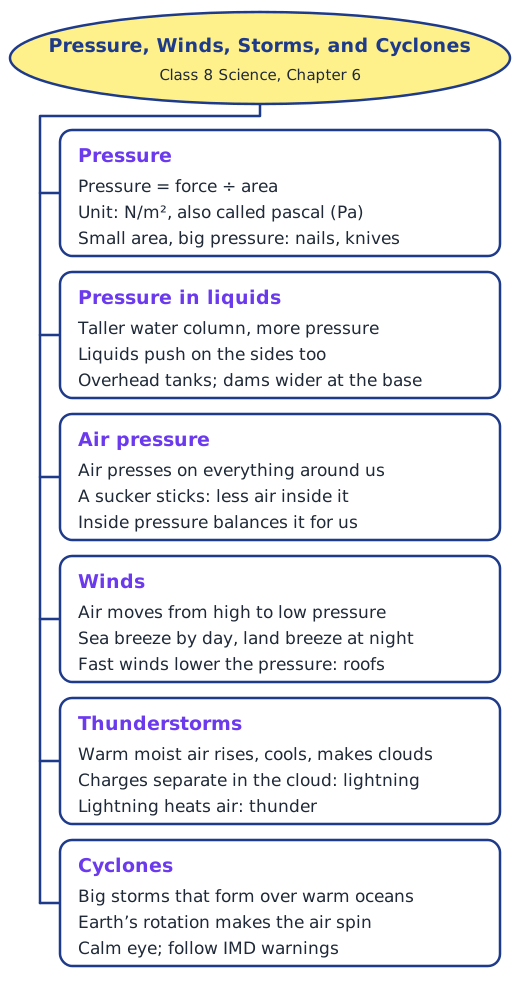
Pressure is force per unit area, measured in pascals (N/m²): a smaller area gives a bigger pressure. Liquids press in all directions, more strongly in a taller column, and the air around us presses on everything. Air moves from high to low pressure as wind. Rising warm, moist air builds thunderstorms with lightning, and over warm seas it can grow into a cyclone.
What is this chapter about?
Watch dry leaves whirl up on a windy day, a door slam shut, or clothes flap on a line. The wind is pushing on them, and that push spread over a surface is called pressure. This chapter starts with pressure in solids and liquids, moves to the air around us and how winds form, and ends with the most powerful winds of all: thunderstorms and cyclones. It builds on forces in Chapter 5 and on land and sea breezes from Grade 7.
How do we stay safe in these activities?
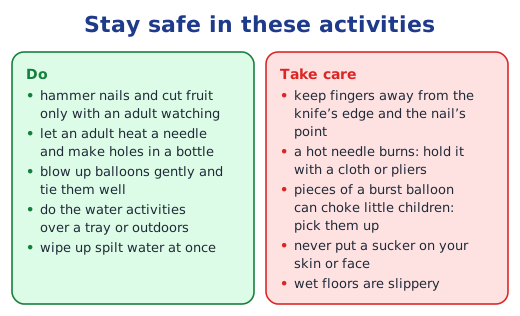
The book asks for an adult to watch while you hammer a nail or cut an apple with a knife. Let an adult heat a needle and make holes in a plastic bottle. Blow up balloons gently, pick up the pieces of any that burst, and wipe up spilt water at once, because wet floors are slippery.
What is pressure?
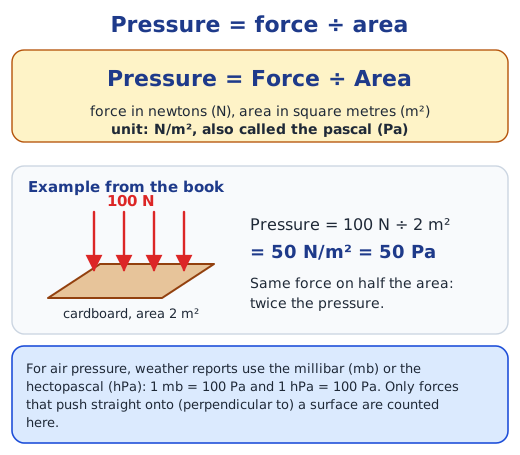
Megha and Pawan carry equally heavy bags, but only Pawan’s hurts. His bag has narrow straps, so its weight presses on a small patch of his shoulders; Megha’s broad straps spread the same weight over a larger patch. The force on each unit of area is called pressure: pressure = force ÷ area. With force in newtons and area in square metres, its unit is N/m², also called the pascal (Pa). A force of 100 N on 2 m² gives 50 Pa. A smaller area means a bigger pressure, which is why a nail’s point and a knife’s sharp edge work so well. Read what is pressure?
Do liquids exert pressure?
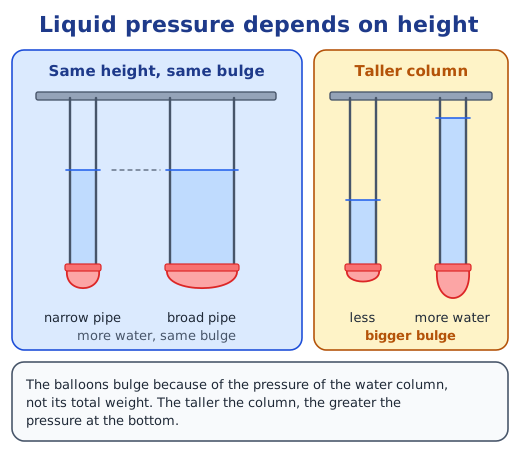
Yes. Fill two pipes of different widths to the same height, each closed by a balloon at the bottom, and both balloons bulge equally, even though the wider pipe holds more water. Add more water and the bulge grows. So liquid pressure depends on the height of the column. That is why overhead tanks are kept high: the taps get a strong stream. Water also spurts sideways from holes in a bottle, so liquids press on the walls too, in fact in all directions. A dam is built wide at the base because the sideways push of the water is greatest near the bottom.
Does air exert pressure?
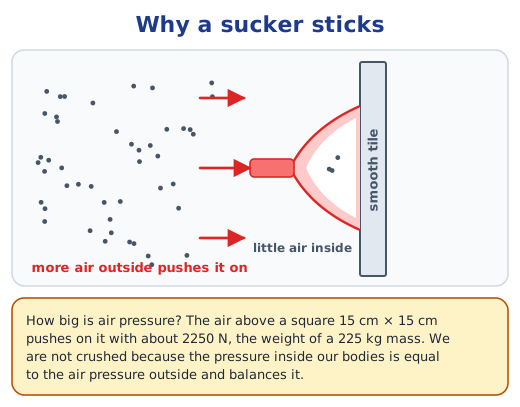
Air surrounds the Earth as the atmosphere, many kilometres thick, and it presses on everything. Cover an upturned paper plate with a large sheet of chart paper and it becomes harder to lift than with a folded, smaller sheet, though the paper weighs the same. A rubber sucker sticks to a smooth tile because there is little air left inside its cup and the air outside presses it on. This atmospheric pressure is large: about 2250 N on a 15 cm × 15 cm square. We are not crushed because the pressure inside our bodies balances it. Weather reports give air pressure in millibars or hectopascals; each is 100 Pa. Read air pressure and wind.
How do winds form?
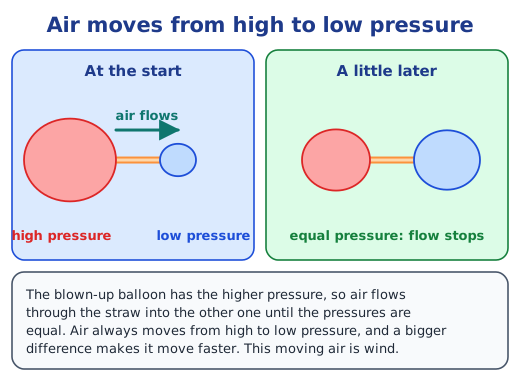
Join a blown-up balloon and an empty one with a straw, and air flows from the full one into the empty one until the pressures are equal. Air always moves from high pressure to low pressure, and the bigger the difference, the faster it moves. Moving air is wind. Sea and land breezes come from this too: by day the land warms faster, warm air rises over it and the wind blows in from the sea; at night it blows the other way.
Why can strong winds blow roofs away?
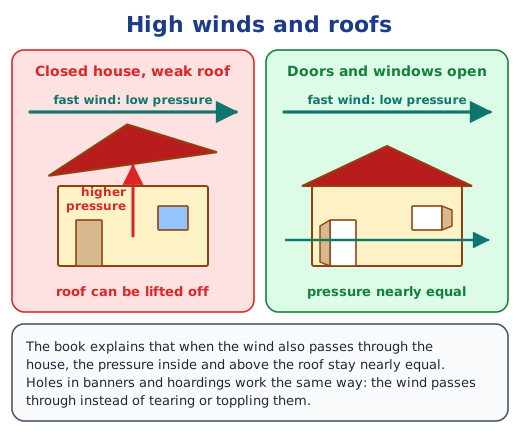
Fast-moving air has lower pressure. Blow between two hanging balloons and they swing together, pushed by the higher pressure outside. When a high-speed wind sweeps over a closed house, the pressure above the roof drops while the air inside still presses up, and a weak roof can lift off. The book explains that open doors and windows let the wind pass through the house too, keeping the pressure difference small.
How do thunderstorms and lightning happen?
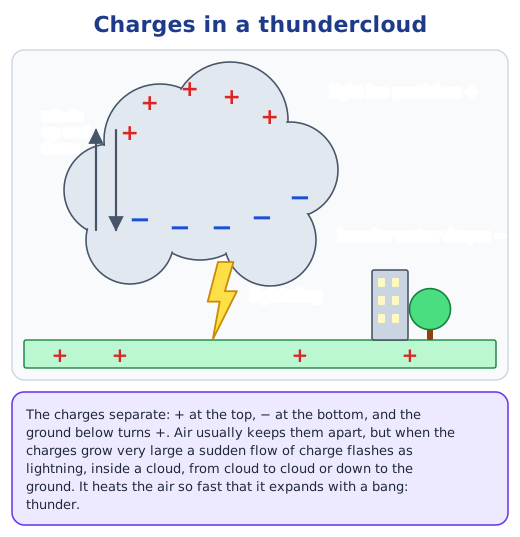
When the land heats up, warm, moist air rises, cools and forms clouds, and cooler air rushes in below: strong winds with rain make a storm. In tall clouds, winds going up and down rub ice particles and water drops together and charge them. The light, positive ice collects at the top and the heavier, negative drops at the bottom, and the ground below turns positive. When the charges grow too large, a sudden flow of charge flashes as lightning, and the air it heats expands with a bang, thunder. Read thunderstorms and cyclones.
What is a cyclone?
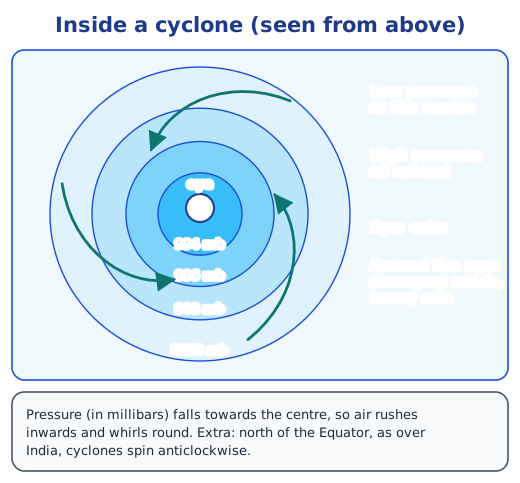
Over warm oceans, rising moist air releases heat as its vapour condenses, rises even higher and leaves a very low pressure. Air rushes in from all around, and the Earth’s rotation makes it spin. The result is a cyclone: a huge whirl of clouds, winds and rain round a calm centre, the eye. Cyclones bring winds faster than ordinary thunderstorms (Cyclone Amphan in 2020 reached 270 km/h), surges of seawater 3–12 m high, floods and power cuts. Follow the warnings of the India Meteorological Department (IMD), keep an emergency kit ready and, when a cyclone comes, move quickly to the nearby cyclone shelter.
Before we move on
Pressure links a school bag, a water tank, a sucker and a cyclone: in each, a force is spread over an area. Look for the pressure difference behind every wind you feel. Answers to every question are in the NCERT solutions for Chapter 6.
Key terms
| Term | Meaning |
|---|---|
| Pressure | The force acting on each unit of area: pressure = force ÷ area. |
| Pascal (Pa) | The SI unit of pressure, one newton per square metre (N/m²). |
| Liquid pressure | The push of a liquid on the bottom and walls of its container; it grows with the height of the liquid column. |
| Atmosphere | The blanket of air around the Earth, many kilometres thick: mostly nitrogen and oxygen, with argon, carbon dioxide and small amounts of other gases. |
| Atmospheric pressure | The pressure that the air around us exerts on every object. |
| Millibar (mb) and hectopascal (hPa) | Practical units of air pressure; each is equal to 100 Pa. |
| Wind | Moving air; it blows from a region of high pressure to one of low pressure. |
| Sea breeze and land breeze | Wind from the sea to the land by day, and from the land to the sea at night. |
| Storm | Strong winds together with rain. |
| Lightning | A bright flash made when a large build-up of electric charge suddenly flows through the air. |
| Thunder | The loud sound made when lightning heats the air so fast that it expands. |
| Thunderstorm | A storm with lightning and thunder. |
| Lightning conductor | A pointed metal rod from above a building down into the ground that leads electric charges safely into the earth. |
| Cyclone | A huge whirl of cloud, wind and rain round a very low-pressure centre, formed over warm ocean water. |
| Eye of a cyclone | The calm centre of a cyclone, where the pressure is lowest. |
Topics in this chapter
Practice
-
The SI unit of pressure is:
Show answer
Answer: (b) pascal
-
A force of 100 N acts on an area of 2 m². The pressure is:
Show answer
Answer: (c) 50 N/m²
-
Why are water tanks placed on rooftops?
Show answer
Answer: (b) so the taps get water at a higher pressure
-
Air always moves from:
Show answer
Answer: (b) high to low pressure
-
The calm centre of a cyclone is called its:
Show answer
Answer: (b) eye
-
During a thunderstorm, the lower part of a cloud usually carries:
Show answer
Answer: (b) negative charge
Questions students ask
What are the main topics of Class 8 Science Chapter 6?
Pressure as force per unit area and its unit, the pascal; pressure in liquids and why tanks and dams are built as they are; atmospheric pressure; how winds form, sea and land breezes, and why fast winds lower the pressure; thunderstorms, lightning and lightning conductors; and how cyclones form, what they do and how to stay safe.
Is Pressure, Winds, Storms, and Cyclones in the new NCERT book?
Yes. It is Chapter 6 of Curiosity, the Class 8 science textbook (Reprint 2026-27), on pages 80 to 97. It builds on forces from Chapter 5 and on land and sea breezes from Grade 7.
Why is the base of a dam made wider than the top?
Water pushes sideways on the dam wall, and this pressure grows with depth, so it is largest near the bottom. A broad base holds the dam up and withstands that large push.
Why don’t we get crushed by air pressure?
The air around us presses very hard: over a 15 cm by 15 cm square it pushes with about 2250 N. But the pressure inside our bodies is equal to it and balances it from inside, so we feel nothing.
Stuck on a question?
Take a photo and Lagnever AI explains it step by step. Try it for 7 days for ₹2.
Get it on Google Play Open in browser
For parents: after the trial, the plan renews monthly by UPI or card autopay. You can cancel anytime in the app.