
Class 8 Science Chapter 5: Exploring Forces Notes
This chapter in five lines
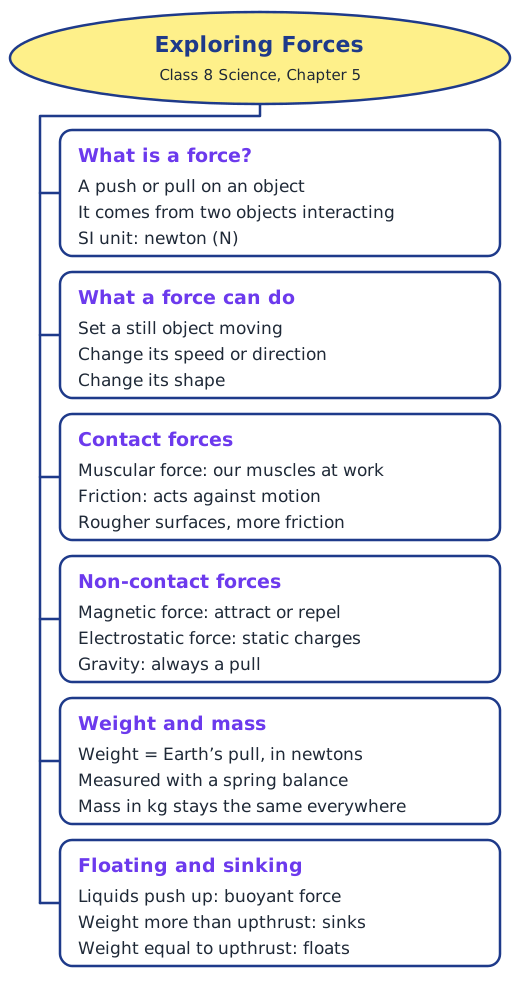
A force is a push or a pull that comes from two objects interacting, and it is measured in newtons (N). A force can start or stop motion, change speed or direction, or change shape. Muscular force and friction need contact; magnetic, electrostatic and gravitational forces act across a gap. Weight is the Earth’s pull on an object, and liquids push up with a buoyant force.
What is this chapter about?
On the first day of their holidays, Sonali and Ragini cycle out of their village on a windy morning. Riding into the wind feels like being shoved backwards, the rough stretches of road are hard work, and on the way home their bicycles race downhill without a single turn of the pedals. On the way they ring their bells and turn their handlebars to steer round a flock of sheep. Something is pushing and pulling them all the time. This chapter is about those pushes and pulls, called forces: what they do, the different kinds, weight, and why some things float. It builds on magnets from Grade 6 and motion from Grade 7.
How do we stay safe in these activities?
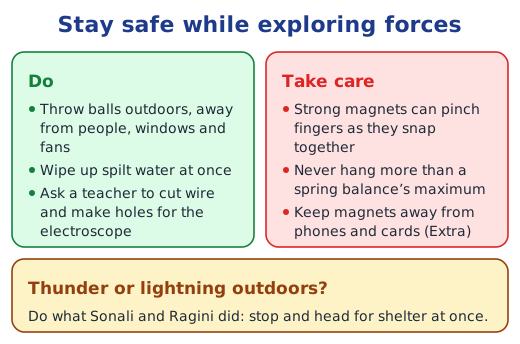
Most activities here are gentle, but a few need care. Throw balls only outdoors, away from people, windows and fans. Strong magnets can pinch fingers when they snap together. Never hang more on a spring balance than its maximum. Wipe up spilt water at once, because a wet floor makes people slip. Let a teacher cut wire and make holes for the electroscope project. And if you hear thunder outdoors, do what Sonali and Ragini did: head for shelter at once.
What is a force?
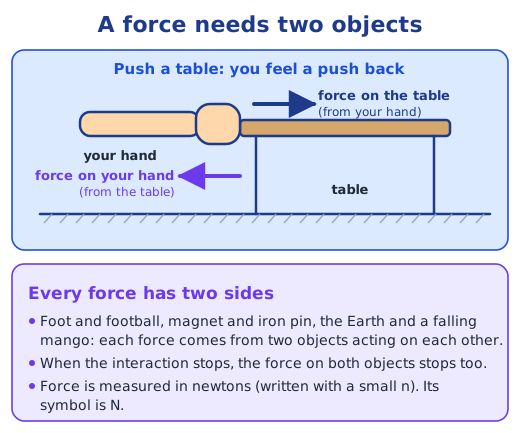
Try to move a big cardboard box: you can push it, pull it, or lift it and carry it. Every way needs a push or a pull, and in science a push or a pull on an object is a force. A force always comes from two objects acting on each other, your hand and the box, a foot and a football, the Earth and a falling mango. When you push a table, you feel the table push back on your hand; stop pushing and both forces vanish. Force is measured in newtons (the name takes a small n), shortened to N.
What can a force do?
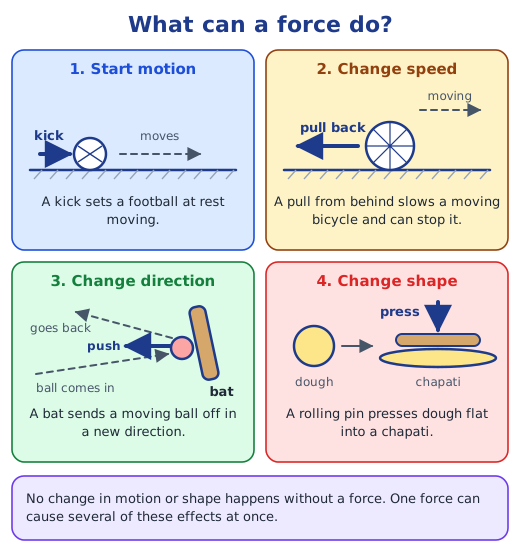
A force can set a still object moving, like a kick on a football. It can change the speed of a moving object, as when a friend holds your bicycle from behind. It can change the direction of motion, as a bat does to a ball, and it can change shape, as a rolling pin does to dough. Opening a drawer, stretching a rubber band and turning an autorickshaw’s handle all work the same way. None of these changes happens without a force. (An object at rest may still have forces on it, but they balance one another; you will learn more in higher classes.)
What are contact forces?
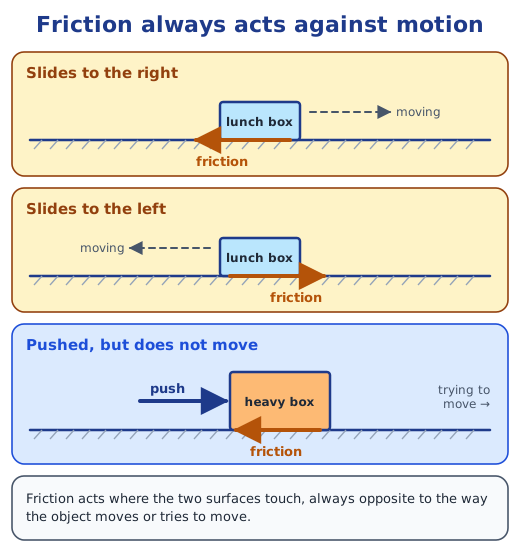
Some forces act only while two objects touch, directly or through a stick or rope. Your muscular force lifts a bag, kicks a ball, chews food and pumps blood round your body, and bullocks, horses and camels have long used theirs to pull carts and ploughs. Friction is a contact force too: it acts between two surfaces, always against the motion or the attempt to move. That is why a rolling ball slows down and stops, and why it stops sooner on a rough road. Read friction.
What are non-contact forces?
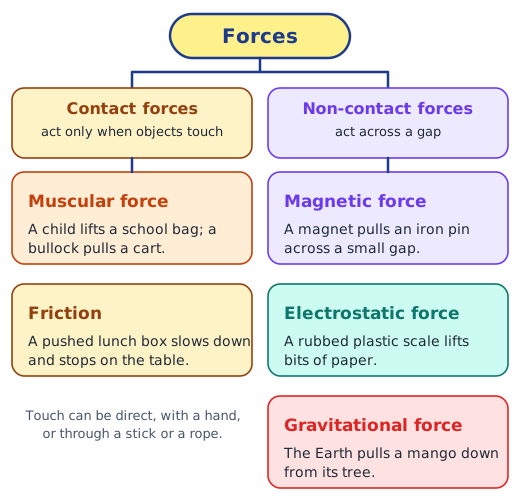
Some forces act across a gap. A magnetic force lets one ring magnet float above another when like poles face each other. A plastic scale rubbed with polythene picks up paper bits without touching them: rubbing leaves static charges on it, and the electrostatic force pulls on the paper. Two balloons rubbed with wool push each other apart, while a balloon and the wool pull together, so like charges repel and unlike charges attract. The two kinds are called positive and negative. Gravity, the Earth’s pull, brings every thrown ball back down and, unlike the other two, it only ever pulls. Read contact and non-contact forces.
What is weight, and how do we measure it?
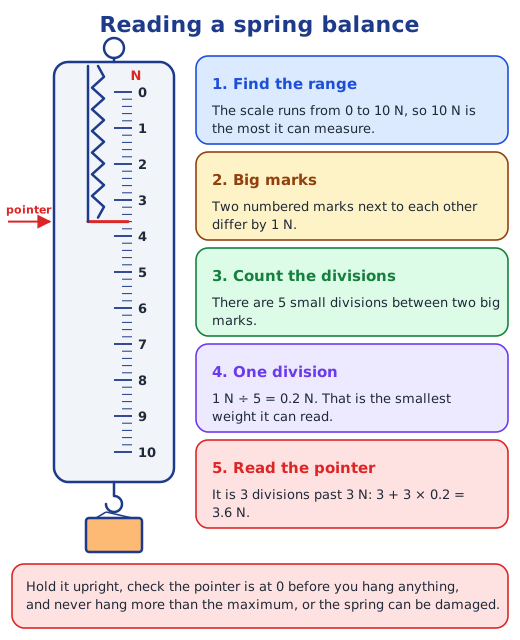
The Earth’s pull on an object is called its weight, so weight is measured in newtons. Hang different objects from a spring: the heavier the pull, the more the spring stretches. A spring balance uses this idea, with a scale marked in newtons. Before using one, find its range and the value of its smallest division, and never hang more than its maximum. Mass, how much matter an object contains, is measured in grams or kilograms and stays the same everywhere. Weight changes: an object of mass 1 kg weighs about 10 N on the Earth but only about 1.6 N on the Moon. Read weight, floating and sinking.
Why do some things float and others sink?
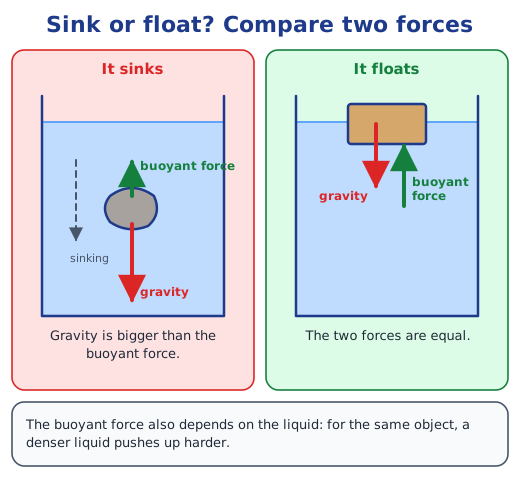
Push an empty, closed bottle into a bucket of water and the water pushes it back up. Every liquid pushes up on objects placed in it with an upthrust, or buoyant force. Gravity pulls an object down and the buoyant force pushes it up: if gravity is more, the object sinks; if the two are equal, it floats. Archimedes found that this upward force equals the weight of the liquid the object pushes aside. The buoyant force also depends on the liquid’s density, which Chapter 9 explains. Even a rock can float: pumice, from volcanoes, is so full of tiny air pockets that it is less dense than water.
Before we move on
Forces are everywhere: in every step you take, every ball you throw and every boat that floats. Look for the two objects behind each force, and for the push or pull that changes how things move. Answers to every question are in the NCERT solutions for Chapter 5.
Key terms
| Term | Meaning |
|---|---|
| Force | A push or a pull on an object that comes from its interaction with another object. |
| Newton (N) | The SI unit of force, written with a small n; its symbol is a capital N. |
| Contact force | A force that acts only while objects touch, directly or through a stick or a rope. |
| Muscular force | The force our muscles produce, for example in lifting, walking, chewing or pumping blood. |
| Friction | The force between two touching surfaces that acts against motion, or against an attempt to move. |
| Non-contact force | A force that acts even when the objects are not touching. |
| Magnetic force | The force a magnet exerts on another magnet or on a magnetic material such as iron. |
| Static charge | Electric charge that builds up on some materials when they are rubbed and stays in place. |
| Electrostatic force | The force a charged object exerts on another object, charged or uncharged. |
| Gravitational force (gravity) | The Earth’s pull on every object, drawing it towards the Earth; it is always a pull. |
| Weight | The pull of the Earth on an object; a force, so it is measured in newtons. |
| Mass | How much matter an object contains, in grams or kilograms; it is the same everywhere. |
| Spring balance | A spring with a hook and a scale that measures weight (force) in newtons. |
| Buoyant force (upthrust) | The upward force a liquid applies on an object placed in it. |
Topics in this chapter
Practice
-
The SI unit of force is the:
Show answer
Answer: (b) newton
-
Which of these is a non-contact force?
Show answer
Answer: (c) gravitational force
-
Friction on a sliding object acts:
Show answer
Answer: (b) opposite to the direction of motion
-
On the Moon, the mass of a 1 kg packet of salt is:
Show answer
Answer: (a) 1 kg
-
A wooden block floats on water. The buoyant force on it is:
Show answer
Answer: (b) equal to its weight
-
Two balloons rubbed with the same woollen cloth will:
Show answer
Answer: (b) repel each other
Questions students ask
What are the main topics of Class 8 Science Chapter 5?
What a force is and what it can do; forces as interactions measured in newtons; contact forces (muscular force and friction); non-contact forces (magnetic, electrostatic and gravitational); weight and the spring balance; mass and weight; and floating, sinking and the buoyant force.
Is Exploring Forces in the new NCERT book?
Yes. It is Chapter 5 of Curiosity, the Class 8 science textbook (Reprint 2026-27), on pages 62 to 79. It builds on magnets from Grade 6 and on motion from Grade 7.
What is the difference between mass and weight?
Mass tells you how much matter an object contains; it is measured in grams or kilograms and is the same everywhere. Weight is the Earth’s pull on the object, measured in newtons, and it changes from place to place, for example on the Moon.
Is gravity a contact force?
No. The Earth pulls a falling mango or a thrown ball without touching it, so gravity is a non-contact force. Unlike magnetic and electrostatic forces, it can only pull, never push.
Stuck on a question?
Take a photo and Lagnever AI explains it step by step. Try it for 7 days for ₹2.
Get it on Google Play Open in browser
For parents: after the trial, the plan renews monthly by UPI or card autopay. You can cancel anytime in the app.