
What is weight, and why do some things float?
Answer in short
Weight is the pull of the Earth on an object; being a force, it is measured in newtons (N), with a spring balance. Mass, the amount of matter, stays the same everywhere, but weight changes from place to place. A liquid pushes up on objects with a buoyant force, and an object floats when this force equals its weight.
Stuck on a question? Take a photo and Lagnever AI explains it step by step. Try it for 7 days for ₹2. Get it on Google Play
What is weight?
The Earth pulls every object towards itself with the force of gravity. The size of that pull on a particular object is its weight: it tells you how strongly the Earth pulls that object. Weight is a force, so its SI unit is the same as for any force, the newton (N).
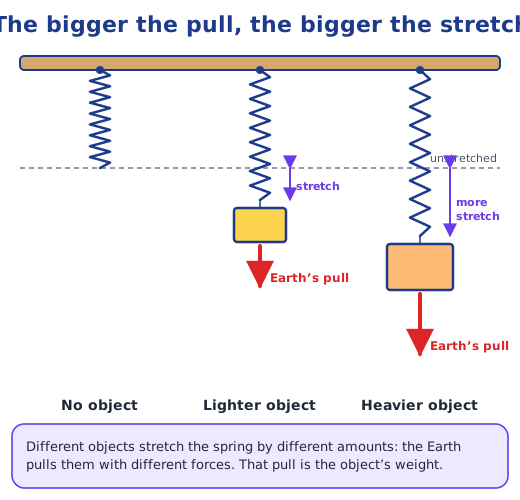
Does the Earth pull everything equally? Hang a spring from a nail and hook on a pencil box, then a tiffin box, then a small stone, one at a time. Each one stretches the spring by a different amount. The Earth’s pull is not the same on every object, so their weights are different, and a bigger pull gives a bigger stretch.
How does a spring balance work?
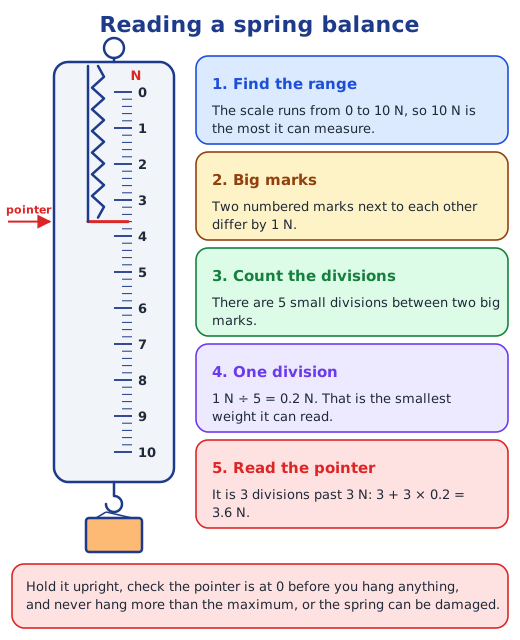
A spring balance turns that stretch into a reading. A spring is fixed at the top, a hook hangs from its lower end, and a pointer moves along a scale marked in newtons as the spring stretches. Many balances also have a second scale in grams, marked on the assumption that the balance is used on the Earth.
Read it the way you learnt to read a thermometer in Grade 6. First find its range: a scale that runs from 0 to 10 N can measure at most 10 N. Then find its smallest division. If two numbered marks differ by 1 N and there are 5 small divisions between them, each division is 1 N ÷ 5 = 0.2 N. Your school’s balance may have a different range and division, so always check before you measure. Never hang an object heavier than the maximum, or the spring can be damaged.
How are mass and weight different?
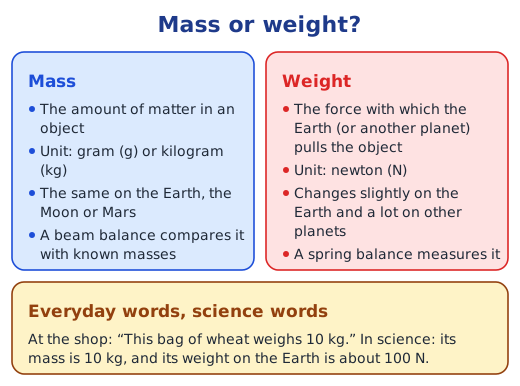
Mass tells you how much matter an object contains. Grams (g) and kilograms (kg) measure it, as you saw in Materials Around Us in Grade 6. It is the same wherever the object is. Weight is the pull of the Earth, or of another planet, on that object. The pull changes a tiny bit across the Earth, and a great deal from one planet to another, so weight can change while mass cannot.
Because weight hardly changes across the Earth, we can find mass by weighing: with a spring balance, or with a beam balance that compares an object with known masses. In daily life we say a bag of wheat ‘weighs 10 kg’, but in science that 10 kg is its mass; its weight is about 100 N. You will use mass and weight again in Chapter 9.
Does your weight change on the Moon?
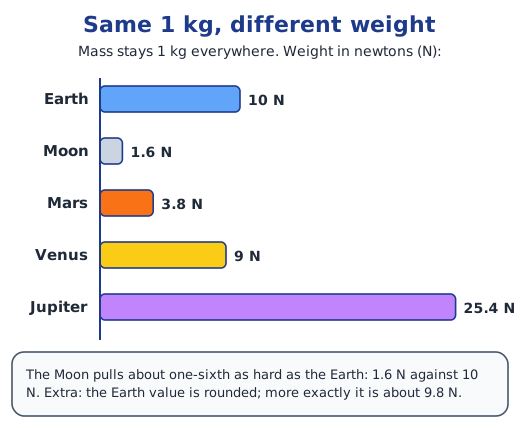
Yes, though your mass stays the same. An object of mass 1 kg weighs about 10 N on the Earth, 1.6 N on the Moon, 3.8 N on Mars, 9 N on Venus and 25.4 N on Jupiter. On the Moon you would weigh about one-sixth of your Earth weight.
Why does water push things up?
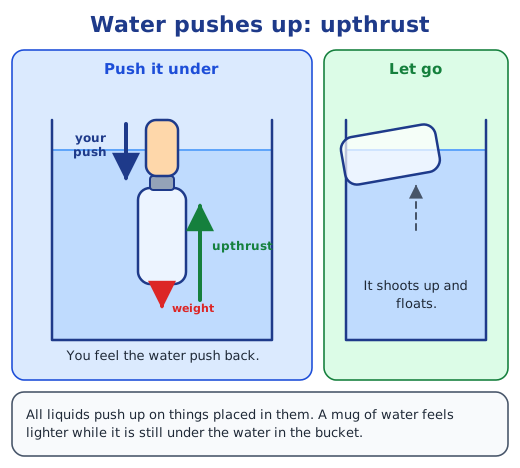
Gravity pulls on everything, so why doesn’t everything sink? Close an empty bottle tightly and push it into a bucket of water. You feel the water pushing back, and when you let go, the bottle bounces up to the surface. Water, like every liquid, pushes up on objects placed in it. This upward force is called upthrust or buoyant force. It is also why a mug full of water feels lighter while it is still under the water in the bucket.
Why do some things float and others sink?
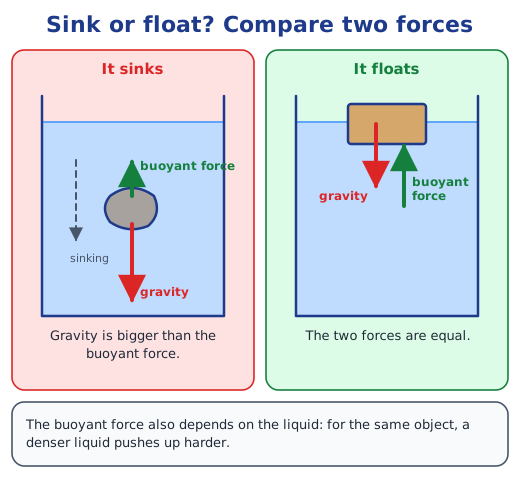
Two forces act on an object in a liquid: gravity pulls it down and the buoyant force pushes it up. If gravity is greater, the object sinks. If the two forces are equal, it floats. The buoyant force also depends on the liquid; one factor is its density, which you will study in Chapter 9.
What did Archimedes discover?
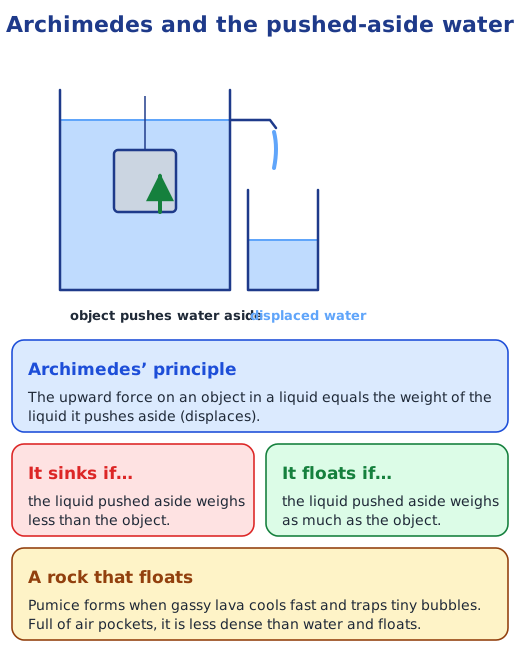
The Greek scientist Archimedes found that an object fully or partly under a liquid is pushed up by a force as big as the weight of the liquid it moves out of the way, or displaces. If the displaced liquid weighs less than the object, the object sinks; if it weighs the same, it floats. Even a rock can float: pumice forms when gassy lava cools quickly and traps countless tiny bubbles, which makes it less dense than water.
Wipe up any water you spill, so nobody slips. Slipping is about friction, the next topic: what is friction? See also the chapter notes and the NCERT solutions.
Practice
-
The SI unit of weight is the:
Show answer
Answer: (c) newton
-
A spring balance has 5 small divisions between the 0 N and 1 N marks. One division is:
Show answer
Answer: (b) 0.2 N
-
A stone sinks in water because:
Show answer
Answer: (b) gravity on it is more than the buoyant force
-
An object has a mass of 1 kg. What are its mass and its weight on the Moon?
Show answer
Answer: Its mass is still 1 kg. Its weight is about 1.6 N, compared with about 10 N on the Earth, as the table in the NCERT book shows.
-
Why does a mug full of water feel lighter while it is still under the water in a bucket?
Show answer
Answer: The water around it pushes it up with a buoyant force, so your hand has less to lift.
Questions students ask
What is weight in science?
Weight is the pull of the Earth on an object, drawing it towards the Earth. Because it is a force, its SI unit is the newton (N), and a spring balance measures it.
Why does weight change on the Moon but mass does not?
Mass tells you how much matter an object contains, and that does not change when it travels. Weight depends on how strongly a body pulls it: the Moon pulls a 1 kg object with about 1.6 N, compared with about 10 N on the Earth.
What is buoyant force?
It is the upward force a liquid applies on an object placed in it, also called upthrust. You feel it when you push an empty, closed bottle into a bucket of water and it bounces back up.
What is Archimedes’ principle?
An object fully or partly in a liquid is pushed up by a force as big as the weight of the liquid pushed aside. If that liquid weighs less than the object, the object sinks; if it weighs the same, the object floats.
Stuck on a question?
Take a photo and Lagnever AI explains it step by step. Try it for 7 days for ₹2.
Get it on Google Play Open in browser
For parents: after the trial, the plan renews monthly by UPI or card autopay. You can cancel anytime in the app.