
Class 6 Science Chapter 6: Materials Around Us Notes
This chapter in five lines
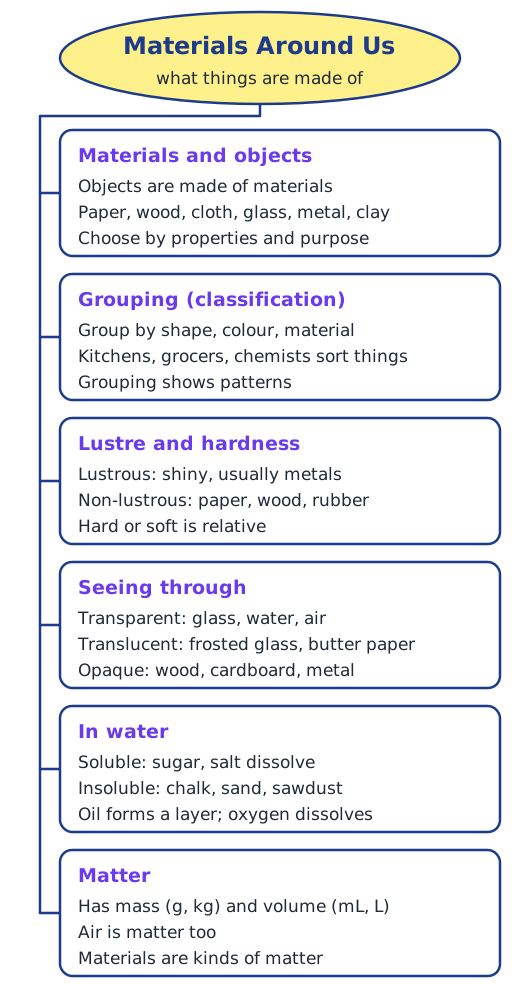
Every object is made of one or more materials, such as wood, glass, metal, plastic or clay, and we choose a material by its properties and the use of the object. Materials can be grouped as lustrous or non-lustrous, hard or soft, transparent, translucent or opaque, and soluble or insoluble in water. Everything that has mass and occupies space is matter; materials are kinds of matter used to make objects.
Objects and materials
The chapter opens with an old Indian text, the Rasaratnasamuchchaya, which says that a crucible, a vessel for melting substances, is made of clay and iron. Back at school, Ghulan and Sheeta show their new notebooks and pens, and their teacher, Madam Vidya, asks how the things they use are alike and different. All of them are made of materials such as paper, wood, cloth, glass, metal, plastic and clay. Any substance that is used to create an object is called a material.
People have long known their materials. The earliest pottery in the Indian subcontinent, from Lahuradewa in the Ganga plains and Mehrgarh in Baluchistan, is 7,000 to 8,000 years old, and by the Harappan period (2600 to 1900 BCE), potters turned clay on wheels, baked it in kilns and painted it. Baked clay is called terracotta.
Choosing and grouping materials
Arranging things into groups by a common property is classification. A grocer keeps spices in one place and pulses in another, and a kitchen keeps similar utensils together. We choose a material for an object by its properties and the object’s purpose: a tumbler must hold water, so it can be made of glass, steel, copper, brass, terracotta or plastic, but not of cloth. One object can use several materials; a pen uses plastic, metal and ink. Balls for different sports are made of different materials so that they bounce and feel right for the game.
Lustre and hardness
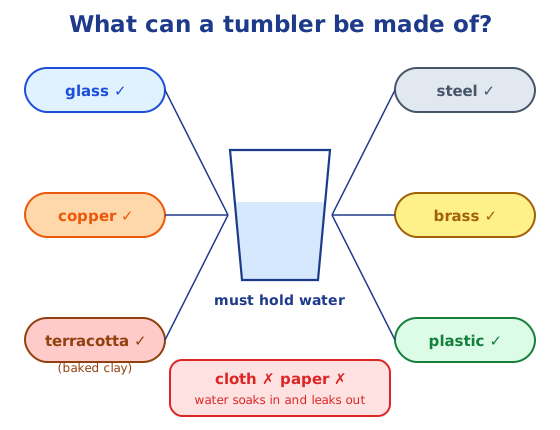
Materials with a shiny surface are lustrous; they are usually metals, such as iron, copper, zinc, aluminium and gold. Some metals lose their shine in air and moisture, so the lustre shows most clearly on a freshly cut surface. Paper, wood, rubber and jute are non-lustrous. But not everything that shines is a metal: polish or a thin coat of plastic or wax can make a surface shine. Materials that are easy to compress or scratch are soft, and those that are difficult to are hard, but these properties are relative: rubber is harder than sponge but softer than iron. Read more in properties of materials.
Seeing through materials
We see clearly through transparent materials such as glass, water, air and cellophane; dimly through translucent ones such as frosted glass and butter paper; and not at all through opaque ones such as wood, cardboard and metals. In a game of hide-and-seek, a wall or a tree hides you completely, but frosted glass shows you as a blur. Read more in transparent, translucent and opaque.
Materials in water
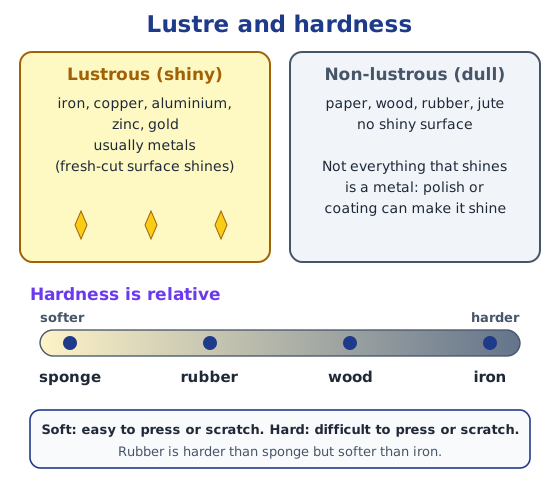
When sugar and salt are stirred into water, they disappear: they dissolve, or are soluble. Chalk powder, sand and sawdust do not, even after long stirring: they are insoluble. Among liquids, vinegar and honey mix with water but oil forms a separate layer; among gases, oxygen dissolves in water and keeps water plants and animals alive. Our body depends on water because it dissolves so many materials. Read more in soluble and insoluble substances.
Mass, volume and matter
Cups filled to the same level with water, sand and pebbles weigh differently: the heavier one has more mass. Mass is measured in grams (g) and kilograms (kg); the kilogram is the SI unit. A bag on a seat takes up space, and the space that something occupies is its volume, measured in millilitres (mL) and litres (L); the SI unit is the cubic metre, and 1 m³ = 1000 L. Write a space between the number and the unit, as in 7 kg or 500 mL.
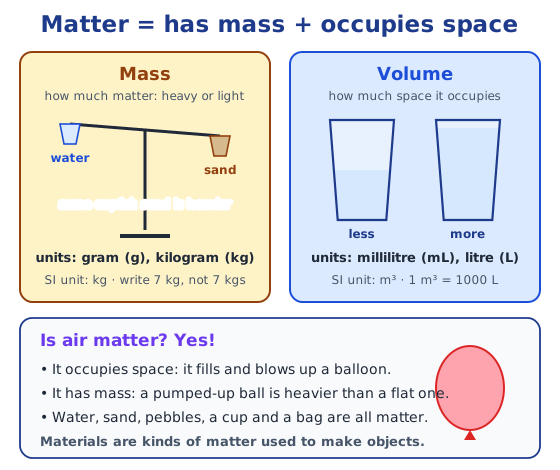
Anything that has mass and occupies space is matter. Water, sand, pebbles and the cup are all matter, and so is air. Materials are kinds of matter used to make objects. Ayurveda, one of India’s systems of medicine, describes all matter with 20 properties, or guṇas, in ten pairs of opposites, such as heavy and light, cold and hot, and soft and hard. The chapter ends by asking whether the invention of plastic has been a boon or a bane.
Answers to every question are in the NCERT solutions for Chapter 6.
Key terms
| Term | Meaning |
|---|---|
| Material | Any substance used to make an object, such as paper, wood, cloth, glass, metal, plastic or clay. |
| Classification | Arranging objects or materials into groups on the basis of a common property. |
| Lustrous | Having a shiny surface; metals such as iron, copper, aluminium and gold are usually lustrous. |
| Non-lustrous | Not shiny, like paper, wood, rubber and jute. |
| Hard and soft | Soft materials are easy to compress or scratch; hard ones are difficult to. These properties are relative. |
| Transparent | Letting us see through clearly, like glass, water, air and cellophane. |
| Translucent | Letting us see through, but not clearly, like frosted glass and butter paper. |
| Opaque | Not letting us see through at all, like wood, cardboard and metals. |
| Soluble | Disappearing completely when mixed in water, like sugar and salt; the material dissolves. |
| Insoluble | Not disappearing in water even after long stirring, like chalk powder, sand and sawdust. |
| Mass | The quantity of matter in an object, measured in grams (g) and kilograms (kg); the SI unit is the kilogram. |
| Volume | The space occupied by matter, measured in millilitres (mL) and litres (L); the SI unit is the cubic metre (1 m³ = 1000 L). |
| Matter | Anything that has mass and occupies space; materials are kinds of matter used to make objects. |
Topics in this chapter
Practice
-
Which of these materials is translucent?
Show answer
Answer: (b) Butter paper
-
Which of these dissolves in water?
Show answer
Answer: (c) Salt
-
Materials with a shiny surface are called:
Show answer
Answer: (b) lustrous
-
Anything that has mass and occupies space is called:
Show answer
Answer: (c) matter
-
1 m³ is equal to:
Show answer
Answer: (b) 1000 L
Questions students ask
What are the main topics of Class 6 Science Chapter 6?
Objects and the materials they are made of, grouping or classification, choosing materials by their properties, lustre, hardness, transparency, solubility in water, mass, volume, and what matter is.
Is Materials Around Us in the new Curiosity book?
Yes. Materials Around Us is Chapter 6 of Curiosity, the Class 6 Science textbook (Reprint 2026-27). It comes after Chapter 5, Measurement of Length and Motion.
How many questions does Chapter 6 have at the end?
The “Let us enhance our learning” section has 10 questions, and there are two word games in “Let us play”. Our NCERT solutions page answers all of them, along with Activities 6.1 to 6.8 and the in-text questions.
Stuck on a question?
Take a photo and Lagnever AI explains it step by step. Try it for 7 days for ₹2.
Get it on Google Play Open in browser
For parents: after the trial, the plan renews monthly by UPI or card autopay. You can cancel anytime in the app.