
Transparent, translucent and opaque
Answer in short
Transparent materials let us see through them clearly, like glass, water and air. Translucent materials let us see through them, but not clearly, like frosted glass and butter paper. Opaque materials do not let us see through them at all, like wood, cardboard and metals. We choose each kind for its use, from windows to doors.
Stuck on a question? Take a photo and Lagnever AI explains it step by step. Try it for 7 days for ₹2. Get it on Google Play
Three ways of letting us see
Some materials let us see right through them, some only blur the view, and some block it completely.
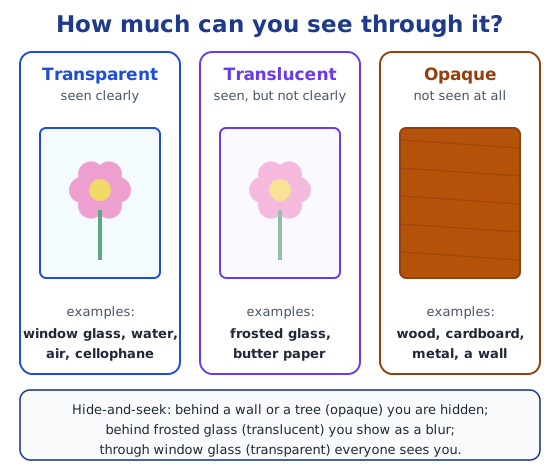
- Transparent materials let us see through them clearly: glass, water, air and cellophane paper.
- Translucent materials let us see through them, but not clearly: frosted glass, which has a hazy surface, and butter paper.
- Opaque materials do not let us see through them at all: wood, cardboard and metals.
Hide-and-seek
In the chapter, Ghulan hides behind a wall, Sheeta behind a big tree and Sara behind a frosted glass door, while Sheeta’s younger brother watches through the glass window of his house.
| Where | Kind of material |
|---|---|
| A: Ghulan, behind a wall | Opaque |
| B: Sheeta, behind a tree | Opaque |
| C: Sara, behind frosted glass | Translucent |
| D: the brother, at a glass window | Transparent |
Ghulan and Sheeta chose opaque things so that they could not be seen at all; Sara’s frosted glass hid her only partly, since her shape showed as a blur. If the brother’s window were wooden and closed, he could not see them, because wood is opaque.
Classifying everyday objects
| Object | Kind |
|---|---|
| Glass tumbler | Transparent |
| Window glass | Transparent |
| Butter paper | Translucent |
| Frosted glass | Translucent |
| Eraser | Opaque |
| Wooden board | Opaque |
Can water change?
Clear water is transparent: we can see a coin at the bottom of a glass of water. Stir in a little milk or mud and the water turns cloudy and translucent; with a lot of mud or ink it becomes opaque.
Try it yourself
Collect a glass sheet, a clear plastic bag, cellophane, butter paper, tissue paper, cloth, cardboard and a steel plate. Hold each one between your eyes and a lamp or a window, and sort them into the three groups. You will find that the same material can change group with its thickness: one layer of tissue paper lets you see shapes, while a thick pad of it hides them completely. (Extra: a drop of oil on plain paper turns that spot translucent, which is why oily food leaves see-through patches on paper bags.)
Why we see through some things (Extra)
We see an object when light from it reaches our eyes. A transparent material lets almost all of that light pass straight through, so the picture stays sharp. A translucent material lets light through but scatters it in many directions, so the picture becomes a blur. An opaque material stops the light, so we cannot see what is behind it.
Using each kind
- Transparent: windows that let light and the view in, spectacles, and glass or plastic jars in shops and kitchens, so that we can see the contents and how much is left.
- Translucent: frosted glass in bathroom windows and doors, which lets light in but keeps privacy, and butter paper for tracing.
- Opaque: walls, doors, curtains and boxes, which block the view and keep things private.
To read about other properties, see properties of materials. For the textbook’s questions, see the Chapter 6 NCERT solutions; for the whole chapter, see the Chapter 6 notes.
Practice
-
Which of these is opaque?
Show answer
Answer: (c) Wooden board
-
Frosted glass is:
Show answer
Answer: (b) translucent
-
Air does not stop us from seeing each other, but a wooden door does, because air is ___ and the door is ___.
Show answer
Answer: (a) transparent, opaque
-
Why are containers in shops usually transparent?
Show answer
Answer: So that people can see what is inside and how much is left without opening them, which also helps to check the contents and keep them sorted.
-
Is water transparent? Can it become opaque?
Show answer
Answer: Clear water is transparent. If a lot of mud, ink or milk is mixed in, light cannot pass through clearly, and the water becomes translucent and then opaque.
Questions students ask
What is the difference between transparent and translucent?
Through a transparent material, such as glass, you see things clearly; through a translucent material, such as frosted glass or butter paper, you can see things, but not clearly.
What are opaque materials?
Materials through which we cannot see at all, such as wood, cardboard, metals and walls.
Is air transparent?
Yes. Air is all around us, yet we see each other through it clearly, so it is transparent.
Stuck on a question?
Take a photo and Lagnever AI explains it step by step. Try it for 7 days for ₹2.
Get it on Google Play Open in browser
For parents: after the trial, the plan renews monthly by UPI or card autopay. You can cancel anytime in the app.