
Properties of materials
Answer in short
Properties of materials are the features that make materials different, such as appearance (lustrous or non-lustrous), hardness (hard or soft), transparency (transparent, translucent or opaque) and solubility in water. All materials also have mass and occupy space. We use these properties to group materials and to choose the right material for each object.
Stuck on a question? Take a photo and Lagnever AI explains it step by step. Try it for 7 days for ₹2. Get it on Google Play
What is a property?
Freshly cut wood looks quite different from iron, and iron looks different from copper or aluminium. Each material has its own properties: how it looks, how it feels and how it behaves. Grouping materials by their properties, or classification, helps us study them and spot patterns, much as a grocer keeps spices in one corner and pulses in another.
Appearance: lustrous or non-lustrous
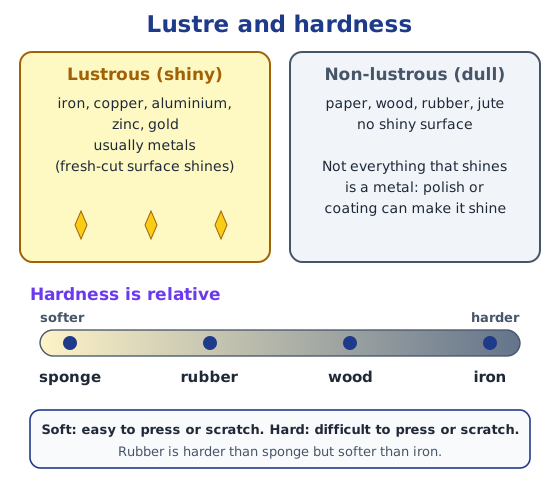
Some materials shine when light falls on them. They are lustrous, and they are usually metals: iron, copper, zinc, aluminium and gold. Air and moisture can dull some metals, so the shine is clearest on a freshly cut surface. Materials without a shiny surface, such as paper, wood, rubber and jute, are non-lustrous. As the old saying goes, all that glitters is not gold: polishing, or a thin coat of plastic or wax, can make other materials shine too.
Feel: hard or soft
Press a stone and it does not change; press an eraser and it gives. Scratch wood, aluminium, stone, iron, a candle and chalk with a metal key: some scratch easily. Materials that are easy to compress or scratch are soft, and those that are difficult are hard. These properties are relative: rubber is harder than sponge but softer than iron. A brick (baked clay), a table and a tumbler feel hard; a pillow and a sweater feel soft.
Seeing through
Materials can be transparent (glass, water, air), translucent (frosted glass, butter paper) or opaque (wood, cardboard, metal), depending on how clearly we can see through them. Read more in transparent, translucent and opaque.
In water
Some materials, like sugar and salt, dissolve in water and are soluble; others, like sand, chalk powder and sawdust, are insoluble. Read more in soluble and insoluble substances.
Mass and volume: properties of all materials
Not every material has every property, but two are shared by all. Mass tells how much matter something has; the heavier object has more mass, measured in grams and kilograms. Volume is the space it occupies, measured in millilitres and litres. Anything with mass and volume is matter.
Grouping by properties
Classification is everywhere. A kitchen keeps similar utensils together, a grocer keeps spices in one corner and pulses and grains in another, and a chemist arranges medicines in an order that makes them easy to find. Scientists group rocks, plants and animals in the same way, by their properties. Ayurveda, one of India’s systems of medicine, describes all matter by 20 properties in ten pairs of opposites, such as heavy and light, cold and hot, soft and hard, and smooth and rough.
Properties decide uses
We pick materials by their properties and the job the object must do:
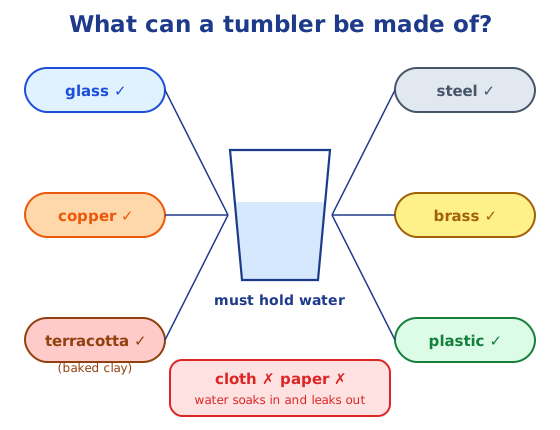
- Tumbler: must hold water, so glass, steel, copper, brass, terracotta or plastic, not cloth or paper.
- Cooking pots: must stand heat, so metal or clay; paper-like materials would burn or go soggy.
- Sports balls: a tennis ball must bounce high, while a cricket ball must be hard and heavy, so each uses different materials.
- Chairs: wood, iron, plastic, bamboo or stone, chosen for strength, light weight, warmth or easy cleaning.
For the textbook’s questions, see the Chapter 6 NCERT solutions; for the whole chapter, see the Chapter 6 notes.
Practice
-
Which material is lustrous?
Show answer
Answer: (b) Aluminium foil
-
Which list goes from softest to hardest?
Show answer
Answer: (b) Sponge, rubber, iron
-
Which property do ALL materials have?
Show answer
Answer: (c) Mass
-
Why is a tumbler not made of cloth?
Show answer
Answer: A tumbler must hold water. Cloth soaks up water and lets it pass through, so it cannot store water; glass, steel, copper, brass, terracotta or plastic can.
-
Which material suits a chair that should not feel cold in winter, and why?
Show answer
Answer: Wood, bamboo or plastic. Metal and stone feel cold to sit on in winter, while these materials do not.
Questions students ask
What are the properties of materials?
The features that describe how materials look and behave: lustre, hardness or softness, transparency, solubility in water, and also mass and volume, which all materials have.
How do we choose a material for an object?
By its properties and the purpose of the object. A tumbler must hold water, a ball must bounce in the right way, and a chair must be strong, so each is made of a material with the right properties.
What is classification?
The method of arranging objects or materials into groups on the basis of a common property, such as shape, colour, hardness or the material they are made of.
Stuck on a question?
Take a photo and Lagnever AI explains it step by step. Try it for 7 days for ₹2.
Get it on Google Play Open in browser
For parents: after the trial, the plan renews monthly by UPI or card autopay. You can cancel anytime in the app.