
Soluble and insoluble substances
Answer in short
A substance is soluble in water if it disappears completely when mixed and stirred, like sugar and salt; it dissolves. A substance is insoluble if it does not disappear even after long stirring, like sand, chalk powder and sawdust. Some liquids, like vinegar and honey, mix with water, while oil forms a separate layer.
Stuck on a question? Take a photo and Lagnever AI explains it step by step. Try it for 7 days for ₹2. Get it on Google Play
Disappearing sugar
Ghulan came home tired and thirsty after playing, so his mother made him shikanji: a spoonful of sugar, a pinch of salt and some lemon juice in a tumbler of water. As she stirred, the sugar and salt disappeared. Where did they go?
Testing materials in water
In the chapter’s activity, five tumblers are two-thirds filled with water, and a teaspoon each of sugar, salt, chalk powder, sand and sawdust is stirred into them. After a few minutes:
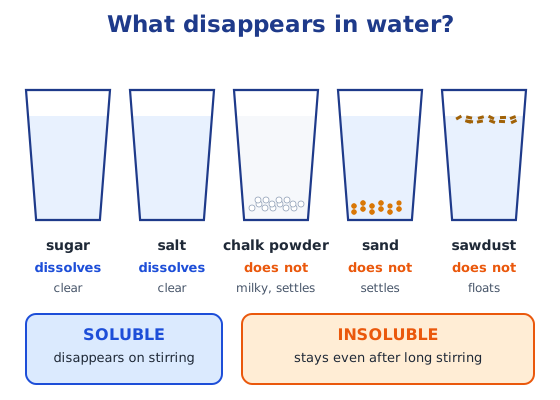
| Material | What happens |
|---|---|
| Sugar | Disappears: soluble |
| Salt | Disappears: soluble |
| Chalk powder | Turns the water milky, then settles: insoluble |
| Sand | Settles at the bottom: insoluble |
| Sawdust | Floats on top: insoluble |
Materials that disappear completely in water dissolve, or are soluble in water. Materials that do not mix and do not disappear, even after long stirring, are insoluble. The dissolved sugar is not lost: it is spread all through the water, which is why the shikanji tastes sweet.
Liquids and gases in water
- Liquids: some mix completely with water, such as vinegar and honey. Others, such as oil, do not mix and form a separate layer when left alone.
- Gases: some dissolve in water and some do not. Oxygen dissolves in water, and fish and water plants depend on it to survive.
Why it matters
Water dissolves a large number of materials, which is why it plays such an important role in our bodies. That is also how ORS works: Oral Rehydration Solution treats dehydration from diarrhoea or other illnesses. A ready packet is dissolved in a litre of water; at home, ORS can be made by mixing six teaspoons of sugar and half a teaspoon of common salt in one litre of boiled and cooled water. The dissolved sugar and salt help the body take back the water and salts it has lost, which is why ORS must be fully dissolved in clean water before it is drunk.
Solutions in daily life
Many things we use every day depend on dissolving. Tea and coffee taste sweet because sugar dissolves in them, salt dissolves into dal and vegetables as they cook, and a pinch of salt and sugar in lemonade makes shikanji. Detergent powder mixes into water to wash clothes. Insoluble materials matter too: sand and pebbles do not dissolve, so they settle at the bottom of a pond, and sawdust floats, so it can be skimmed off.
Making things dissolve faster (Extra)
Sugar dissolves faster if you stir, if the water is warm, and if the sugar is in small grains rather than a big lump. Try putting a sugar cube in one glass of water and the same amount of powdered sugar in another, and see which disappears first.
Pairs to remember
From vinegar, honey, mustard oil, water, glucose and wheat flour:
- Soluble pairs: honey in water, glucose in water, and vinegar in water.
- Insoluble pairs: mustard oil and water, and wheat flour and water.
To read about other properties of materials, see properties of materials. For the textbook’s questions, see the Chapter 6 NCERT solutions; for the whole chapter, see the Chapter 6 notes.
Practice
-
Which of these is soluble in water?
Show answer
Answer: (c) Sugar
-
When mustard oil is poured into water and left alone, it:
Show answer
Answer: (b) forms a separate layer
-
Which gas dissolved in water helps fish and water plants survive?
Show answer
Answer: (a) Oxygen
-
Make two pairs from vinegar, honey, mustard oil, water, glucose and wheat flour where one material is soluble in the other.
Show answer
Answer: Honey in water, and glucose in water. (Vinegar also mixes completely with water.)
-
Make two pairs where one material stays insoluble in the other.
Show answer
Answer: Mustard oil and water, which form two layers, and wheat flour and water, where the flour does not dissolve and settles.
Questions students ask
What are soluble substances?
Substances that disappear completely when mixed and stirred in water, such as sugar and salt. We say they dissolve in water.
What are insoluble substances?
Substances that do not disappear in water even after long stirring, such as sand, chalk powder and sawdust. They settle, float or stay as separate pieces.
How do you make ORS at home?
Mix six teaspoons of sugar and half a teaspoon of common salt in one litre of boiled and cooled water. ORS treats dehydration from diarrhoea or other illnesses; ready packets are also available.
Stuck on a question?
Take a photo and Lagnever AI explains it step by step. Try it for 7 days for ₹2.
Get it on Google Play Open in browser
For parents: after the trial, the plan renews monthly by UPI or card autopay. You can cancel anytime in the app.