
NCERT Solutions Class 6 Science Chapter 6: Materials Around Us
Answers to Activities 6.1 to 6.8, the in-text questions, the two “Let us play” games, all 10 “Let us enhance our learning” questions and the Learning further tasks in Chapter 6, Materials Around Us, of Curiosity (Reprint 2026-27). The page numbers match the book. Activities about things around you have sample answers; yours will differ. Short notes: Chapter 6 notes.
Observing objects around us (pages 101–102)
Activity 6.1, sample table:
| I observe | Materials it is made of |
|---|---|
| Notebook | Paper |
| Pen | Plastic, metal, ink |
| School bag | Cloth or plastic, metal zip |
| Desk | Wood, iron |
| Window | Glass, wood or aluminium |
| Water bottle | Plastic or steel |
Objects are made of various materials, and one object can use several of them.
Grouping materials (pages 103–106)
Activity 6.2: the objects in Fig. 6.1 can be grouped by shape (round or flat), colour, hardness or softness, shine or dullness, or by the material they are made of. Friends may choose different properties, so their groups differ. We learn that an object can be made of different materials, and one material can make many objects. Grouping by a common property is classification.
Activity 6.3, materials for a tumbler: glass, steel, copper, brass, terracotta (baked clay) and plastic, because they can hold water.
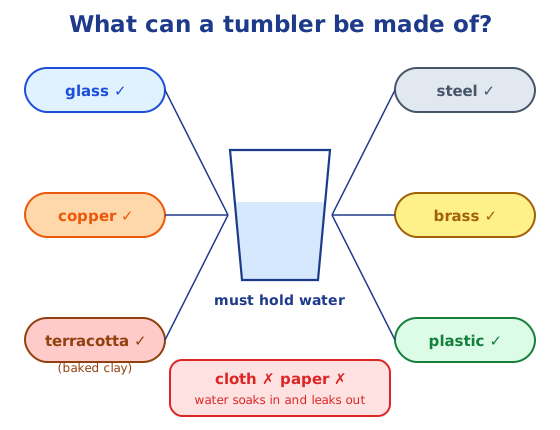
Why can’t a tumbler made of cloth store water? Cloth soaks up water and lets it pass through.
Would paper-like materials make good cooking utensils? No. Paper burns on a fire and goes soft and soggy when wet, so it cannot hold hot food or water.
Activity 6.4, bouncing balls (sample):
| Ball | Bounce |
|---|---|
| Tennis ball | High |
| Cricket ball | Medium to low |
| Hand exercise ball | Low |
The tennis ball bounces highest. Different materials are used for balls because each sport needs a particular bounce, weight, hardness and grip. A cricket ball cannot be used to play tennis: it is hard and heavy and bounces too little, and it could damage a tennis racket or hurt someone.
Fig. 6.4, grouping: the objects can be grouped by shape, colour, material, or use, such as things for writing, eating or storing.
Lustre and hardness (pages 106–108)
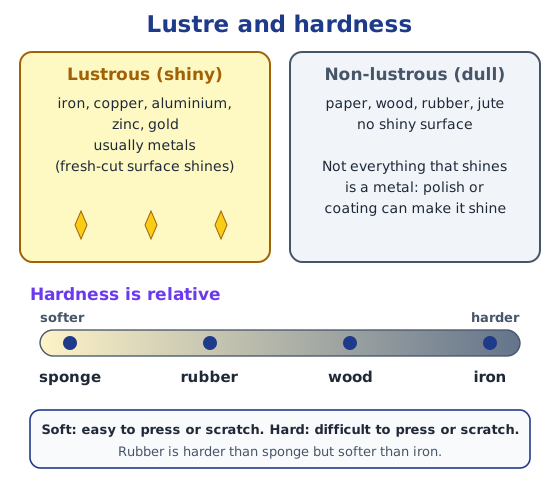
Sorting challenge: copper wire, aluminium foil and articles of brass, bronze and steel shine, so they are lustrous; paper, cardboard, wood and chalk do not, so they are non-lustrous.
Are all lustrous materials metals? No. Polishing, or a coat of plastic or wax, can make wood, paper or other materials shine.
Scratching with a key: a candle, chalk and wood scratch easily; aluminium scratches with some effort; iron and stone are difficult to scratch.
Activity 6.5, sample Table 6.3:
| Object | Hard or soft, and material |
|---|---|
| Brick | Hard, baked clay (given) |
| Water bottle | Hard, plastic or steel (a soft plastic bottle can be squeezed) |
| Pillow | Soft, cotton or foam inside a cloth cover |
| Tumbler | Hard, glass or steel |
| Table | Hard, wood or iron |
| Sweater | Soft, wool |
Transparent, translucent and opaque (pages 108–110)
Why did they choose those places to hide? Ghulan (a wall) and Sheeta (a big tree) chose opaque things, so they could not be seen at all. Sara chose a frosted glass door, so she could be seen only as a blur. Could Sheeta’s brother see them through a closed wooden window? No, wood is opaque.
Fig. 6.5: A (Ghulan, wall): opaque; B (Sheeta, tree): opaque; C (Sara, frosted glass): translucent; D (Sheeta’s brother, glass window): transparent.
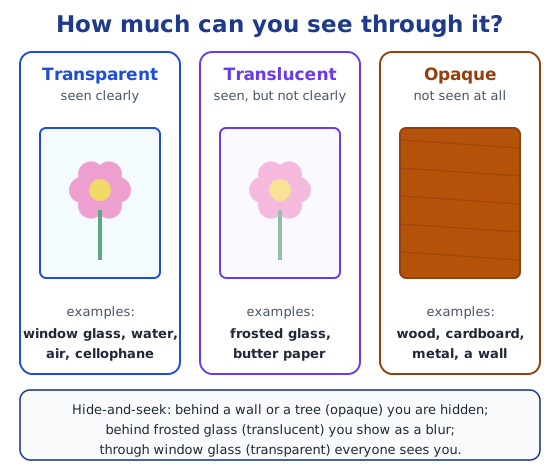
Activity 6.6, Table 6.4: transparent: glass tumbler, window glass; translucent: butter paper, frosted glass; opaque: eraser, wooden board.
Is water transparent? Can it be made opaque? Clear water is transparent. Mixing in a lot of mud, ink or milk makes it cloudy and then opaque.
Soluble and insoluble (pages 110–112)
Activity 6.7, Table 6.5:
| Material | Observation in water |
|---|---|
| Sugar | Disappears (soluble) |
| Salt | Disappears (soluble) |
| Chalk powder | Does not disappear; water turns milky, then it settles |
| Sand | Does not disappear; settles at the bottom |
| Sawdust | Does not disappear; floats |
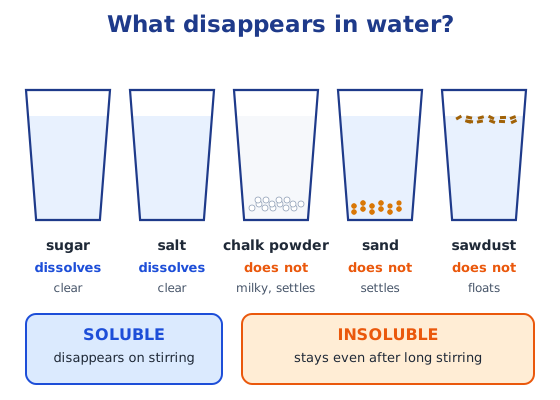
Does everything you put in water disappear? No. Sand, chalk powder and sawdust stay even after long stirring.
Do oil, vinegar and honey dissolve in water? Vinegar and honey mix completely with water; oil does not and forms a separate layer on top. Gases: oxygen dissolves in water, which is vital for animals and plants that live in water, while some other gases do not dissolve.
Mass and volume (pages 112–115)
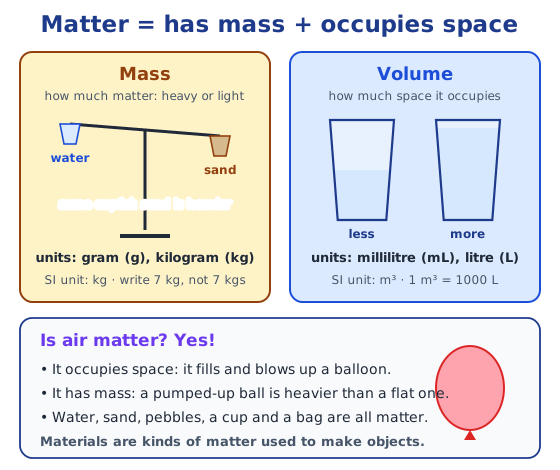
Activity 6.8 (sample): cup A (water) is the lightest; cups B (sand) and C (pebbles) are heavier than the same cupful of water. The heavier cup has more mass. (Which of sand and pebbles weighs more depends on how closely they pack.)
Why are the water levels different? Both tumblers hold the same amount, but one has less water in it, so the water occupies less space: its volume is less.
Why couldn’t all the water from the jug go into the empty bottle? The water in the jug had a larger volume than the bottle could hold, so the extra water overflowed.
What is matter? (pages 115–116)
Properties shown by all materials: mass and volume. Is air matter? Yes: it occupies space, filling a balloon, and it has mass, since a pumped-up ball weighs more than a flat one. Are all materials around us matter? Yes, they all have mass and occupy space.
Think it over: plastic, boon or bane? Points for discussion. A boon: plastic is light, cheap, waterproof and strong, so it is used in medical equipment, packaging that keeps food clean, pipes and countless objects. A bane: much of it does not break down for hundreds of years, single-use plastic litters land, rivers and oceans, harms animals and blocks drains, and burning it pollutes the air. Using it carefully, reusing it and recycling it reduce the harm.
The 20 properties in Ayurveda (Do you know?): the ten pairs are heavy and light, slow and quick, cold and hot, unctuous and dry, smooth and rough, solid and liquid, soft and hard, stable and moving, subtle and gross, and non-slimy and slimy. (The book prints the moving quality as ‘khāla’; in Sanskrit it is usually ‘chala’.)
Let us play (pages 118–119)
1. Find the companion (sample links): iron and copper, both lustrous metals; glass and transparent; wood and opaque; plastic and bottle; and solid with iron, copper, wood, glass and plastic, which are all solids.
2. Word-hub: this is a classroom bingo game. Choose nine of the words, write them in the grid, and tick each one when its word or meaning is read out.
Let us enhance our learning (pages 119–121)
1. Sorting in the kitchen
Sample answer: keep things by kind and by use: grains and pulses together in labelled, transparent jars; spices in one tray near the stove; oils and liquids on a lower shelf; things used daily at the front and rarely used things at the back.
2. Unscramble and match
(i) TREMAT → MATTER: (b) occupies space and has mass. (ii) ULSBELO → SOLUBLE: (d) mixes completely in water. (iii) TNERPASNART → TRANSPARENT: (a) objects can be seen clearly through it. (iv) ERUSTL → LUSTRE: (c) shiny surface.
3. Transparent containers
So that people can see what is inside and how much is left without opening the container. This helps to find things quickly, to check the quality of the contents, and in shops, to show the goods to buyers.
4. True or false
(i) False: wood is opaque while glass is transparent. (ii) True. (iii) True. (iv) False: an apple is matter because it occupies space and has mass.
5. Materials for chairs
| Property | Materials that fit it most |
|---|---|
| (i) Hardness | Iron, stone, cement and wood |
| (ii) Light weight | Plastic and bamboo |
| (iii) Not cold in winter | Wood, bamboo and plastic |
| (iv) Easy to clean and look new | Plastic and iron (painted or steel) |
6. Waste containers
- Food waste: a plastic or metal bin with a lid. It must not soak up water or leak, must be easy to wash, and, if metal, must not rust easily.
- Broken glass: a strong, hard container of metal or thick plastic, so that sharp pieces cannot cut through it.
- Wastepaper: any light container, such as a cardboard box, a cane or plastic basket, or a cloth or jute bag.
The properties to think of are hardness and strength, whether the material soaks up water or rusts, whether it is easy to clean, and its weight.
7. Air and the wooden door
(i) transparent, opaque.
8. Materials X and Y
X is hard, because it is rigid and does not change shape when pressed, and it dissolves in water: it could be a sugar cube or a crystal of rock salt. Y is soft, because it changes shape easily when pressed, and it does not dissolve: it could be a sponge, a lump of modelling clay or a piece of rubber.
9. Who am I?
(i) (a) A metal, such as aluminium foil, copper or gold. (b) A sponge, cotton or foam. (c) A sugar cube or a salt crystal. (d) A translucent material such as frosted glass or butter paper. (e) Air.
(ii) Sample: “I am transparent, I am a liquid, and many things dissolve in me. Who am I?” (Water.)
10. Soluble and insoluble pairs
- Soluble: honey in water, and glucose in water (vinegar also mixes completely with water).
- Insoluble: mustard oil in water, which forms a layer, and wheat flour in water, which settles.
Learning further (page 121)
- Recyclable materials: paper and cardboard, glass, metals such as iron, aluminium, copper and brass, and many kinds of plastic.
- Survey of recyclers (sample findings): they check the material, for example using a magnet for iron or the colour and shine for copper and brass, and they weigh it. They often refuse very dirty or wet waste, mixed or multi-layer packets, thermocol and broken ceramics, because these are hard to separate or sell.
- Classifying household objects: group them as metal, plastic, wood, glass or cloth, as hard or soft, and as transparent or opaque. The properties explain the uses: glass jars show their contents, steel pans stand heat, and cloth bags are soft and light.
- A useful object from discarded materials: for example, a pen stand from an old bottle or a planter from a tin can. Discuss how well it works and what could be improved.
For more practice, read properties of materials, transparent, translucent and opaque and soluble and insoluble substances.
Practice
-
Unscramble ‘ERUSTL’:
Show answer
Answer: (b) LUSTRE
-
Which of these is NOT matter?
Show answer
Answer: (c) A shadow
-
A brick is hard. What material is it made of?
Show answer
Answer: (b) Baked clay
-
Correct this statement: ‘Wood is translucent while glass is opaque.’
Show answer
Answer: Wood is opaque while glass is transparent.
-
Why do materials that shine not always have to be metals?
Show answer
Answer: A surface can be made shiny by polishing it or coating it with a thin layer of plastic, wax or another material, so polished wood or coated paper can shine without being a metal.
Stuck on a question?
Take a photo and Lagnever AI explains it step by step. Try it for 7 days for ₹2.
Get it on Google Play Open in browser
For parents: after the trial, the plan renews monthly by UPI or card autopay. You can cancel anytime in the app.