
How to measure mass and volume
Answer in short
Mass is measured on a balance: zero a digital balance, place a watch glass, press tare, then add the object. Liquid volume is read in a measuring cylinder, at eye level with the meniscus. A cuboid’s volume is length × width × height; an irregular solid’s volume is the rise in water level when it is lowered in.
Stuck on a question? Take a photo and Lagnever AI explains it step by step. Try it for 7 days for ₹2. Get it on Google Play
Why measure both?
Density is mass divided by volume, so finding the density of anything, from a stone to a spoonful of oil, needs two careful measurements. Chapter 9 sets out a method for each, in Activities 9.3 to 9.7.
Mass on a digital balance
Mass is the quantity of matter in an object. It is measured with a balance, and a digital weighing balance makes it quick (Activity 9.3):
- Switch the balance on and check the display. It should show zero; if not, press the tare (reset) button.
- Place a clean, dry watch glass or a piece of butter paper on the pan and note the reading.
- Press tare again, so the display returns to zero with the watch glass on it.
- Place the object, say a stone, on the watch glass.
- Read the display: that is the stone’s mass, for example 16.400 g.
For a liquid, use a beaker in place of the watch glass, tare it, and pour the liquid in.
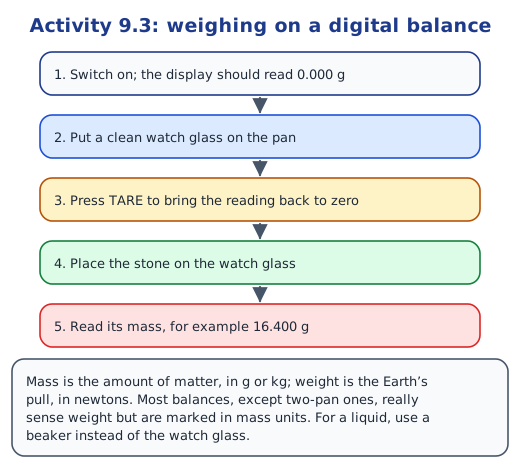
In everyday speech “mass” and “weight” are used as if they meant the same thing, but in science they differ. Mass is measured in grams and kilograms. Weight is the force with which the Earth pulls an object, measured in newtons. Most balances, other than two-pan balances, actually sense weight, but their scales are marked so that they show mass in grams or kilograms.
Volume of a liquid
Volume is the space an object occupies. The SI unit is the cubic metre (m³); smaller volumes use the cubic decimetre (dm³) or cubic centimetre (cm³, also called cc). A litre equals 1 dm³ and a millilitre equals 1 cm³, so a 200 mL pack of buttermilk holds 200 cm³.
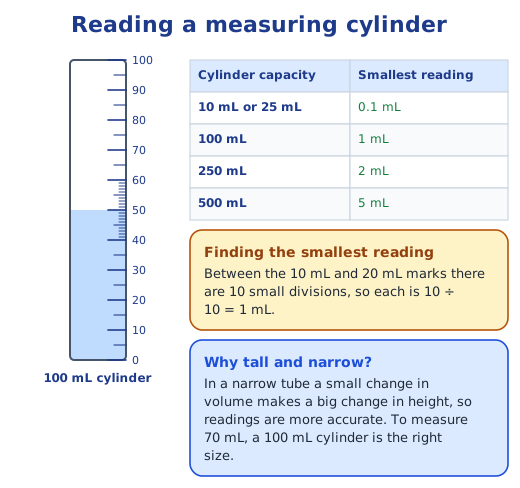
A measuring cylinder is a narrow, transparent tube, closed at one end, with volume marks on its side. They come in sizes such as 5, 10, 25, 50, 100 and 250 mL. To find the smallest reading of one (Activity 9.4), take two numbered marks, such as 10 mL and 20 mL, and divide the difference by the number of small divisions between them: 10 mL ÷ 10 = 1 mL for a 100 mL cylinder. Smaller cylinders often read to 0.1 mL, a 250 mL one to 2 mL and a 500 mL one to 5 mL. So pick a size close to the volume you need: for 70 mL, a 100 mL cylinder does it in one step and to 1 mL.
The meniscus
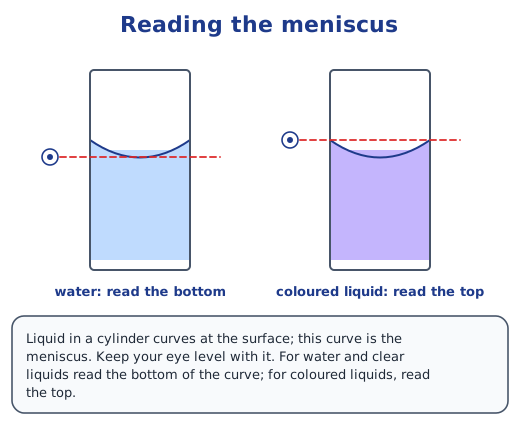
To measure 50 mL of water (Activity 9.5), stand the cylinder on a flat surface, pour slowly up to the mark, and adjust with a dropper. The water surface curves; this curve is the meniscus. Keep your eyes level with it and read the mark at the bottom of the curve for water and other colourless liquids. For coloured liquids, read the top of the meniscus instead.
Volume of a solid
A solid with a regular shape is easy (Activity 9.6). Measure a cuboid with a scale and multiply: a notebook 25 cm long, 18 cm wide and 2 cm thick has a volume of 25 × 18 × 2 = 900 cm³.
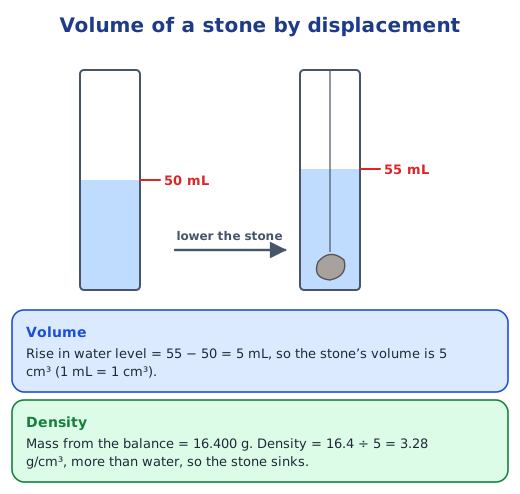
A stone has no neat sides, so use displacement (Activity 9.7). Pour water into a measuring cylinder up to a known level, say 50 mL. Tie the stone to a thread and lower it gently in; the level rises, say to 55 mL. The rise, 55 − 50 = 5 mL, is the volume of water pushed aside, which equals the stone’s volume, 5 cm³. Try it with a metal key too.
Putting them together
With the stone’s mass (16.400 g) and volume (5 cm³), density = 16.4 ÷ 5 = 3.28 g/cm³. That is more than water’s 1 g/cm³, so the stone sinks. Read more in density and solubility, or see the Chapter 9 notes and the NCERT solutions.
Practice
-
The tare button on a digital balance is used to:
Show answer
Answer: (b) bring the reading back to zero
-
For water in a measuring cylinder, the reading is taken at:
Show answer
Answer: (b) the bottom of the meniscus
-
Water in a cylinder rises from 50 mL to 55 mL when a stone is lowered in. The stone’s volume is:
Show answer
Answer: (a) 5 cm³
-
Find the volume of a notebook 25 cm long, 18 cm wide and 2 cm thick.
Show answer
Answer: Volume = length × width × height = 25 cm × 18 cm × 2 cm = 900 cm³.
-
Which cylinder would you choose to measure 70 mL of water: 50 mL, 100 mL or 500 mL? Why?
Show answer
Answer: The 100 mL cylinder. A 50 mL cylinder would need two measurements, and a 500 mL cylinder’s smallest reading is 5 mL, so it is less accurate. The 100 mL one measures 70 mL in one step, to 1 mL.
Questions students ask
What is the difference between mass and weight?
Mass is the quantity of matter in an object, measured in grams or kilograms. Weight is the force with which the Earth pulls the object, measured in newtons. Most balances, apart from two-pan balances, actually sense weight, but their readings are given in mass units, grams or kilograms.
How do you find the volume of an irregular object like a stone?
Use the displacement method. Fill a measuring cylinder with water to a known level, say 50 mL, tie the stone to a thread and lower it in, and note the new level, say 55 mL. The difference, 5 mL, is the stone’s volume, written as 5 cm³ for a solid.
Why are measuring cylinders tall and narrow?
In a narrow tube, a small change in volume makes a noticeable change in the height of the liquid, so the marks can be spaced further apart and read more precisely. In a wide, short container the same change would barely move the level.
Stuck on a question?
Take a photo and Lagnever AI explains it step by step. Try it for 7 days for ₹2.
Get it on Google Play Open in browser
For parents: after the trial, the plan renews monthly by UPI or card autopay. You can cancel anytime in the app.