
Class 8 Science Chapter 9: The Amazing World of Solutes, Solvents, and Solutions Notes
This chapter in five lines
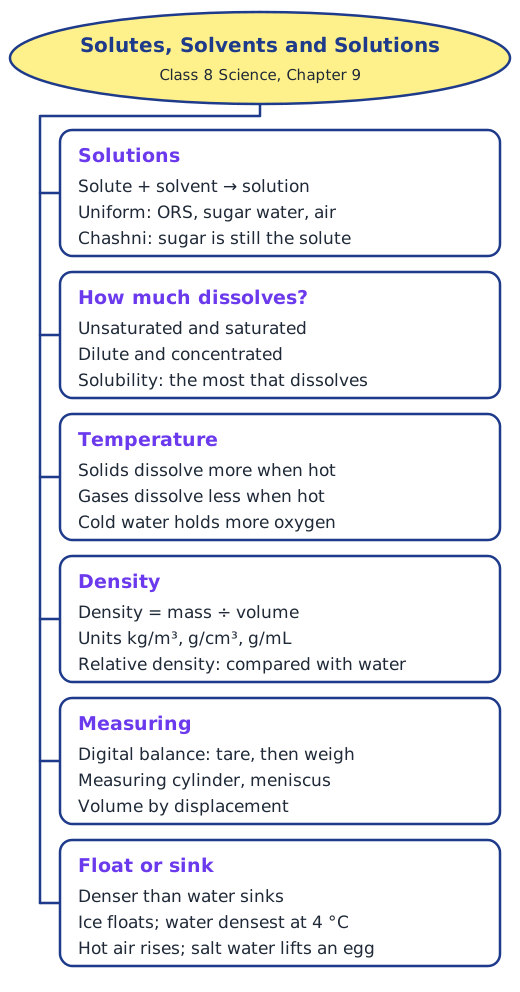
The Amazing World of Solutes, Solvents, and Solutions explains why ORS tastes the same in every sip: a solute dissolves evenly in a solvent to form a solution. Only a limited amount dissolves, and temperature changes that limit. The second half is about density, mass per unit volume, how to measure mass and volume, and why some things float while others sink.
What is this chapter about?
Homemade ORS tastes the same whether you take the first sip or the last; it is never salty in one mouthful and sweet in the next. That happens because sugar and salt spread evenly through the water. The chapter explores such mixtures: what dissolves in what, how much can dissolve, and what heat does to it. Its second half asks why husk floats while rice sinks when rice is washed, which leads to density and to measuring mass and volume carefully.
Solutes, solvents and solutions
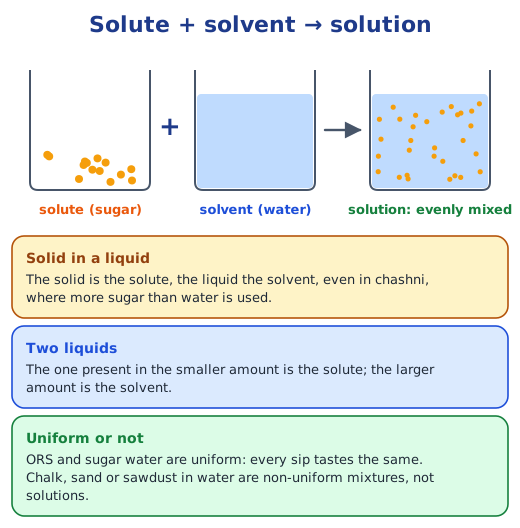
Mix salt or sugar with water and you get a uniform mixture, called a solution. Stir chalk powder, sand or sawdust into water and the parts stay visible, so those are non-uniform mixtures, not solutions. When a solid dissolves in a liquid, the solid is the solute and the liquid is the solvent: solute + solvent → solution. The chashni of gulab jamun holds far more sugar than water, yet sugar is still the solute. When two liquids mix, the one present in the smaller amount is called the solute. Air, a uniform mixture of gases, is a solution too.
How much can dissolve?
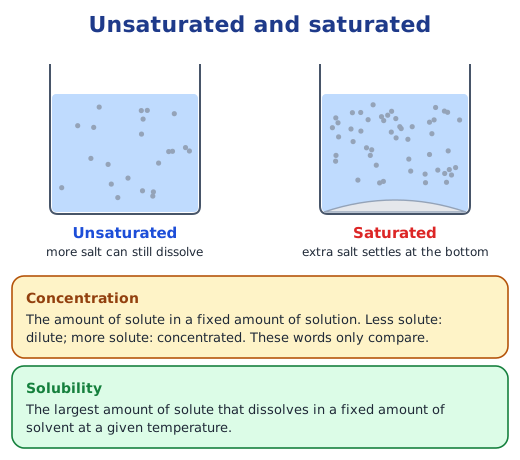
Add salt to half a glass of water one spoon at a time (Activity 9.1). At first every spoonful disappears; after a few, some salt stays at the bottom however much you stir. Water can hold only a limited amount. A solution that can still dissolve more is unsaturated; once extra solute settles, it is saturated at that temperature. The amount of solute in a fixed amount of solution is its concentration: less solute makes a dilute solution and more makes a concentrated one, words that only compare. The most solute that a fixed amount of solvent can take is its solubility. Read solubility.
Temperature and solubility
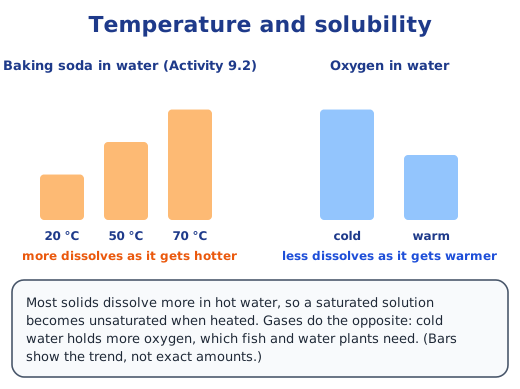
In a demonstration (Activity 9.2), baking soda is stirred into 50 mL of water at 20 °C until some stays undissolved. Warmed to 50 °C, the leftover dissolves and more can be added; at 70 °C even more goes in. For most solids, solubility rises with temperature, so a saturated solution becomes unsaturated when heated. Gases behave the other way. Oxygen dissolves in water only slightly, yet that dissolved oxygen keeps fish and water plants alive, and cold water holds more of it than warm water.
Water has long been the main solvent in Ayurveda, Siddha and other Indian systems of medicine, with oils, ghee and milk also used to carry medicines. The chemist Asima Chatterjee used solvents to extract compounds from medicinal plants and developed anti-epileptic and anti-malarial drugs.
What is density?
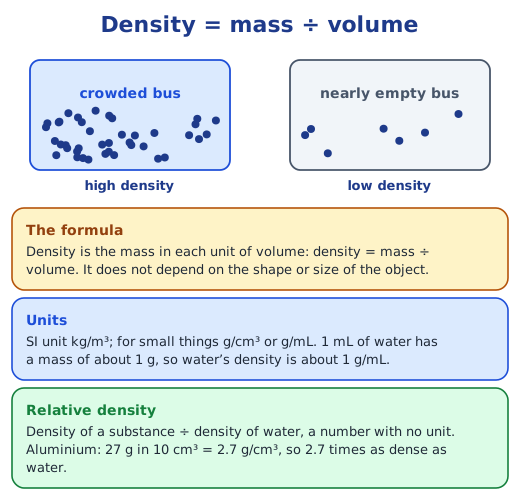
A wooden stick and an iron rod of the same size feel very different in the hand. A crowded bus and a nearly empty one, or a dense forest and a sparse one, show the idea: how tightly matter is packed. Density is the mass in one unit of volume, density = mass ÷ volume. It does not depend on an object’s shape or size. Its SI unit is kg/m³, and g/mL or g/cm³ are handy for small amounts. Since 1 mL of water has a mass of about 1 g, water’s density is about 1 g/mL. Relative density compares a substance with water: aluminium, 27 g in 10 cm³, is 2.7 g/cm³, so its relative density is 2.7. Read density.
Measuring mass and volume
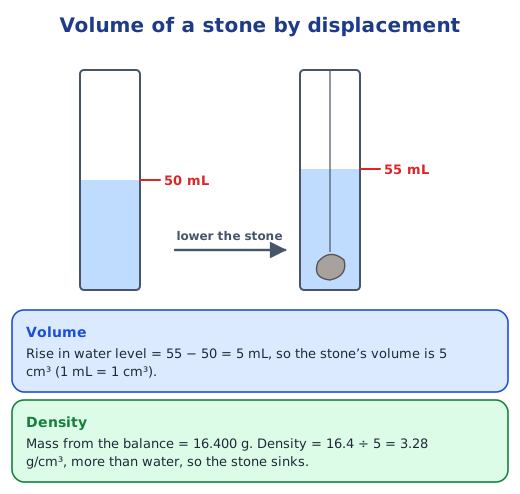
Mass is measured with a balance. On a digital balance, check that the display shows zero, put a clean watch glass on the pan, press tare to return to zero, and then place the object; a stone might read 16.400 g. Mass is the quantity of matter, in grams or kilograms; weight is the Earth’s pull, in newtons. Volume of a liquid is measured with a measuring cylinder: find the smallest reading by dividing the gap between two numbered marks by the number of small divisions, keep your eye level with the meniscus, and read its bottom for water. For a cuboid, volume = length × width × height. For a stone, use displacement. Read how to measure mass and volume.
Temperature, pressure and density
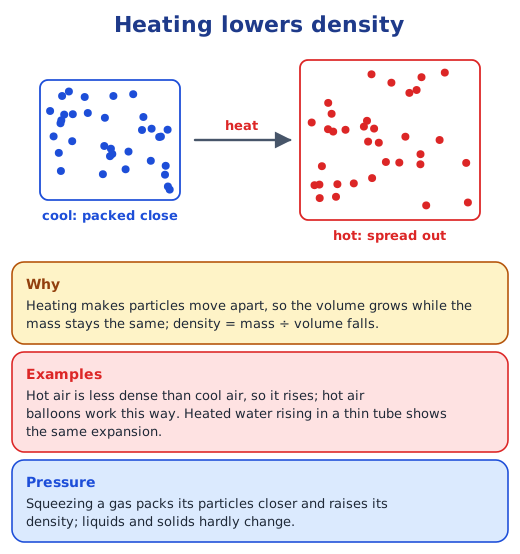
Heating makes particles move apart, so a substance takes up more space with the same mass, and its density falls. That is why hot air rises above cooler air and how a hot air balloon lifts off. Pressure squeezes gases into a smaller volume and raises their density, but barely affects liquids and solids. Water is unusual: it is densest at 4 °C and expands as it freezes, so ice floats and shelters the water and fish below. Inside the Earth the layers grow denser from the light crust to the inner core.
Before we move on
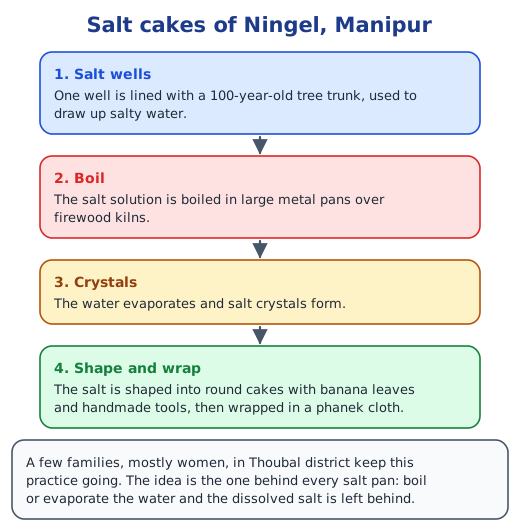
Long before ships of steel, people crossed rivers on rafts of hollow bamboo and wooden logs, which float easily. In Ningel village in Manipur, families still boil salty well water in metal pans until salt crystals form, then shape them into salt cakes. Answers to every question are in the NCERT solutions for Chapter 9.
Key terms
| Term | Meaning |
|---|---|
| Solution | A uniform mixture in which one substance is spread evenly through another, such as salt or sugar in water. |
| Solute | The substance that dissolves; in a solid-in-liquid solution it is always the solid, and with two liquids it is the one present in smaller amount. |
| Solvent | The substance in which the solute dissolves, such as water in sugar water; with two liquids it is the one present in larger amount. |
| Non-uniform mixture | A mixture whose parts are not evenly spread and can be seen, such as chalk, sand or sawdust in water. |
| Unsaturated solution | A solution that can still dissolve more solute at that temperature. |
| Saturated solution | A solution that cannot dissolve any more solute at that temperature; extra solute settles at the bottom. |
| Concentration | The amount of solute in a fixed amount of solution or solvent; a dilute solution has less solute and a concentrated one more. |
| Solubility | The largest amount of a solute that dissolves in a fixed amount (100 mL) of solvent at a particular temperature. |
| Density | The mass in one unit of volume of a substance: density = mass ÷ volume, in kg/m³, g/cm³ or g/mL. |
| Relative density | The density of a substance divided by the density of water; a plain number with no unit. |
| Mass | The quantity of matter in an object, measured in grams or kilograms with a balance. |
| Weight | The force with which the Earth pulls an object, measured in newtons. |
| Meniscus | The curved surface of a liquid in a measuring cylinder; read its bottom for water and its top for coloured liquids. |
| Displacement method | Finding the volume of an irregular solid from the rise in water level when it is lowered into a measuring cylinder. |
Topics in this chapter
Practice
-
Which of these is a solution?
Show answer
Answer: (c) Sugar dissolved in water
-
In chashni (sugar syrup), the solvent is:
Show answer
Answer: (b) water
-
When the temperature of water rises, the solubility of oxygen in it:
Show answer
Answer: (b) decreases
-
The SI unit of density is:
Show answer
Answer: (b) kg/m³
-
A 100 mL measuring cylinder has 10 small divisions between the 10 mL and 20 mL marks. Its smallest reading is:
Show answer
Answer: (b) 1 mL
-
Water is densest at:
Show answer
Answer: (b) 4 °C
Questions students ask
What are the main topics of Class 8 Science Chapter 9?
Solutions and their parts, the solute and the solvent; uniform and non-uniform mixtures; saturated and unsaturated solutions, concentration and solubility; how temperature affects the solubility of solids and gases; density and relative density; measuring mass with a digital balance and volume with a measuring cylinder; and how temperature and pressure change density.
Is The Amazing World of Solutes, Solvents, and Solutions in the new NCERT Class 8 Science book?
Yes. It is Chapter 9 of Curiosity, the Class 8 Science textbook (Reprint 2026-27), on pages 134 to 151. It follows Nature of Matter: Elements, Compounds, and Mixtures, which introduced uniform mixtures.
What is the difference between a saturated and an unsaturated solution?
An unsaturated solution can still dissolve more solute at that temperature. A saturated solution has dissolved all the solute it can, so any extra settles at the bottom. Heating a saturated solution of a solid usually makes it unsaturated again, because more can then dissolve.
Why does oil float on water?
Oil is less dense than water. A 1 litre pack of oil has a mass of only about 910 g, while 1 litre of water has a mass of about 1000 g, so oil’s density is about 0.91 g/mL, below water’s 1 g/mL, and it stays on top.
Stuck on a question?
Take a photo and Lagnever AI explains it step by step. Try it for 7 days for ₹2.
Get it on Google Play Open in browser
For parents: after the trial, the plan renews monthly by UPI or card autopay. You can cancel anytime in the app.