
Solubility: how much can dissolve?
Answer in short
Solubility is the largest amount of a solute that can dissolve in a fixed amount of solvent, usually 100 mL, at a particular temperature. Below that limit the solution is unsaturated; at the limit it is saturated and extra solute settles. Most solids dissolve more in hot water, while gases such as oxygen dissolve less.
Stuck on a question? Take a photo and Lagnever AI explains it step by step. Try it for 7 days for ₹2. Get it on Google Play
The salt test
Fill a glass tumbler half with water and add one spoon of salt, stirring until it disappears. Keep adding salt, a spoonful at a time, and note each time whether it dissolves (Activity 9.1). For a while every spoonful vanishes. Then a stage comes when stirring no longer helps and some salt lies at the bottom of the glass. The water has reached its limit for salt.
That limit has a name. The largest amount of a solute that can dissolve in a fixed amount of solvent at a given temperature is its solubility. The book’s summary takes 100 mL as that fixed amount, which makes it easy to compare different solutes.
Unsaturated and saturated
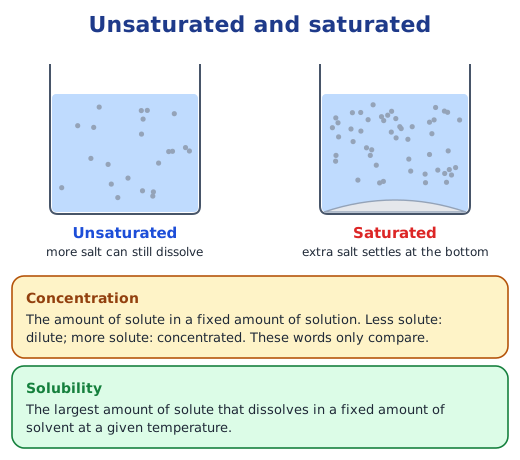
While the water can still take in more salt, the solution is unsaturated. Once no more will dissolve and the extra begins to settle, the solution is saturated at that temperature. The words “at that temperature” matter, because the limit moves when the temperature changes.
Sugar in tea shows the same thing. If you add too much, some sugar stays at the bottom of the cup: the tea is saturated with sugar. Warming the tea or adding more tea lets the extra sugar dissolve.
Dilute and concentrated
Concentration tells how much solute is present in a set amount of solution (or solvent). A solution with less solute is dilute; one with more is concentrated. These are relative words: the glass with one spoon of salt is dilute compared with the glass that has two or three.
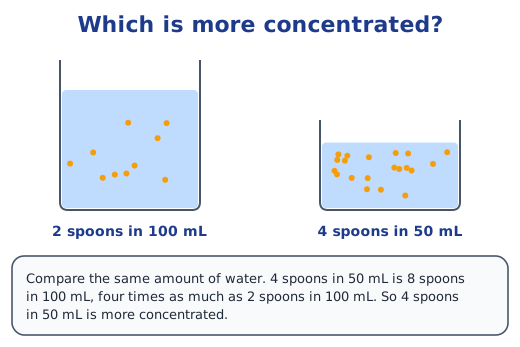
To compare two solutions fairly, bring them to the same amount of water. Is 2 spoons of salt in 100 mL more concentrated than 4 spoons in 50 mL? Doubling the second gives 8 spoons in 100 mL, four times as much salt in the same water, so 4 spoons in 50 mL is more concentrated.
Heat helps solids dissolve
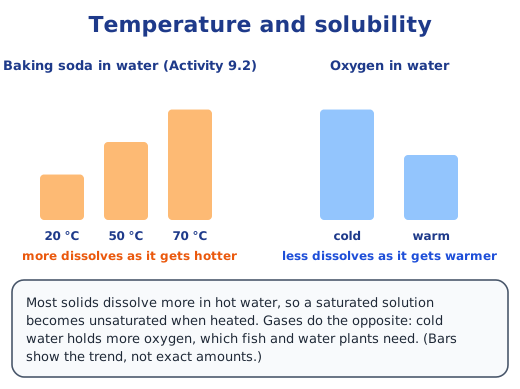
In Activity 9.2, a teacher stirs baking soda (sodium hydrogen carbonate) into about 50 mL of water at 20 °C until some stays undissolved. Heated to 50 °C, the leftover baking soda dissolves and more can be added. At 70 °C still more dissolves. For most substances, then, solubility increases as the temperature rises, and a solution that was saturated when cool behaves as unsaturated once it is heated.
This is why sugar dissolves so easily in hot milk or tea, and why syrups are made over a flame.
Gases dissolve less when warm
Gases such as oxygen also dissolve in water, only a little, and they spread evenly, so the mixture is uniform. That small amount of dissolved oxygen supports fish, water plants and other aquatic life. Here temperature works the other way: the solubility of gases generally falls as water warms. Cold water holds more oxygen, which is good for life in it, while warm water holds less.
Does the solvent matter?
Sugar and salt dissolve readily in water but hardly at all in oil. Water dissolves so many substances that it is called a good solvent, and traditional Indian medicine has long used it, along with oils, ghee and milk, to prepare medicines. Even so, water cannot dissolve everything: oil and fat stay separate. Learn about the other half of the chapter in density and how to measure mass and volume, or see the Chapter 9 notes and the NCERT solutions.
Practice
-
A solution in which more solute can still dissolve at that temperature is:
Show answer
Answer: (b) unsaturated
-
Which solution has the higher concentration?
Show answer
Answer: (b) 4 spoons of salt in 50 mL
-
For most solids, solubility in water:
Show answer
Answer: (a) rises with temperature
-
Some sugar stays at the bottom of your tea. Give two ways to make it dissolve.
Show answer
Answer: Warm the tea, because more sugar dissolves in hotter water, or add more tea or water, so there is more solvent to dissolve it. Stirring helps it dissolve faster but cannot raise the limit.
-
Why can fish find it harder to breathe in a warm pond?
Show answer
Answer: Gases dissolve less as water gets warmer. Warm water holds less dissolved oxygen than cold water, so less oxygen is available for fish and other water life.
Questions students ask
What is solubility in simple words?
It is the limit of how much of a substance can dissolve. For example, only a certain number of spoons of salt dissolve in a glass of water; after that, the extra salt stays at the bottom. That limit, for a fixed amount of solvent at a particular temperature, is the solubility.
How does temperature affect solubility?
For most solids, raising the temperature raises the solubility: in Activity 9.2, more baking soda dissolves at 70 °C than at 50 °C, and the least at 20 °C. For gases it is the reverse; oxygen is more soluble in cold water than in hot water.
How can a saturated solution be made unsaturated?
Heat it, for a solid solute, so that more can dissolve, or add more solvent. Either way, the solution can once again take in more solute.
Stuck on a question?
Take a photo and Lagnever AI explains it step by step. Try it for 7 days for ₹2.
Get it on Google Play Open in browser
For parents: after the trial, the plan renews monthly by UPI or card autopay. You can cancel anytime in the app.