
Density: why some things float and others sink
Answer in short
Density is the mass in one unit of volume: density = mass ÷ volume. Its SI unit is kg/m³, and g/cm³ or g/mL are used for small amounts. Water is about 1 g/mL. Things less dense than water, such as oil and ice, float on it, while denser things, such as stone and iron, sink.
Stuck on a question? Take a photo and Lagnever AI explains it step by step. Try it for 7 days for ₹2. Get it on Google Play
Heavy or dense?
While washing rice, the husk floats and the grains sink. Oil poured into water rises to the top. People often say floating things are lighter, but a huge wooden log floats while a small pebble sinks. A wooden stick and an iron rod of the same size settle the question: the iron feels much heavier because more mass is packed into the same space. That property is density.
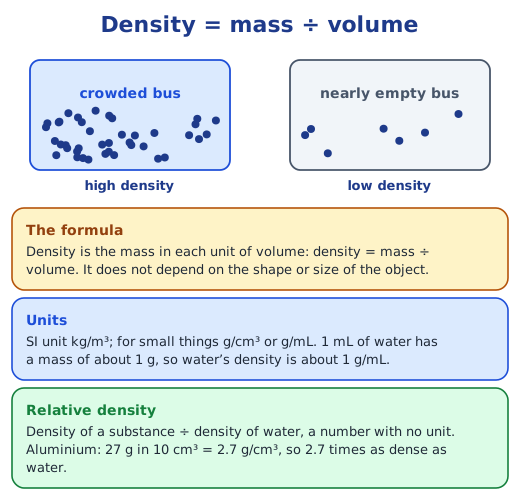
Picture a crowded bus, with people pressed together: high density. The same bus with a handful of riders has low density. A forest with trees close together is called dense; one with trees spread out is less dense.
The formula
Density is the mass in one unit of volume of a substance:
Density = mass ÷ volume
It is a property of the material, not of the object, so it does not depend on shape or size. A clay cube of 120 g and 60 cm³ has a density of 2 g/cm³, and it still has 2 g/cm³ after being pressed into a thin sheet, because neither its mass nor its volume has changed.
Units and relative density
With mass in kilograms and volume in cubic metres, the SI unit is kg/m³. For liquids and small objects, g/mL and g/cm³ are easier; 1 kg/m³ works out to 1 g per litre. At room temperature 1 mL of water has a mass of about 1 g, so 100 mL of water is about 100 g, and water’s density is about 1 g/mL.
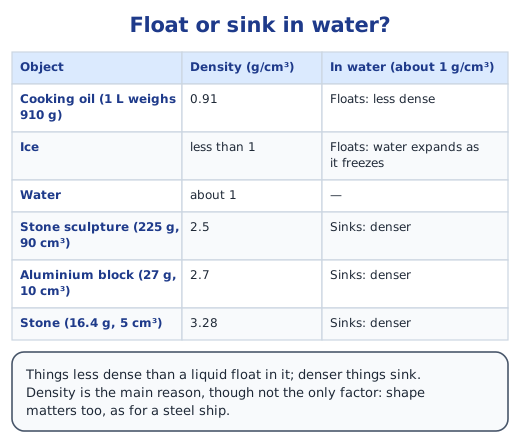
An aluminium block of 27 g with a volume of 10 cm³ has a density of 2.7 g/cm³, which makes it 2.7 times as dense as water. That ratio, the density of a substance divided by the density of water, is its relative density. Being a ratio, it has no unit.
Float or sink?
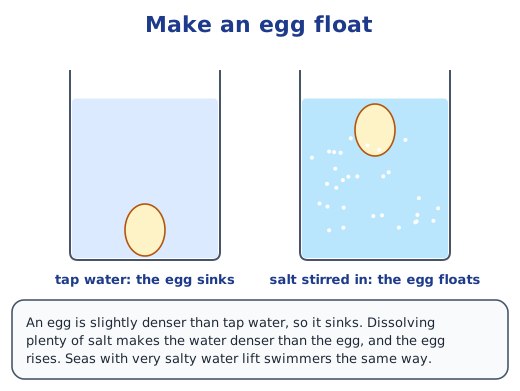
Anything less dense than a liquid floats in it; anything denser sinks. Oil (about 0.91 g/mL) floats on water. A stone of 16.4 g and 5 cm³, at 3.28 g/cm³, sinks. Dissolving plenty of salt makes water denser, which is how an egg that sinks in tap water can be made to float. Density explains a lot but not everything; shape matters too, which is why rafts of light, hollow bamboo float so well.
Heat and pressure
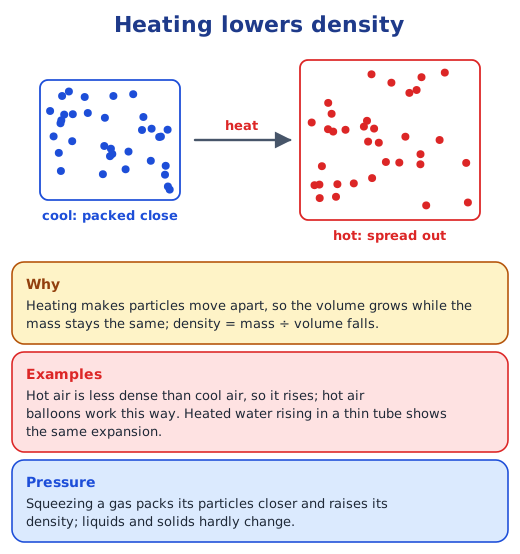
Density usually falls with heating and rises with cooling. Warmed particles move apart, so the volume grows while the mass stays the same, and mass ÷ volume gets smaller. Hot air has a lower density than the cooler air surrounding it, so it rises, which is how a hot air balloon flies. Pressure matters mostly for gases: squeezing a gas brings its particles closer and raises its density, while liquids and solids hardly change.
Ice, and the Earth below us
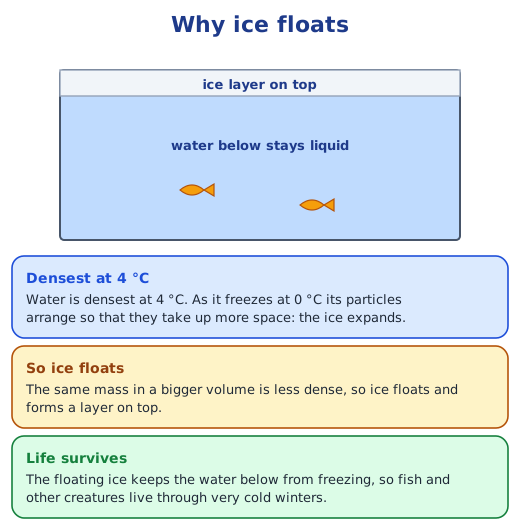
Water breaks the usual pattern near freezing. It is densest at 4 °C, and when it turns to ice at 0 °C its particles arrange themselves to take up more space. So ice is less dense than water and floats, forming a lid that keeps the water underneath liquid for fish through the coldest winters.
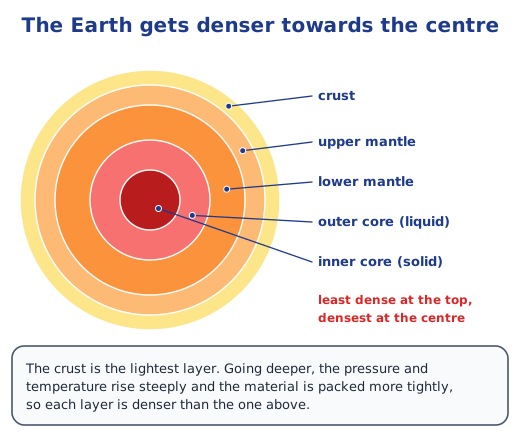
The Earth is layered by density too. The crust is the lightest layer; deeper down, through the upper and lower mantle to the liquid outer core and the solid inner core, pressure and temperature climb and the material is packed ever more tightly.
To find a density yourself you need two measurements; see how to measure mass and volume. Also read solubility, the Chapter 9 notes and the NCERT solutions.
Practice
-
A stone sculpture has a mass of 225 g and a volume of 90 cm³. Its density is:
Show answer
Answer: (b) 2.5 g/cm³
-
Relative density has:
Show answer
Answer: (c) no unit
-
When a substance is heated, its density usually:
Show answer
Answer: (b) decreases
-
A pack of oil says 1 litre but only 910 g. What does this tell you?
Show answer
Answer: One litre of water has a mass of about 1000 g, so the same volume of oil is lighter. Oil’s density is about 0.91 g/mL, less than water’s 1 g/mL, so oil floats on water.
-
Why does pressure change the density of air much more than that of water?
Show answer
Answer: Gas particles are far apart, so pressing a gas pushes them closer, reducing its volume and raising its density. Particles in liquids and solids are already close together, so pressure hardly changes their volume or density.
Questions students ask
What is density in simple words?
Density tells how tightly matter is packed in a given space. A crowded bus has many people in the same space, so it is dense; a bus with a few passengers is not. In the same way, iron packs more mass into each cubic centimetre than wood does.
What is the SI unit of density?
Kilogram per cubic metre (kg/m³), since mass is measured in kilograms and volume in cubic metres. For small objects and liquids, gram per cubic centimetre (g/cm³) or gram per millilitre (g/mL) is more convenient.
Why does ice float on water?
Water is densest at 4 °C. As it freezes at 0 °C, its particles arrange themselves so that they take up more space. The same mass now fills a larger volume, so ice is less dense than liquid water and floats on top.
Stuck on a question?
Take a photo and Lagnever AI explains it step by step. Try it for 7 days for ₹2.
Get it on Google Play Open in browser
For parents: after the trial, the plan renews monthly by UPI or card autopay. You can cancel anytime in the app.