
NCERT Solutions Class 8 Science Chapter 9: The Amazing World of Solutes, Solvents, and Solutions
Answers to every question in Chapter 9, The Amazing World of Solutes, Solvents, and Solutions, of Curiosity, the Class 8 Science textbook (Reprint 2026-27): Probe and ponder, the questions in Activities 9.1 to 9.7 and in the text, all twelve questions of Keep the curiosity alive, and Discover, design, and debate. Page numbers follow the book (pages 134–151). Short notes: Chapter 9 notes.
Probe and ponder (page 134)
What is happening in the picture? Gandhi and his companions are gathering salt on the shore at Dandi. Seawater is a solution of salt in water; when the sun evaporates the water, the dissolved salt is left behind as crystals.
Too much sugar in your tea stops dissolving. How can you fix it? The tea is saturated with sugar. Warm it, since more sugar dissolves in hotter liquid, or add more tea or water so there is more solvent.
Sugar and salt dissolve in water but not in oil: why? And why is water called a good solvent? Water’s particles attract and surround particles of sugar and salt, pulling them apart and spreading them evenly; oil’s particles do not, so the crystals stay whole. Because water dissolves a great many substances, it is called a good solvent.
Why are water bottles tall and cylindrical, not spherical? A cylinder is easy to grip and pour from, stands upright on its flat base, and packs side by side with little wasted space. A sphere would roll away, be hard to hold and leave gaps when packed.
Solutions and how much dissolves (pages 135–137)
Is the mixture in Fig. 9.1 uniform? Yes. Sugar, salt and water form a uniform mixture, a solution. Chalk powder in water? No, that is a non-uniform mixture: the chalk particles stay visible and settle.
Is a mixture of gases, such as air, also a solution? Yes. Its gases are spread evenly, so it is a uniform mixture, a solution of gases in gases.
Activity 9.1. The first few spoons of salt dissolve completely; after that, some salt remains undissolved at the bottom however long you stir. The number of spoons depends on the amount of water, often four or five in half a glass. This shows that a fixed amount of water can dissolve only a limited amount of salt at a given temperature: the solution has become saturated.
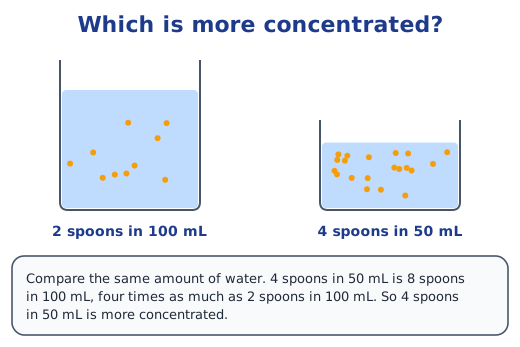
Which has the higher concentration: 2 spoons of salt in 100 mL, or 4 spoons in 50 mL? Compare them in the same amount of water: 4 spoons in 50 mL equals 8 spoons in 100 mL. So 4 spoons in 50 mL is more concentrated.
Activity 9.2 and gases in water (pages 137–139)
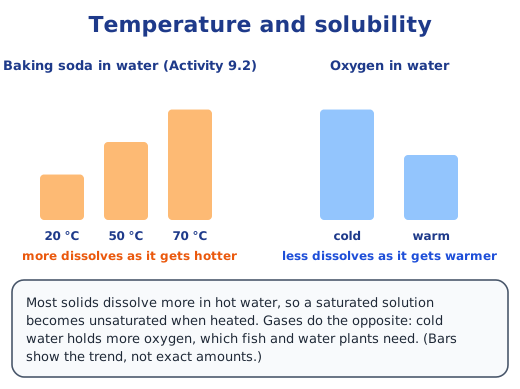
What happens to the undissolved baking soda on heating to 50 °C? It dissolves, and more can then be added before some is left over again. Heated to 70 °C, the leftover dissolves once more. Inference: the solubility of baking soda, like that of most solids, increases with temperature: water at 70 °C dissolves more than at 50 °C, and at 20 °C it dissolves the least.
What drew Asima Chatterjee to medicinal plants? She grew up sharing her father’s interest in plants used as medicine, and India has a long tradition of such remedies in Ayurveda. As a chemist she used solvents to extract and isolate the useful compounds in these plants, and developed anti-epileptic and anti-malarial drugs.
Do gases dissolve in water? Is the mixture uniform? Yes. Many gases, including oxygen, dissolve in small amounts, and they spread evenly, so the mixture is uniform. Does temperature affect their solubility? Yes: gases dissolve less as water warms, so cold water holds more oxygen for aquatic life.
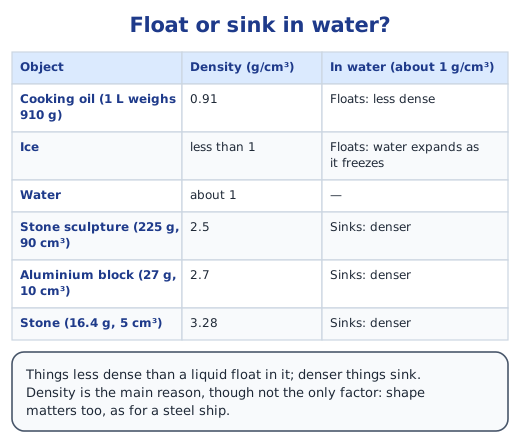
Why does sawdust float in water while sand sinks? Sawdust is less dense than water, and sand is denser.
Density and measuring (pages 139–148)
Husk floats and rice sinks while washing rice. Why? Husk is less dense than water and rice grains are denser.
A packet of oil says 1 litre but 910 g. What does this tell you about the oil? One litre of water has a mass of about 1000 g. The same volume of oil is lighter, so its density, about 0.91 g/mL, is less than that of water, and oil floats on water.
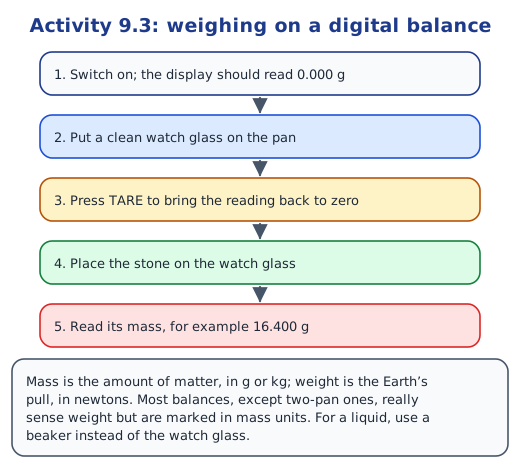
Activity 9.3. With the balance tared to zero after placing the watch glass, the display shows only the mass of the stone, for example 16.400 g.
What does ‘200 mL’ on a pack of buttermilk mean? The buttermilk inside occupies a volume of 200 mL, which is 200 cm³.
Activity 9.4. The cylinder in Fig. 9.16 can measure up to 100 mL. Between two bigger marks, such as 10 mL and 20 mL, the difference is 10 mL, and there are 10 small divisions, so one division is 10 ÷ 10 = 1 mL. The smallest volume it can read is 1 mL.
Why are measuring cylinders narrow and tall instead of wide and short like a beaker? In a narrow tube even a small change in volume changes the height of the liquid noticeably, so the marks are spaced out and can be read accurately. In a wide container the level would hardly move.
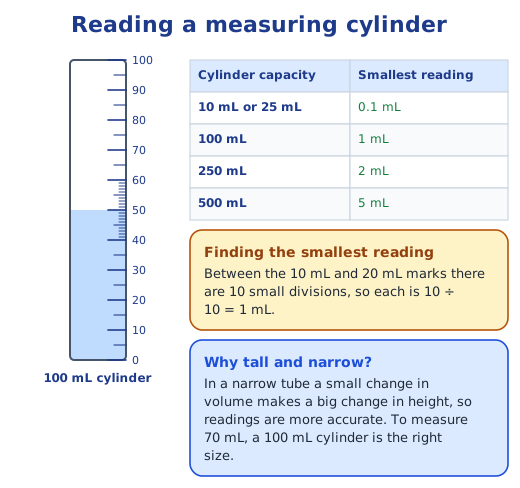
Activity 9.5. How is the level of a coloured liquid read? At the top of the meniscus; for water and colourless liquids, at the bottom, with the eye level with the surface.
Activity 9.6. Notebook: 25 cm × 18 cm × 2 cm = 900 cm³. A shoe box or a dice is measured the same way, length × width × height.
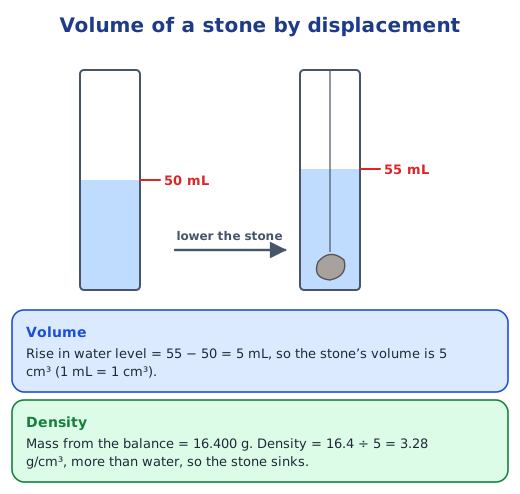
Activity 9.7 (Table 9.2). Stone: initial 50 mL, final 55 mL, water displaced 5 mL, so the stone’s volume is 5 cm³. A metal key or any other object is recorded the same way; a small key usually raises the level by only 1 or 2 mL. Density of the stone: 16.400 g ÷ 5 cm³ = 3.28 g/cm³.
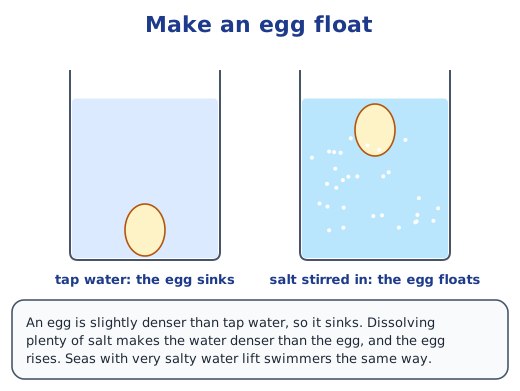
Think like a scientist: how can the sinking egg be made to float? Stir plenty of salt into the water. The salt water becomes denser than the egg, so the egg rises and floats.
Keep the curiosity alive (pages 149–151)
1. (i) False. Oxygen is more soluble in cold water than in hot water. (ii) False. Sand and water make a non-uniform mixture, not a solution. (iii) False. The space occupied by an object is its volume, not its mass. (iv) False. An unsaturated solution has less solute dissolved than a saturated one at the same temperature. (v) True.
2. (i) immersed (lowered); rise. (ii) solute; a fixed quantity (100 mL) of solvent. (iii) decreases. (iv) saturated.
3. (ii): water is denser than oil, so oil floats on it.
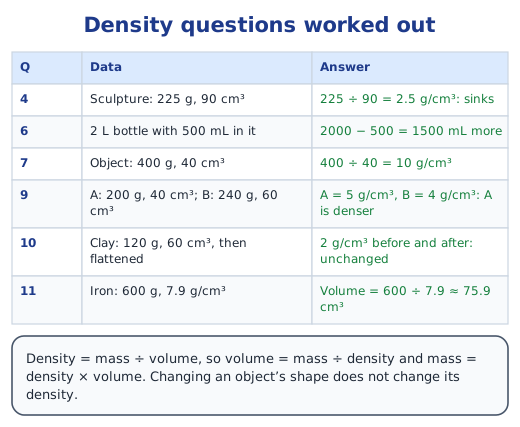
4. Density = 225 g ÷ 90 cm³ = 2.5 g/cm³. That is more than water’s 1 g/cm³, so the sculpture sinks.
5. (iii) is the most appropriate: no more solute can dissolve in a saturated solution at that temperature. (i) is wrong, because a saturated solution has already reached its limit. (ii) is wrong, because it describes a saturated solution; an unsaturated one can still dissolve more. (iv) is wrong, because a solution becomes saturated at any temperature once it holds as much solute as it can.
6. 2 litres = 2000 mL, so the bottle can hold 2000 − 500 = 1500 mL (1.5 L) more.
7. Density = 400 g ÷ 40 cm³ = 10 g/cm³.
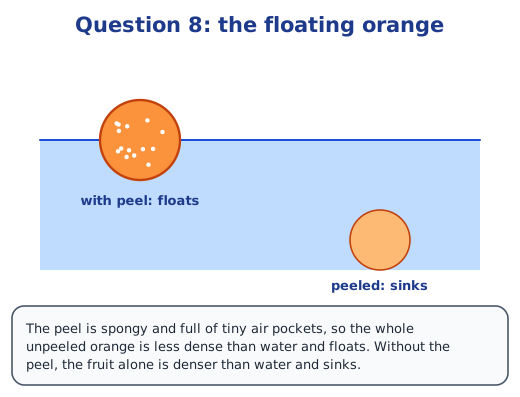
8. The peel is spongy and full of tiny air pockets, so the unpeeled orange as a whole is less dense than water and floats. Without the peel, the fruit is denser than water and sinks.
9. A: 200 ÷ 40 = 5 g/cm³. B: 240 ÷ 60 = 4 g/cm³. Object A is denser, though B is heavier.
10. The density of the clay is 120 g ÷ 60 cm³ = 2 g/cm³, and it stays 2 g/cm³ after flattening. A change of shape alters neither the mass nor the volume.
11. Volume = mass ÷ density = 600 ÷ 7.9 ≈ 75.9 cm³.
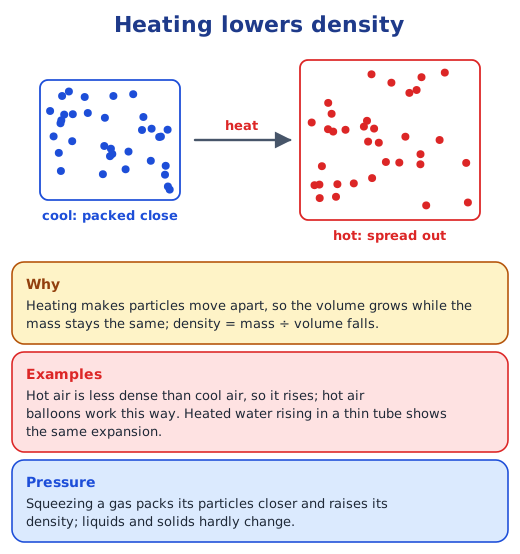
12. The water rising in the glass tube shows that the water in the test tube expands when heated: its volume increases while its mass stays the same. So its density decreases.
Discover, design, and debate (page 151)
Dead Sea: its water is extremely salty, almost ten times as salty as the ocean, and fish and plants cannot survive in such a concentrated solution; only some microbes can. The salty water is also so dense that people float on it easily. Similar salty lakes include the Great Salt Lake in the USA and Lake Assal in Djibouti. Salt in different solvents: salt dissolves well in water, also dissolves in vinegar, which is mostly water, and hardly dissolves in oil. Debate: water dissolves more substances than any other common liquid, which is why it is so useful in cooking, cleaning, medicine and inside our bodies; but it cannot dissolve oil, grease or wax, which need other solvents, so it is very versatile but not able to dissolve everything.
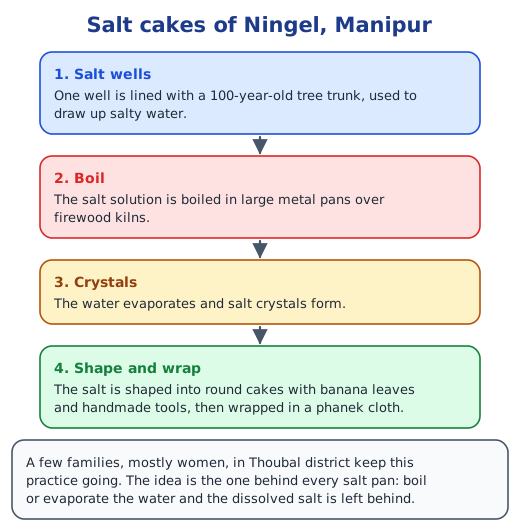
Our scientific heritage, Ningel salt. In Ningel village in Manipur’s Thoubal district, salty water from old wells is boiled in metal pans over firewood until the water evaporates and salt crystals form; the salt is shaped into round cakes with banana leaves and wrapped in a phanek cloth.
Practice
-
Which statement is correct?
Show answer
Answer: (c) No more solute can dissolve in a saturated solution at that temperature
-
Oil poured into water floats on top. This shows that:
Show answer
Answer: (b) water is denser than oil
-
Object A is 200 g and 40 cm³; object B is 240 g and 60 cm³. Which is denser?
Show answer
Answer: (a) A, at 5 g/cm³
-
An iron block of mass 600 g has a density of 7.9 g/cm³. Find its volume.
Show answer
Answer: Volume = mass ÷ density = 600 g ÷ 7.9 g/cm³ ≈ 75.9 cm³.
-
Reema flattens a 120 g clay cube of volume 60 cm³ into a thin sheet. What happens to its density?
Show answer
Answer: Nothing. Its density is 120 ÷ 60 = 2 g/cm³ before and after, because flattening changes only the shape; the mass and the volume of the clay stay the same.
Stuck on a question?
Take a photo and Lagnever AI explains it step by step. Try it for 7 days for ₹2.
Get it on Google Play Open in browser
For parents: after the trial, the plan renews monthly by UPI or card autopay. You can cancel anytime in the app.