
NCERT Solutions Class 8 Science Chapter 5: Exploring Forces
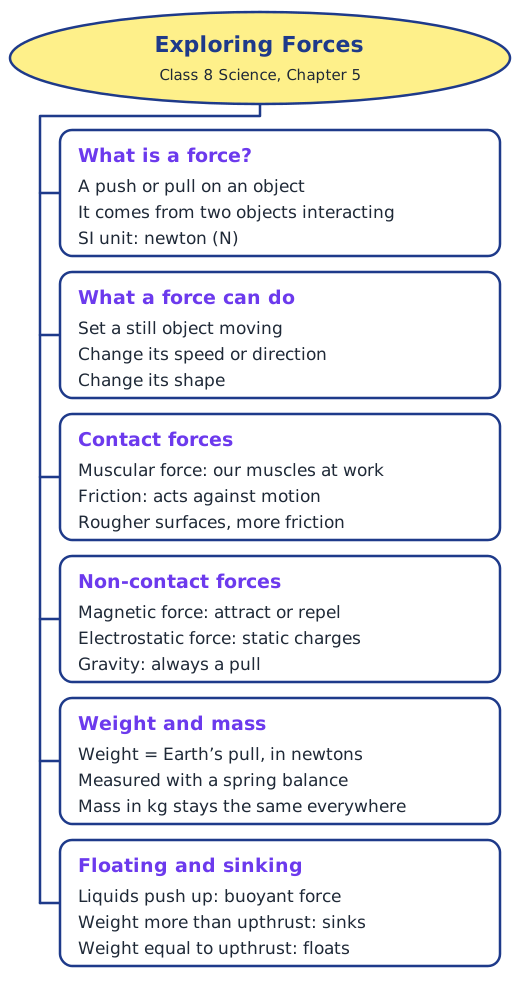
Answers to Probe and ponder, the questions inside the chapter, Activities 5.1 to 5.13, all ten Keep the curiosity alive questions and the Discover, design, and debate projects in Chapter 5, Exploring Forces, of Curiosity, the Grade 8 science textbook. Page numbers follow the 2026-27 reprint (pages 62–79). Short notes: Chapter 5 notes.
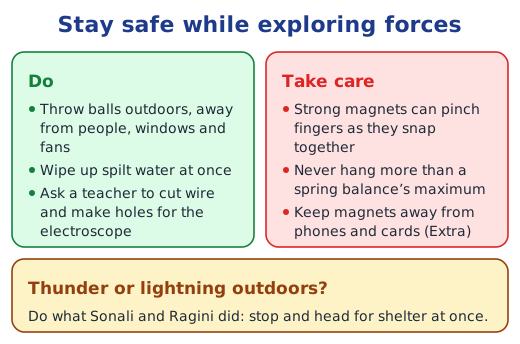
Stay safe. Throw balls only outdoors, away from people, windows and fans. Keep fingers clear when strong magnets snap together. Never hang more on a spring balance than its maximum. Wipe up spilt water at once. Let a teacher cut wire and make holes for the electroscope.
Probe and ponder (page 62)
Why is pedalling uphill harder than on flat ground? Gravity pulls you and the bicycle down towards the Earth. On a slope, part of that pull acts back down the hill, against your motion, so your muscles must push harder on the pedals. On the way down, the same pull speeds you up without pedalling.
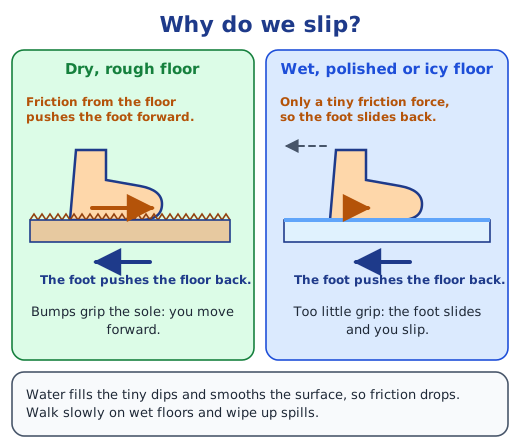
Why do wet floors make us slip more easily? Water fills the tiny dips in the surface and makes it smoother, so friction between your feet and the floor becomes small. With little friction, your foot slides instead of gripping.
Why do we feel ‘light’ just after a swing passes its highest point? (Extra.) We feel our weight through the push of whatever holds us up. As the swing starts to come down, you and the seat begin to fall together, so the seat presses up on you much less, and you feel light or floating. The Earth’s pull on you, your weight, has not changed at all.
Share your questions. For example: Why does a cricket ball stop sooner on long grass? How do magnets push without touching? Why do astronauts float in space?
Inside the chapter (pages 63–76)
The bicycle story (page 63). The bicycles speed downhill without pedalling because the Earth’s gravity pulls them down the slope. The wind pushing on the riders, the rough road, the bells and the turning handlebars are all forces at work too.
Activity 5.1: Let us explore (page 63). Besides pushing, pulling and lifting, you could drag the box with a rope, tip it over, slide it with your foot or nudge it with a stick. Every way still needs a push or a pull, so every way uses a force.
Activity 5.2: Let us analyse (pages 64–65). Some more rows for Table 5.1:
| Action | Push or pull | Effect |
|---|---|---|
| Opening a drawer | Pull | Starts it moving |
| Stretching a rubber band | Pull | Changes its shape |
| A fielder stopping a ball | Push | Stops it |
| Turning an autorickshaw’s handle | Push and pull | Changes its direction |
| Rolling a chapati | Push | Changes the dough’s shape |
Yes: a force can stop a moving object, change its speed or direction, and change its shape.
Does every change in speed, direction or shape mean a force is acting? (page 65) Yes. None of these changes happens without a force. An object at rest may still have forces acting on it, but they balance one another.
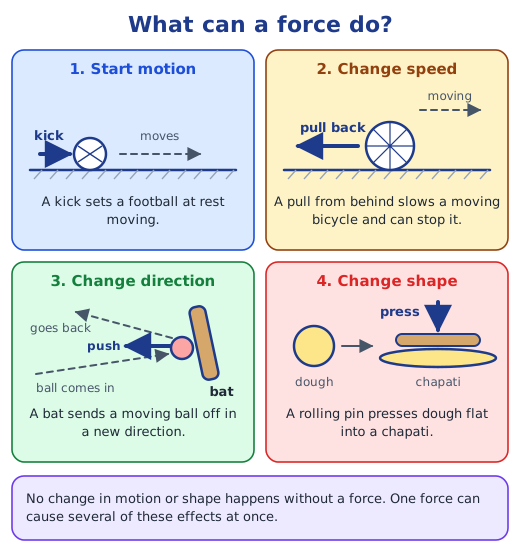
How many objects are involved in each action? (page 65) At least two in every case: a hand and a drawer, a foot and a football, a rolling pin and the dough. A force is always an interaction between objects.
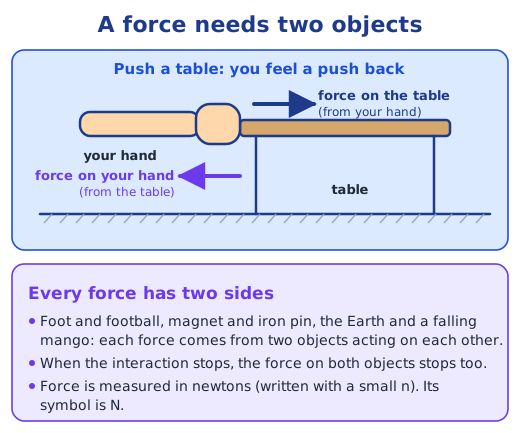
A step further: does your hand feel a force too? (page 66) Yes. While you push the table, it pushes back on your hand; when you stop, both forces end.
Muscular force and ‘Ever heard of …’ (pages 66–67). Walking, lifting, jumping and stretching all use muscular force. Inside the body, muscles help us chew and move food through the alimentary canal, and the heart’s muscles pump blood.
Is there any other contact force? (page 67) Yes, friction.
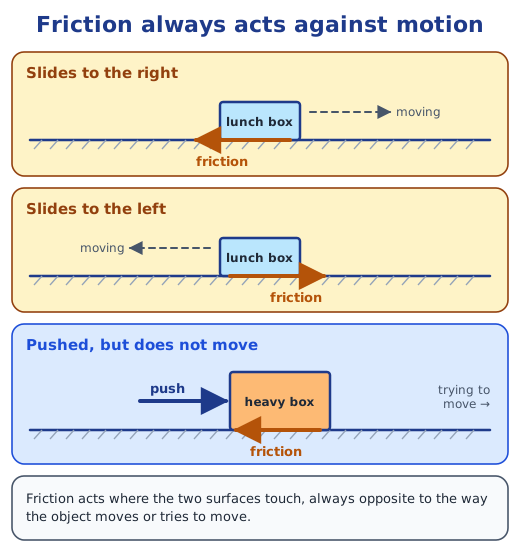
Activity 5.3: Let us investigate (pages 67–68). Yes, the box stops after sliding some distance, and yes, it stops again when pushed the other way. A force acting where the box touches the table, friction, brings it to rest, and it always acts opposite to the motion.
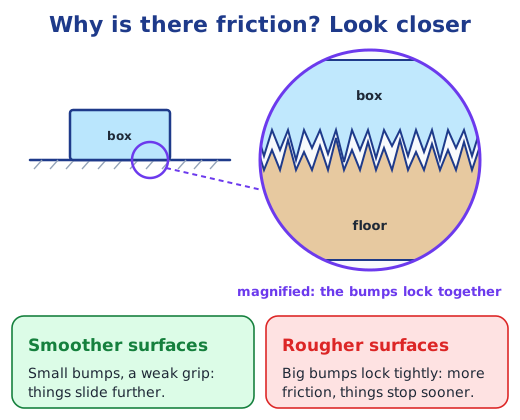
Will friction be greater if the surfaces are rough? (page 68) Yes. Rough surfaces have bigger bumps, which lock together more.
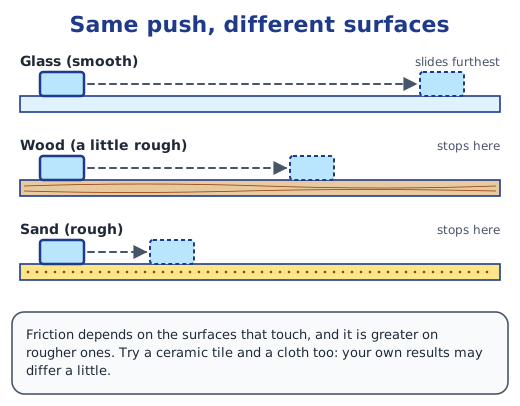
Activity 5.4: Let us explore (page 68). No, the box does not stop at the same distance as on the table, and no, it stops at different distances on different surfaces: furthest on smooth surfaces such as glass and a tile, and soonest on rough ones such as cloth and sand. So friction depends on the surfaces in contact.
A step further: friction in liquids and gases (page 68). Air and water also act against objects moving through them, so aeroplanes, ships, boats and high-speed trains get streamlined shapes.
Must an object touch another to apply a force? (page 69) No. Magnetic, electrostatic and gravitational forces act across a gap.
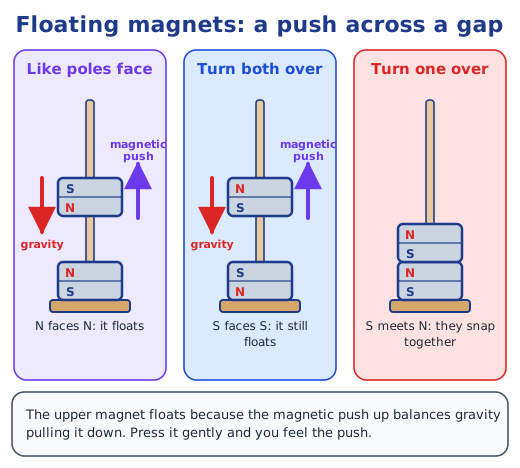
Activity 5.5: Let us test (page 69). Yes, the upper magnet floats above the lower one, and pushing it down you feel an upward push. When both magnets are turned over, like poles still face each other (south to south instead of north to north), so it still floats. (If only one were turned over, unlike poles would face each other and the magnets would snap together.) A magnet exerts a force without contact.
Are there more forces that act from a distance? (page 69) Yes: the electrostatic force and the gravitational force.
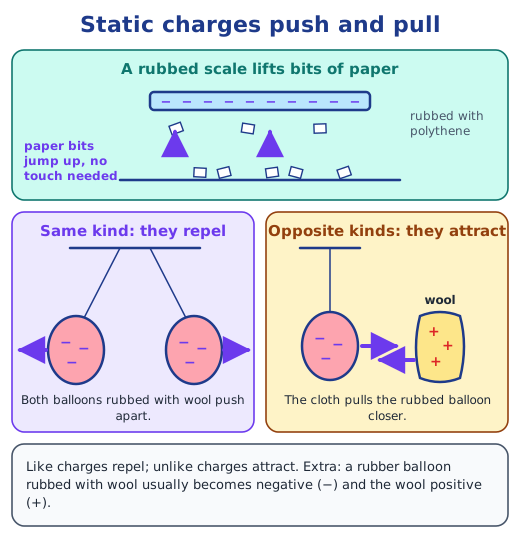
Activity 5.6: Let us experiment (page 70). The paper bits jump up to the rubbed scale or straw and cling to it, before it touches them. Rubbing leaves static charges on the plastic, and a charged object attracts small uncharged pieces of paper.
Activity 5.7: Let us experiment (pages 70–71). The two rubbed balloons move away from each other. The woollen cloth and a rubbed balloon move towards each other. Both balloons were charged the same way, so they carry the same kind of charge, and like charges repel. The cloth and the balloon carry opposite kinds, and unlike charges attract.
Are there two kinds of electrical charges? (page 71) Yes, called positive and negative.
A step further: moving charges (page 71). When charges move round a circuit, they make the electric current that lights a lamp and gives the heating and magnetic effects of Chapter 4.
Activity 5.8: Let us observe (page 71). Yes, the ball comes down. Thrown harder, it rises higher but still falls back to the ground. Do this outdoors, away from people and windows.
Why do all objects fall towards the Earth? What exerts the force? (page 72) The Earth pulls every object towards itself with the gravitational force, or gravity. Gravity is a non-contact force and is always attractive.
Is every object pulled equally hard by the Earth? (page 72) No, as Activity 5.9 shows.
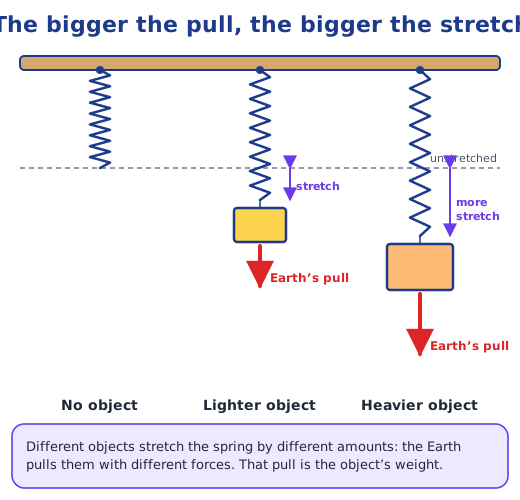
Activity 5.9: Let us explore (page 73). Yes, the spring stretches. No, the stretch is different for different objects, because the Earth pulls them with different forces: they have different weights. Yes, a spring can measure weight, which is how a spring balance works.
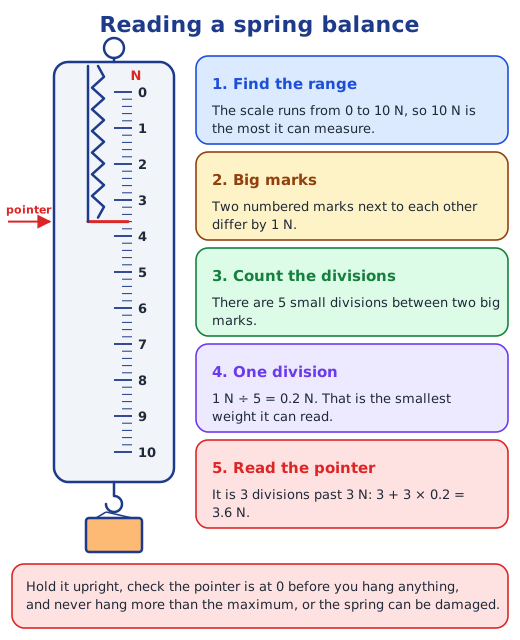
Activity 5.10: Let us observe (page 73). The balance in Fig. 5.13 can measure at most 10 N, so its range is 0 to 10 N.
Activity 5.11: Let us calculate (page 74). Two big marks differ by 1 N; there are 5 divisions between them; so one division reads 1 N ÷ 5 = 0.2 N. For your own balance, use the same method: for example, if two big marks differ by 1 N with 10 divisions between them, one division is 0.1 N.
Activity 5.12: Let us measure (pages 74–75). Hold the balance upright, check the pointer is at 0, hang each object from the hook and read the pointer at eye level. Your readings depend on your own objects, so write them to the nearest division, such as 2.4 N on a balance that reads 0.2 N. Never hang anything heavier than the maximum. Read the mass scale in the same way, after working out its smallest division.
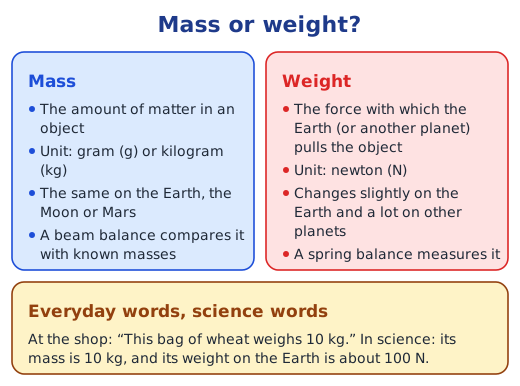
How is weight different from mass? (page 75) Mass tells you how much matter an object contains, in grams or kilograms, and it is the same everywhere. Weight is the pull of the Earth (or another planet) on it, in newtons, and it changes from place to place.
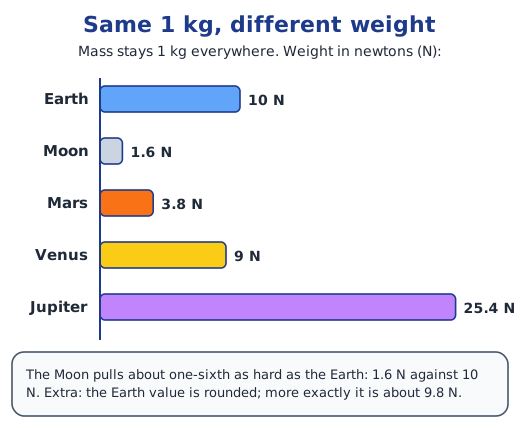
A step further: 1 kg on other worlds, and ‘10 kg of wheat’ (page 75). A 1 kg object stays 1 kg everywhere but weighs about 10 N on the Earth, 1.6 N on the Moon, 3.8 N on Mars, 9 N on Venus and 25.4 N on Jupiter. In science, ‘a 10 kg bag of wheat’ gives its mass; its weight on the Earth is about 100 N.
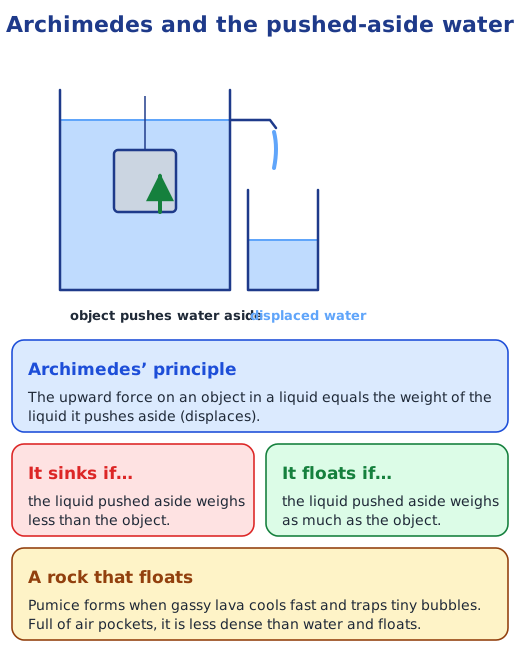
If gravity pulls everything, why do some objects stay up in water, and why does the mug feel lighter? (page 76) Water pushes up on objects with a buoyant force. A floating object gets as much upward push as its weight, and a mug under water is partly held up by the water.
Activity 5.13: Let us investigate (page 76). Yes, you feel an upward push, and yes, the bottle bounces back up when released. The water pushes up on it with upthrust, also called buoyant force.
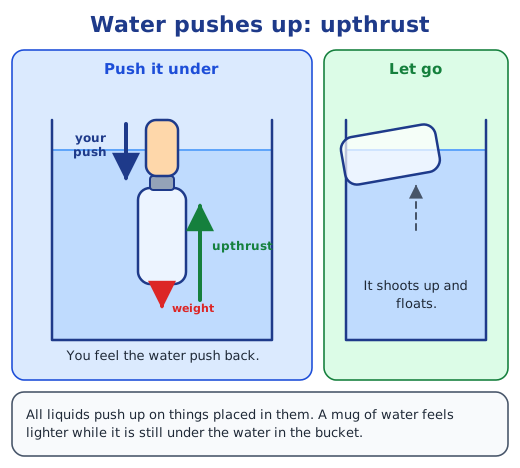
A step further: Archimedes, and ‘Ever heard of …’ pumice (page 76). The upward force on an object in a liquid equals the weight of the liquid it pushes aside. Pumice floats because its trapped gas bubbles make it less dense than water.
Keep the curiosity alive (pages 77–79)
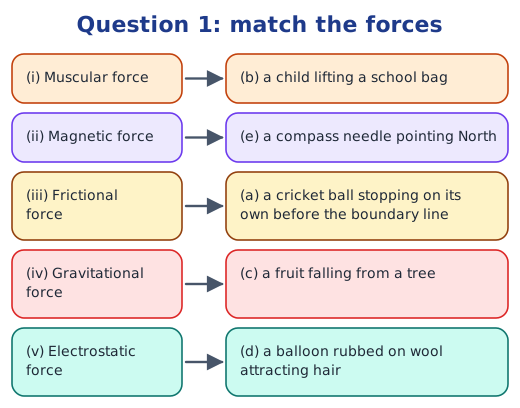
1. “Match items in Column A with the items in Column B.” (Column A (Type of force): (i) Muscular force, (ii) Magnetic force, (iii) Frictional force, (iv) Gravitational force, (v) Electrostatic force. Column B (Example): (a) A cricket ball stopping on its own just before touching the boundary line, (b) A child lifting a school bag, (c) A fruit falling from a tree, (d) Balloon rubbed on woollen cloth attracting hair strands, (e) A compass needle pointing North.)
- (i) Muscular force: (b), the child’s muscles lift the bag.
- (ii) Magnetic force: (e), the needle is a small magnet acted on without contact.
- (iii) Frictional force: (a), friction from the grass slows the ball to a stop.
- (iv) Gravitational force: (c), the Earth pulls the fruit down.
- (v) Electrostatic force: (d), the charged balloon attracts the hair.
2. “State whether the following statements are True or False.”
(i) “A force is always required to change the speed of motion of an object.” True. Speed never changes on its own; a push or pull is needed to speed an object up or slow it down.
(ii) “Due to friction, the speed of the ball rolling on a flat ground increases.” False. Friction acts against the motion, so the ball’s speed decreases until it stops.
(iii) “There is no force between two charged objects placed at a small distance apart.” False. They exert an electrostatic force on each other without touching: a push if their charges are alike, a pull if they are opposite.
3. “Two balloons rubbed with a woollen cloth are brought near each other. What would happen and why?” They move away from each other. Rubbed with the same cloth, both balloons get the same kind of charge, and like charges repel. This electrostatic force acts across the gap, without contact.
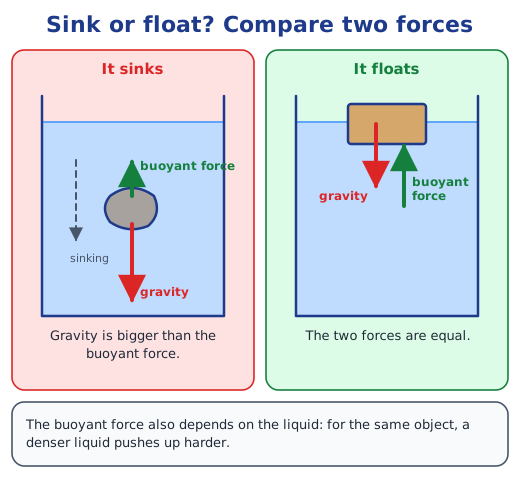
4. “When you drop a coin in a glass of water, it sinks, but when you place a bigger wooden block in water, it floats. Explain.” Two forces act on each: gravity pulling down and the buoyant force of the water pushing up. For the coin, gravity is more than the buoyant force, so it sinks. The wooden block sinks only part of the way in, until the buoyant force on it equals its weight, and then it floats. So being bigger does not make an object sink; what matters is how its weight compares with the upthrust. By Archimedes’ principle, the block pushes aside water as heavy as itself before it is fully under, but the coin, even fully under, pushes aside water lighter than itself. (Extra: wood is less dense than water and the metal of a coin is denser; see density.)
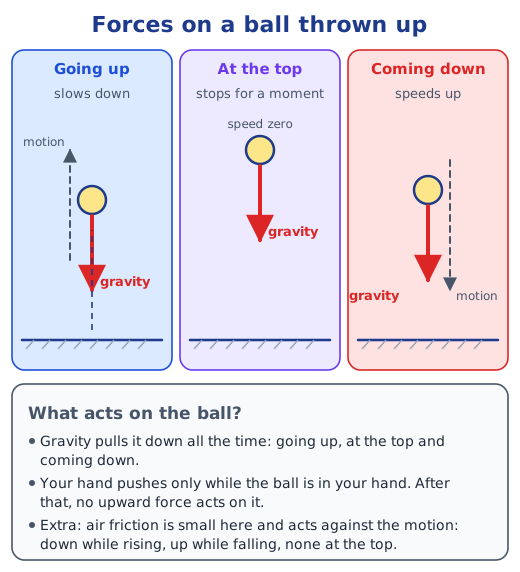
5. “If a ball is thrown upwards, it slows down, stops momentarily, and then falls back to the ground. Name the forces acting on the ball and specify their directions. (i) During its upward motion (ii) During its downward motion (iii) At its topmost position” Once the ball has left the hand, the hand no longer pushes it, so no upward force acts on it.
- (i) Going up: gravity, downwards. The air’s friction, which is small, acts against the motion, so also downwards. Both slow the ball.
- (ii) Coming down: gravity, downwards, which speeds the ball up. The air’s small friction now acts upwards, against the motion.
- (iii) At the top: gravity, downwards. The ball is still for an instant, so there is no air friction just then; gravity alone starts it falling.
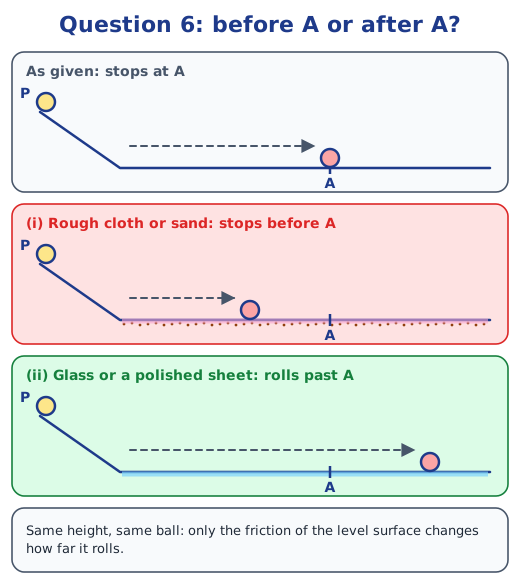
6. “A ball is released from the point P and moves along an inclined plane and then along a horizontal surface as shown in the Fig. 5.16. It comes to stop at the point A on the horizontal surface. Think of a way so that when the ball is released from the same point P, it stops (i) before the point A (ii) after crossing the point A.” Keep the same ball and the same point P, and change only the friction of the surface.
- (i) To stop it before A, make the horizontal surface rougher: cover it with a cloth, a towel, a jute sack or a thin layer of sand. More friction slows the ball sooner.
- (ii) To make it roll past A, make the surface smoother: lay a sheet of glass or a polished board on it. Less friction lets the ball travel further.
7. “Why do we sometimes slip on smooth surfaces like ice or polished floors? Explain.” To walk, our foot pushes backwards on the ground, and friction from the ground pushes the foot forwards and stops it sliding. Friction depends on the surfaces: ice and polished floors are very smooth, with tiny bumps that hardly grip the sole, so friction is small. The foot then slides back instead of gripping, and we slip. A film of water makes this worse.
8. “Is any force being applied to an object in a non-uniform motion?” Yes. In non-uniform motion, the object’s speed keeps changing (you met uniform and non-uniform motion in Grade 7). Speed changes only when a force acts, so a force must be acting: for example, gravity speeds up a bicycle rolling downhill, and friction slows down a ball rolling on the ground.
9. “The weight of an object on the Moon becomes one-sixth of its weight on the Earth. What causes this change? Does the mass of the object also become one-sixth of its mass on the Earth?” Weight is the pull of gravity on an object. On the Moon, the object is pulled by the Moon, whose gravitational pull is about one-sixth as strong as the Earth’s, so the weight becomes about one-sixth: a 1 kg object weighs about 1.6 N there instead of about 10 N. The mass does not change; the object still has exactly the same amount of matter, so its mass stays the same. (Extra: the Moon pulls more weakly because it has much less mass than the Earth.)
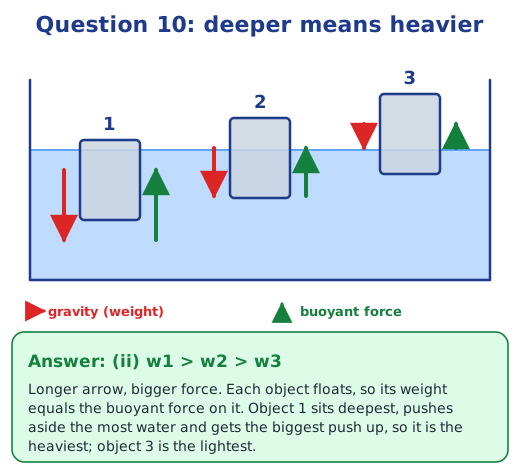
10. “Three objects 1, 2, and 3 of the same size and shape but made of different materials are placed in the water. They dip to different depths as shown in Fig. 5.17. If the weights of the three objects 1, 2, and 3 are w1, w2, and w3, respectively, then (i) w1 = w2 = w3 (ii) w1 > w2 > w3 (iii) w2 > w3 > w1 (iv) w3 > w1 > w2” (ii) w1 > w2 > w3. All three float, so each weight equals the buoyant force on that object. In Fig. 5.17 object 1 dips the deepest, so it pushes aside the most water and gets the biggest upward push; object 3 dips the least. So object 1 is the heaviest and object 3 the lightest.
Prepare some questions of your own (pages 77–78). For example: Why do new shoes grip better than worn ones? Can static charges ever be dangerous? Would a spring balance show the same reading on a mountain top? Why does an iron ship float when an iron nail sinks?
Discover, design, and debate (page 79)
Which materials get charged? Rub pairs such as a plastic scale with polythene, a balloon with wool, a rubber eraser with silk and a steel spoon with paper, and hold each rubbed object near small bits of paper. Record each pair in a table with three columns: material rubbed, rubbed with, and attracts paper (yes or no). Plastics, polythene, rubber balloons, silk and wool usually pick up a charge; a metal spoon held in the hand does not seem to. (Extra: the charge on a metal held in the hand leaks away through the body, and on a humid day charges leak into the air, so try on a dry day.) Write your findings as a short research paper: aim, materials, method, results and conclusion.
A world without gravity. Ideas for your story and cartoon strip: water will not pour from a jug, a ball thrown up never comes back, rain does not fall, and people, food and furniture drift about the room unless tied down. (Extra: without gravity the air would no longer stay around the Earth; see why the Earth supports life.)
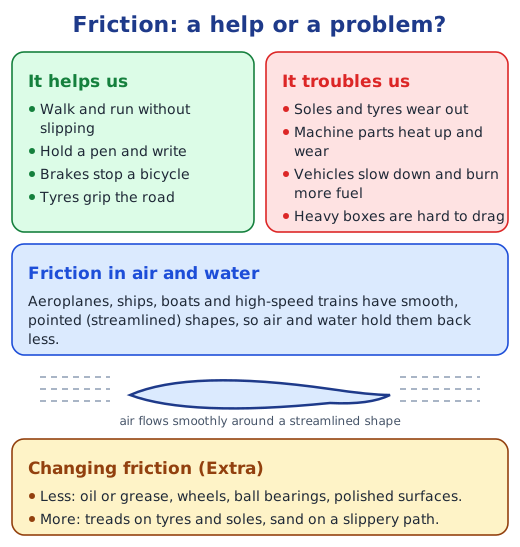
Friction: a necessity or a problem? Friction is a necessity when we walk, write, hold things, tie knots and stop vehicles with brakes, and when tyres grip the road. It is a problem when it wears out soles, tyres and machine parts, wastes fuel and heats machines. (Extra: we reduce friction with oil, grease, wheels and ball bearings, and increase it with treads on tyres and soles.) A fair conclusion: friction is both, and we control it to suit the job.
Make your own spring balance. Hang a spring or a strong rubber band inside a box lid, fix a card scale beside it, and mark the pointer’s position with your teacher’s standard masses hung from the hook. Then hang other objects and read them. Since the book takes 1 kg to weigh about 10 N on the Earth, dividing weight in newtons by mass in kilograms gives about the same number, close to 10, for every object: weight grows in step with mass. (Extra: more exactly the number is about 9.8.)
Make an electroscope. Push a straw through a hole in a jar’s lid, pass a copper wire down it, bend the top into a coil and hang a folded strip of aluminium foil from a hook at the bottom. Touch the coil with a rubbed plastic scale: both halves of the foil get the same kind of charge, so they spread apart. Uses: test which rubbed objects are charged, compare how strongly, or watch how fast the charge leaks away in damp air. Let your teacher make the hole in the lid and cut the wire, whose ends can be sharp.
Practice
-
A ball thrown straight up is at its highest point. The force acting on it is:
Show answer
Answer: (b) gravity, downwards
-
Which pair always attract each other?
Show answer
Answer: (c) the Earth and a falling stone
-
A spring balance has 10 small divisions between its 0 N and 1 N marks. Its smallest reading is:
Show answer
Answer: (b) 0.1 N
-
Why does a footballer’s kick count as a contact force, but a magnet pulling a pin does not?
Show answer
Answer: The foot must touch the ball to push it, while the magnet pulls the pin across a gap without touching it.
-
A packet is marked ‘500 g’. Is this its mass or its weight? Give a reason.
Show answer
Answer: Its mass: grams measure the amount of matter. Its weight is a force and would be given in newtons (about 5 N on the Earth).
Stuck on a question?
Take a photo and Lagnever AI explains it step by step. Try it for 7 days for ₹2.
Get it on Google Play Open in browser
For parents: after the trial, the plan renews monthly by UPI or card autopay. You can cancel anytime in the app.