
What is friction, and why does it slow things down?
Answer in short
Friction is the force that acts between two surfaces when one slides, or tries to slide, over the other. It always acts opposite to the direction of motion. It arises because tiny bumps on the two surfaces lock together, so it is greater on rough surfaces. Air and water cause friction too.
Stuck on a question? Take a photo and Lagnever AI explains it step by step. Try it for 7 days for ₹2. Get it on Google Play
Why do moving things slow down and stop?
Roll a ball along flat ground and it stops by itself after a while. Stop pedalling your bicycle on a level road and it slows down and stops, sooner on a rough road than on a smooth one. We know that a force is needed to change the speed of an object. Nothing seems to push these objects backwards, yet they slow down. So some force must be acting on them. That force is friction.
What is friction?
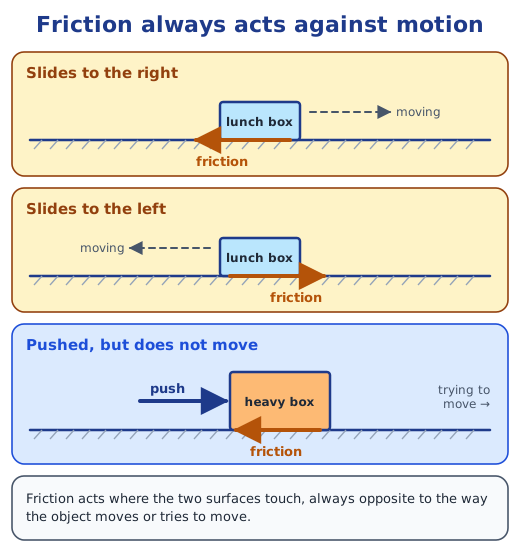
Place a lunch box, a geometry box or a notebook flat on a table and give it a gentle push. It slides a little way and stops. Push it the other way, and again it stops. Something acting where the box touches the table must be pulling it back, against its motion.
When one surface slides, or is about to slide, over another, the force that acts between them is friction, also called the force of friction. It always acts in the direction opposite to the motion, or to the motion the object is trying to make. Push a heavy box that does not budge and friction is acting then too, holding it back. Because it arises only where two surfaces touch, friction is a contact force.
Why does friction happen?
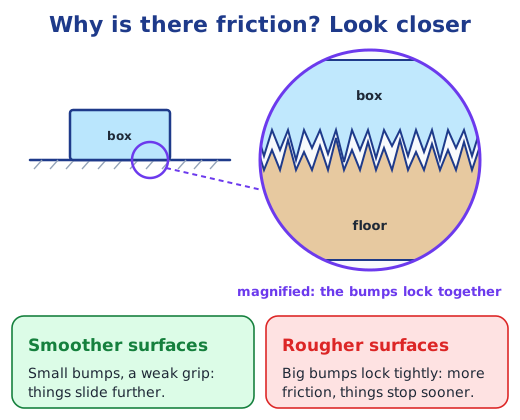
Look at any surface through a powerful magnifier and you would see that even a ‘smooth’ one is covered in tiny bumps and dips. When two surfaces touch, these bumps catch in each other’s dips and lock together. To slide one surface over the other, you have to force them past one another, and that resistance is friction. Bigger bumps lock more firmly, so rougher surfaces give more friction.
Does the surface matter?
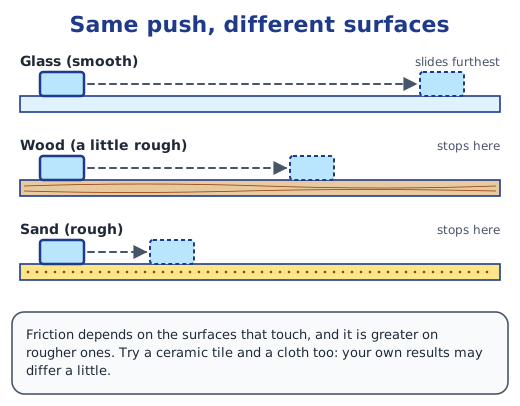
Repeat the lunch box test on different surfaces, such as glass, a ceramic tile, wood, cloth and sand, giving the same gentle push each time. The box slides different distances: furthest on the smoothest surfaces and the shortest way on the roughest. Friction depends on the nature of the two surfaces in contact, and it is greater on rough surfaces.
Why do we slip on wet or icy floors?
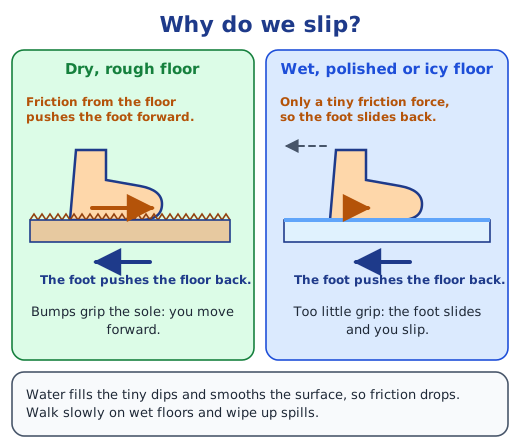
Each step you take, your foot pushes backwards on the ground. Friction from the ground pushes your foot the other way, forwards, and stops it sliding. On a dry, rough floor the bumps grip your sole well. Ice and polished floors are very smooth, and water fills in the tiny dips of a floor, so the friction becomes small. Your foot slides back instead of gripping, and you slip. Walk slowly on wet floors, and wipe up spills straight away.
Is there friction in air and water?
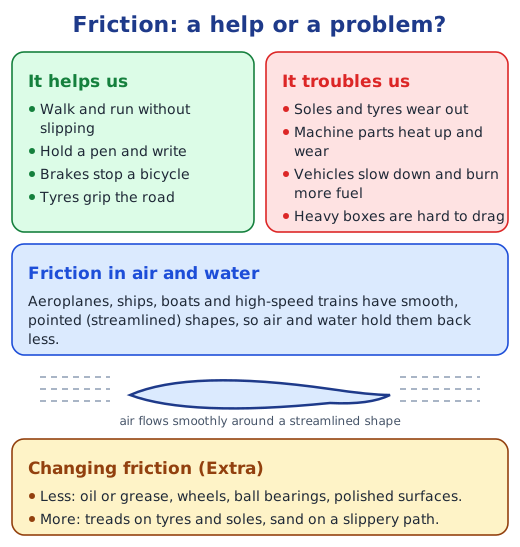
Yes. Friction is not only between solids. Air, water and other liquids also act against objects moving through them. Cyclists feel it as the wind pushing on them, and swimmers feel it in the pool. That is why high-speed trains, aeroplanes, ships and boats are built with smooth, pointed shapes, called streamlined shapes, that slip through air or water more easily.
Is friction a help or a problem?
Both. Friction lets us walk and run without slipping, hold a pen and write, and stop a bicycle with its brakes; it lets tyres grip the road. It also wears out shoe soles and tyres, heats up and wears down the moving parts of machines, and slows down vehicles, so they burn more fuel. (Extra: oil, grease, wheels and ball bearings reduce friction, while treads on tyres and soles, or sand spread on a slippery path, increase it.)
Friction is one of the contact forces; the others are on contact and non-contact forces. See also the chapter notes and the NCERT solutions.
Practice
-
A lunch box pushed to the left slides on a table. Friction on it acts:
Show answer
Answer: (b) to the right
-
With the same push, on which surface will a lunch box stop soonest?
Show answer
Answer: (c) sand
-
Aeroplanes and ships have smooth, pointed shapes mainly to:
Show answer
Answer: (b) reduce friction from air or water
-
Why does a ball rolling on flat ground stop by itself?
Show answer
Answer: Friction between the ball and the ground acts against its motion and slowly brings its speed down to zero.
-
Give one way friction helps us and one way it troubles us.
Show answer
Answer: It helps us walk without slipping (or stop a bicycle with its brakes). It wears out shoe soles and tyres (or heats up moving parts of machines).
Questions students ask
What is friction in simple words?
Friction is the force that tries to stop one surface sliding over another. It acts where the surfaces touch and always opposite to the direction of motion.
Why is friction greater on rough surfaces?
Every surface has tiny bumps and dips, even one that looks smooth. On a rough surface the bumps are bigger, so they lock together more and resist sliding more.
Why do we slip on wet floors?
Water fills the tiny dips in the floor and smooths it, so the friction between your shoe and the floor becomes small. When your foot pushes on the floor, it slides instead of gripping.
Do air and water cause friction?
Yes. Air and water also act against objects moving through them. That is why high-speed trains, aeroplanes, ships and boats are given smooth, streamlined shapes.
Stuck on a question?
Take a photo and Lagnever AI explains it step by step. Try it for 7 days for ₹2.
Get it on Google Play Open in browser
For parents: after the trial, the plan renews monthly by UPI or card autopay. You can cancel anytime in the app.