
What are contact and non-contact forces?
Answer in short
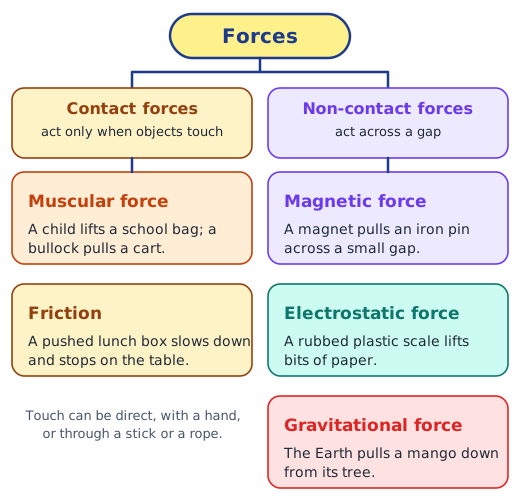
A force is a push or a pull that arises when two objects interact, and it is measured in newtons (N). Contact forces act only when the objects touch: muscular force and friction are examples. Non-contact forces act across a gap: magnetic force, electrostatic force from charged objects, and gravitational force, the Earth’s pull, which is always attractive.
Stuck on a question? Take a photo and Lagnever AI explains it step by step. Try it for 7 days for ₹2. Get it on Google Play
What is a force?
Think of the ways you can move a heavy carton: push it along the floor, pull it with a rope, or lift it and carry it. Each way needs a push or a pull. In science, a push or a pull on an object is called a force.
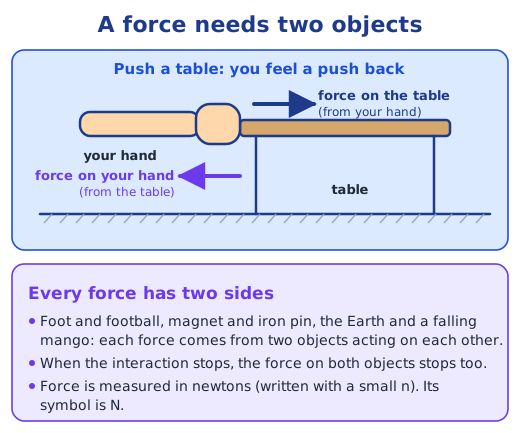
A force never comes from one object alone. When you push a table, your hand acts on the table, and you can feel the table pressing back on your hand. Stop pushing, and the force on both of them disappears. So a force is a push or a pull on an object that comes from its interaction with another object, and at least two objects are always involved. Force is measured in newtons (the name takes a small n), shortened to N.
What can a force do to an object?
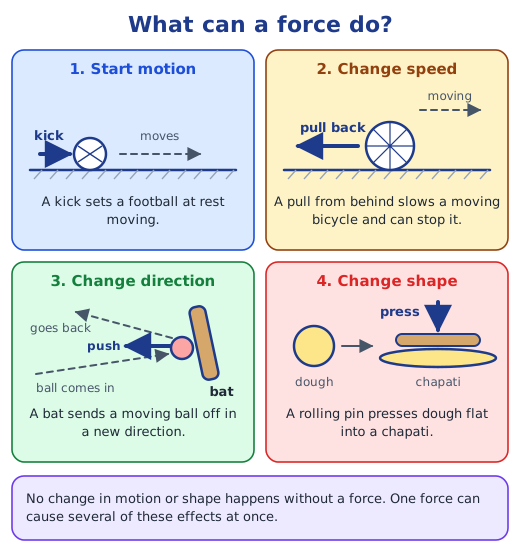
A force can set a still object moving, change the speed of a moving one, change its direction, or change its shape, and sometimes several of these at once. A kick starts a football rolling, brakes slow a bicycle, a bat turns a ball back, and pressing a balloon squashes it. Whenever speed, direction or shape changes, a force is at work.
What are contact forces?
Some forces act only while the two objects touch. The touch can be direct, like your hand on a door, or through something in between, like a stick or a rope. These are contact forces.
Muscular force comes from our muscles, which shorten and lengthen as we walk, run, lift, jump or stretch. Animals, birds, fish and insects use it to move, and people have long used the muscles of bullocks, horses and camels to pull loads. It works inside us too: muscles help us chew, push food along the alimentary canal, and keep the heart pumping blood.
Friction acts between two surfaces in contact and always opposes motion, which is why a rolling ball slows down and stops on its own. It has a page of its own: what is friction?
How can a magnet push without touching?
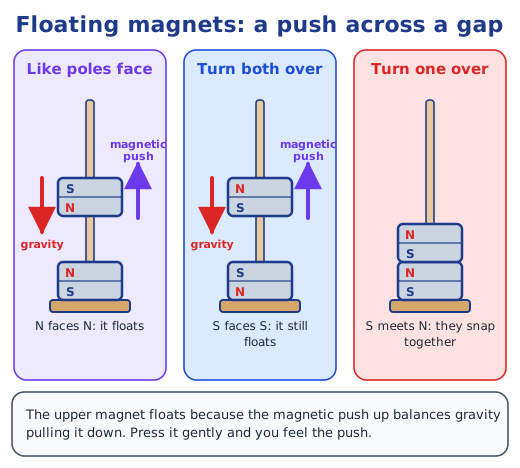
Slide two ring magnets onto an upright wooden stick so that like poles face each other. The upper magnet stays in the air above the lower one, and if you press it down gently you feel a springy push. Turn both magnets over and like poles still face each other, so it still floats. Turn only one over and they snap together. The force a magnet exerts on another magnet or on a magnetic material is the magnetic force, and because it acts across a gap it is a non-contact force. You met magnets in Grade 6 and electromagnets in Chapter 4.
What is electrostatic force?
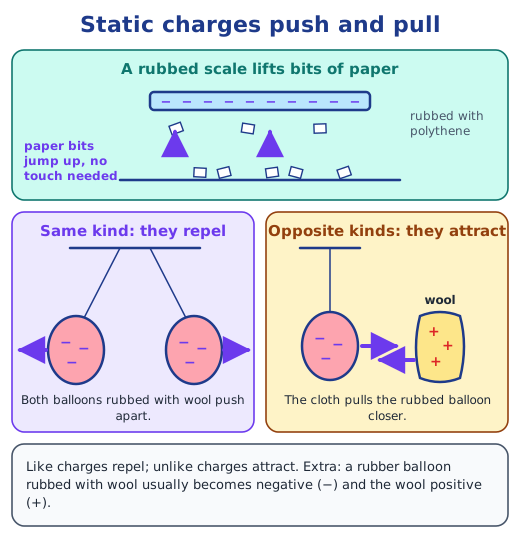
Rub a plastic scale or straw hard with a piece of polythene, keeping your fingers off the rubbed part, and bring it close to small bits of paper. They jump up and cling to it. Rubbing certain materials together builds up electric charges on them that stay put, called static charges, and a charged object pulls on light, uncharged objects like paper.
Now rub two hanging balloons with a woollen cloth: they swing apart. Bring the cloth near one balloon and the two move together. Both balloons got the same kind of charge, so like charges repel. The cloth and the balloon got opposite kinds, so unlike charges attract. The two kinds are called positive and negative. The force from a charged object on another object is the electrostatic force, another non-contact force. When charges flow, they make the electric current of Chapter 4.
Why does everything fall back to the Earth?
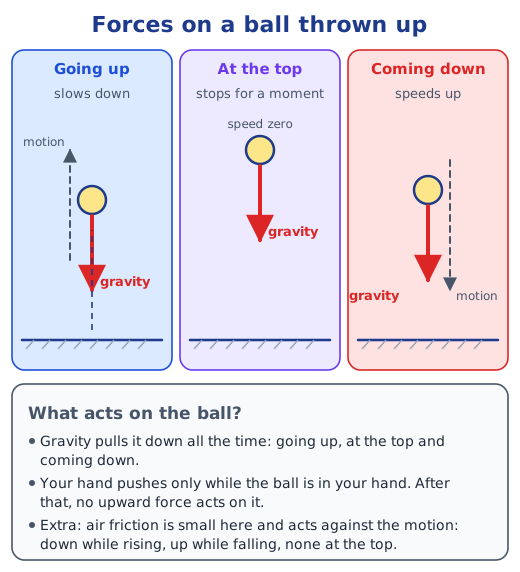
Throw a ball straight up and it comes back. Throw it harder and it rises higher, but it still returns, like a fruit dropping from a tree or a cricket ball hit for a six. The Earth pulls every object towards itself. This pull is the gravitational force, also called the force of gravity or simply gravity. It acts without touching, so it is a non-contact force, and unlike magnetic and electrostatic forces it always attracts and never repels.
A dropped stone falls straight down. A ball thrown straight up slows as it rises, stops for a moment at the top, then falls straight back, getting faster. This up-and-down movement under gravity is called vertical motion.
Stay safe: throw balls only outdoors, away from people and windows, and keep fingers clear of strong magnets. Gravity also gives every object its weight, the next topic: weight, floating and sinking. See also the chapter notes and the NCERT solutions.
Practice
-
Which of these forces needs contact to act?
Show answer
Answer: (b) friction
-
Two ring magnets on a wooden stick float apart when:
Show answer
Answer: (b) like poles face each other
-
A plastic scale rubbed with polythene picks up bits of paper because of:
Show answer
Answer: (c) electrostatic force
-
Why is gravity called a non-contact force?
Show answer
Answer: Because the Earth pulls objects, such as a fruit falling from a tree, without touching them: the force acts across a distance.
-
Name the force in each case: (a) chewing food, (b) a compass needle settling to point north.
Show answer
Answer: (a) Muscular force, from the muscles of the jaw. (b) Magnetic force, which acts on the needle without contact.
Questions students ask
What is a force in science?
A force is a push or a pull on an object that comes from its interaction with another object. At least two objects are needed, and when the interaction stops, so does the force. Its SI unit is the newton (N).
What are examples of contact forces?
Muscular force, when you lift a bag, kick a ball or chew food, and friction, which slows a sliding box or a rolling ball. Both act only while the objects touch, directly or through a stick or a rope.
What are the three non-contact forces in Class 8?
Magnetic force, between magnets or between a magnet and a magnetic material; electrostatic force, from charged objects; and gravitational force, the Earth’s pull on every object.
Can a non-contact force push as well as pull?
Magnetic and electrostatic forces can do both: like poles and like charges repel, while unlike ones attract. Gravity can only pull.
Stuck on a question?
Take a photo and Lagnever AI explains it step by step. Try it for 7 days for ₹2.
Get it on Google Play Open in browser
For parents: after the trial, the plan renews monthly by UPI or card autopay. You can cancel anytime in the app.