
What is air pressure, and how does wind form?
Answer in short
The air around the Earth presses on everything it touches; this is atmospheric pressure. We are not crushed because the pressure inside our bodies balances it. Air moves from a region of high pressure to one of low pressure, and this moving air is wind. Fast-moving air has a lower pressure, which is how strong winds lift weak roofs.
Stuck on a question? Take a photo and Lagnever AI explains it step by step. Try it for 7 days for ₹2. Get it on Google Play
Does air exert pressure?
Air is all around us. The layer of air wrapped round the Earth, the atmosphere, is mostly nitrogen and oxygen with a little argon, carbon dioxide and other gases, and it stretches up for many kilometres. Does all that air press on things?
Try this. Turn a paper plate upside down on a flat surface and push a stick through its middle as a handle. Cover the plate with a chart-paper sheet of roughly 70 cm × 56 cm, folded twice, with a hole for the stick, and lift it. Then cover it with an unfolded sheet instead and lift again. The unfolded sheet makes the plate harder to lift, though the paper’s weight has not changed. Air is pushing down on the sheet, and the larger the area, the larger the force. So air exerts pressure, on every object. The pressure of the air around us is called atmospheric pressure.
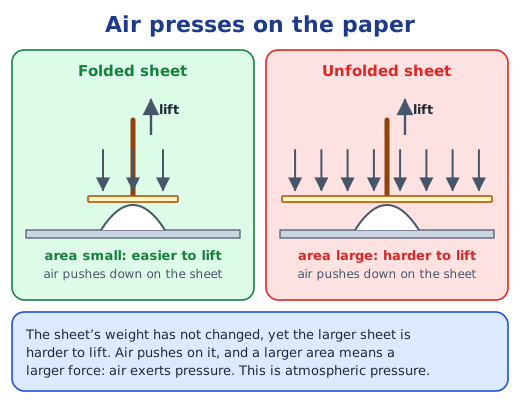
Blow into a balloon and it swells in every direction, because the air inside presses outwards on all its walls. Let go of its mouth and the air rushes out, because the pressure inside is higher than outside.
How strong is air pressure?
Press a rubber sucker firmly onto a smooth tile. Most of the air in its cup is squeezed out, so the pressure inside is low, and the air outside presses the sucker onto the tile. To pull it off, you must beat that pressure difference.
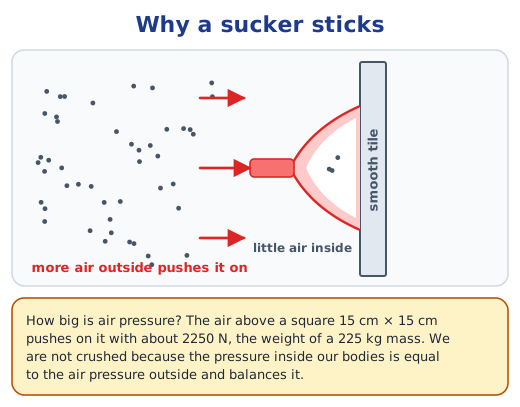
The push is large. The air above a square 15 cm × 15 cm presses on it with about 2250 N, about the weight of something with a mass of 225 kg. We are not crushed because the pressure inside our bodies, from fluids and gases moving in our tissues and organs, is equal to the pressure outside and balances it.
The SI unit, the pascal, is small for air pressure, so weather maps use the millibar (mb) or the hectopascal (hPa). Each is equal to 100 Pa.
How does wind form?
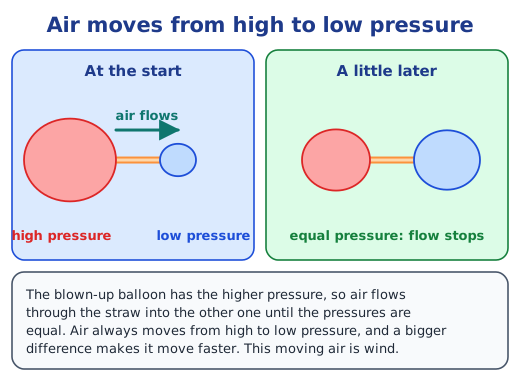
Join two thin balloons with a drinking straw: one blown up and held shut while you fit the straw, the other empty. Let go. Air flows from the full balloon into the empty one, which grows while the full one shrinks. Soon they are about the same size and the flow stops. The full balloon had the higher pressure, and air kept moving until the pressures were equal. Air always moves from a region of high pressure to one of low pressure. Moving air is wind, and a bigger pressure difference makes it blow faster. That is why some days are calm and others windy.
Why do sea and land breezes change direction?
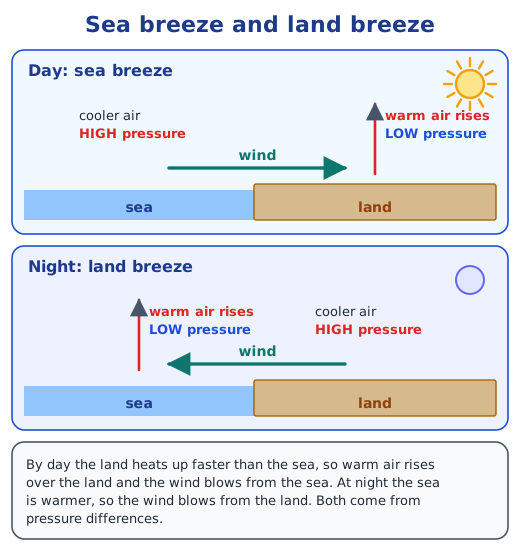
You met these breezes in Grade 7; pressure explains them. By day the land heats up faster than the sea. Warm air over the land becomes lighter and rises, leaving low pressure, so cooler air from the sea, at higher pressure, blows in: a sea breeze. At night the sea stays warmer than the land, low pressure forms over the sea, and the wind blows from the land: a land breeze.
Why does fast-moving air lower the pressure?
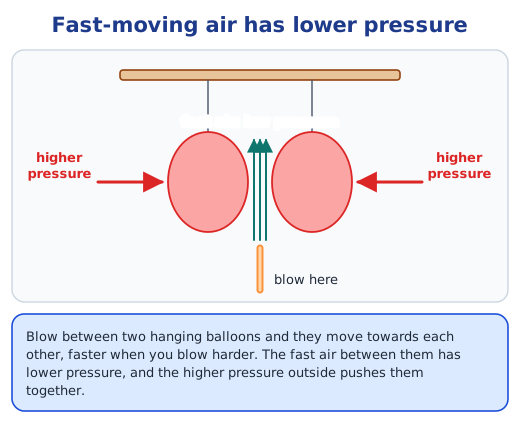
Hang two blown-up balloons from a stick, 6–10 cm apart, and blow into the gap. Instead of flying apart, they swing towards each other, and blow harder to make them move faster. The fast air between them has a lower pressure, and the higher pressure outside pushes them together. So high-speed winds come with reduced air pressure.
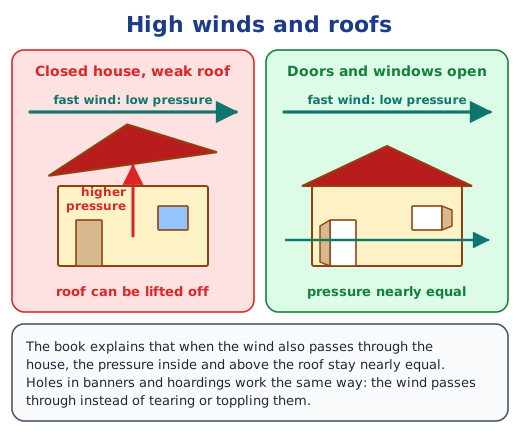
This is how a storm lifts roofs. A fast wind over a closed house lowers the pressure above the roof, while the air inside still presses up. If the difference is large and the roof weak, the roof can be blown away. The book explains that with doors and windows open, the wind also passes through the house, so the pressure inside and above the roof stays nearly equal. For the same reason, banners and hoardings have holes that let the wind through. This is the physics of the idea, not storm advice: in a real cyclone, stay indoors in a strong building and follow what local officials and the weather office say.
Strong winds often come with thunder and lightning, the next topic: thunderstorms and cyclones. See also the chapter notes and the NCERT solutions.
Practice
-
A rubber sucker sticks to a smooth tile because:
Show answer
Answer: (b) the air pressure outside is greater than inside
-
Wind blows:
Show answer
Answer: (b) from high to low pressure
-
When you blow between two hanging balloons, they:
Show answer
Answer: (b) move towards each other
-
Why does air rush out of a punctured bicycle tube?
Show answer
Answer: The air pressure inside the tube is higher than outside, and air moves from high to low pressure.
-
Which way does the breeze blow at a beach on a sunny afternoon? Why?
Show answer
Answer: From the sea to the land: the land heats up faster, warm air rises over it and leaves low pressure, so air flows in from the sea.
Questions students ask
What is atmospheric pressure?
It is the pressure the air around us exerts on everything. The atmosphere, a layer of air many kilometres thick, presses on every surface; over a 15 cm by 15 cm square the push is about 2250 N.
Why are we not crushed by air pressure?
The pressure inside our bodies is equal to the atmospheric pressure outside, so the two balance. The book explains that the pressure inside comes from fluids and gases moving in our tissues and organs.
How does wind form?
When one place has a higher air pressure than another, air moves from the high-pressure region to the low-pressure region. This moving air is wind, and it is faster when the pressure difference is bigger.
Why do strong winds blow off roofs?
Fast-moving air has lower pressure. When a strong wind sweeps over a house, the pressure above the roof falls below the pressure inside, and if the difference is large and the roof weak, it can be lifted away.
Stuck on a question?
Take a photo and Lagnever AI explains it step by step. Try it for 7 days for ₹2.
Get it on Google Play Open in browser
For parents: after the trial, the plan renews monthly by UPI or card autopay. You can cancel anytime in the app.