
How do thunderstorms and cyclones form?
Answer in short
Warm, moist air rises, cools and forms clouds, and cooler air rushes in below. In tall clouds, winds rub ice and water drops together, charges separate, and lightning flashes, followed by thunder. Over warm oceans, rising air releases heat, the pressure falls very low and the Earth’s rotation makes the inrushing air spin: a cyclone.
Stuck on a question? Take a photo and Lagnever AI explains it step by step. Try it for 7 days for ₹2. Get it on Google Play
How does a thunderstorm form?
On a hot day the land heats up, and so does the air touching it. Warm, moist air is lighter, so it rises and leaves an area of low pressure. Cooler air from the higher-pressure areas around flows in, warms up and rises too, and the air keeps circulating. As the air rises it expands and cools, and its water vapour condenses into tiny droplets: clouds. Droplets join into heavier drops that fall as rain, hail or snow. Strong winds with rain make a storm. Storms are common in hot, humid, tropical countries such as India.
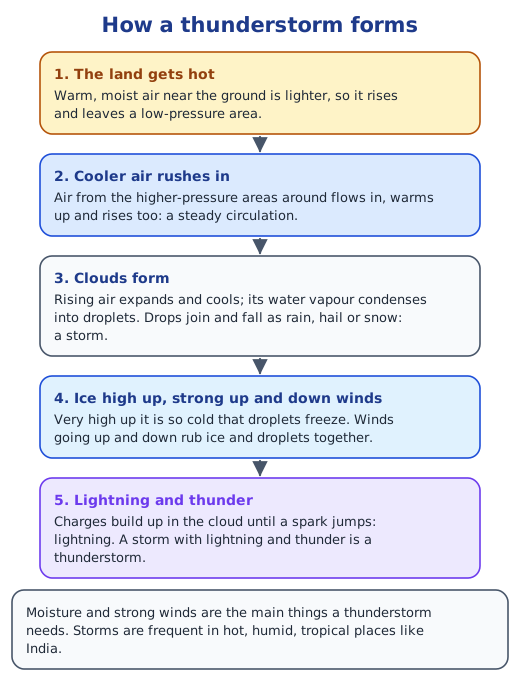
Sometimes the warm air climbs so high that the cold there turns droplets into ice. Moisture and strong winds are the main things a thunderstorm needs.
Why does lightning flash?
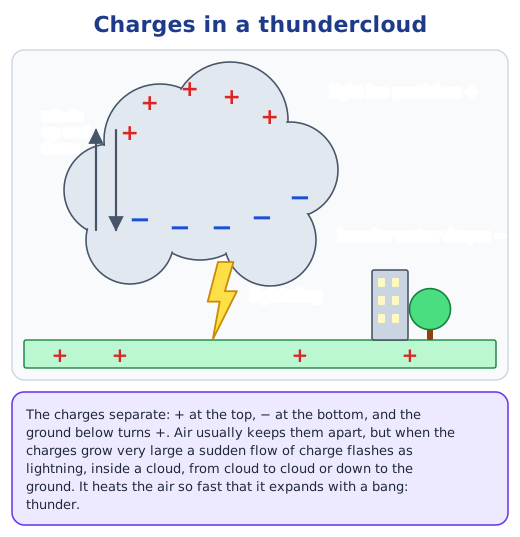
Inside a tall cloud, winds rush up and down and rub ice particles and water droplets against each other. You saw in Chapter 5 that rubbing gives objects electric charges. The light ice particles, with positive charge, are carried to the top of the cloud; the heavier water drops, with negative charge, gather at the bottom. When the negative base of the cloud comes close to the ground, the ground and things on it, such as trees and buildings, become positively charged.
Air is normally an insulator and keeps opposite charges apart. But when the build-up becomes very large, the air gives way, and charge flows suddenly through it as a brilliant flash: lightning. It can flash inside one cloud, from one cloud to another, or from a cloud to the ground. Lightning heats the air around it so quickly that the air expands with a loud sound: thunder. A storm with lightning and thunder is a thunderstorm.
How do we protect ourselves from lightning?
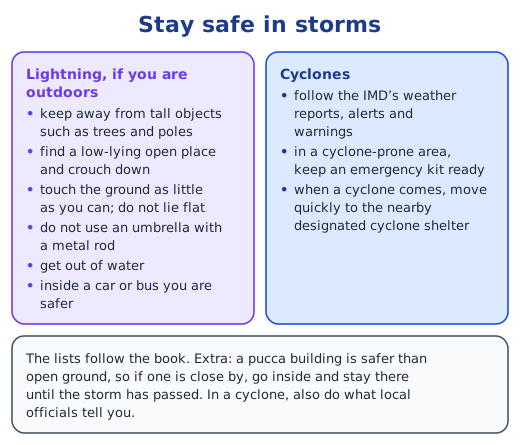
Lightning can set things on fire, harm buildings, and badly burn or even kill people and animals. If it catches you outdoors, the book says: keep away from tall objects, crouch down in a low-lying open spot, touching the ground as little as you can, and do not lie flat. Do not carry an umbrella with a metal rod, and leave the water if you are swimming or wading. Inside a car or a bus you are comparatively safer. (Extra: a pucca building close by is safer still; go in and stay there until the storm has passed.)
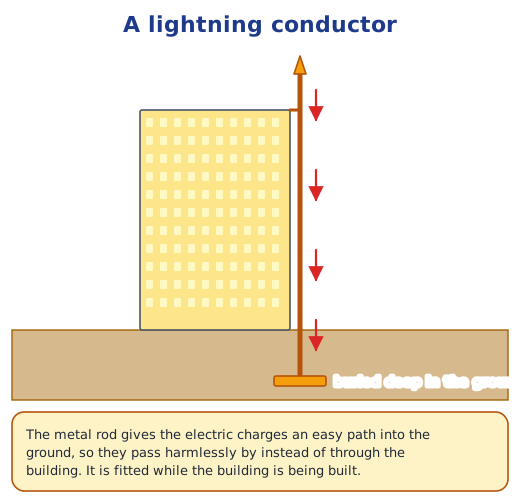
Buildings are protected by a lightning conductor, a metal rod fitted along the wall while the building is built. Its pointed top stands above the highest point of the building, and its other end is buried deep in the ground, so charges have an easy path into the earth.
Do thunderstorms have local names in India?
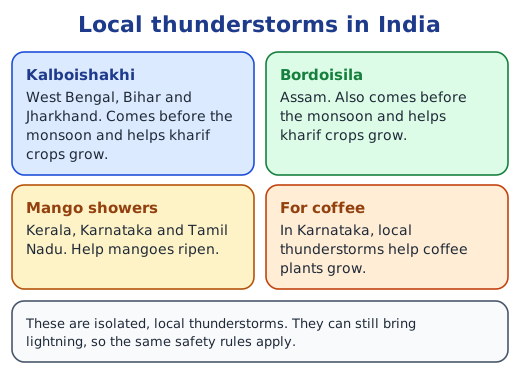
Yes. Before the monsoon, local thunderstorms called Kalboishakhi (West Bengal, Bihar and Jharkhand) and Bordoisila (Assam) help kharif crops grow. Kerala, Karnataka and Tamil Nadu call them mango showers, because they help mangoes ripen, and in Karnataka they help coffee plants grow.
How does a storm become a cyclone?
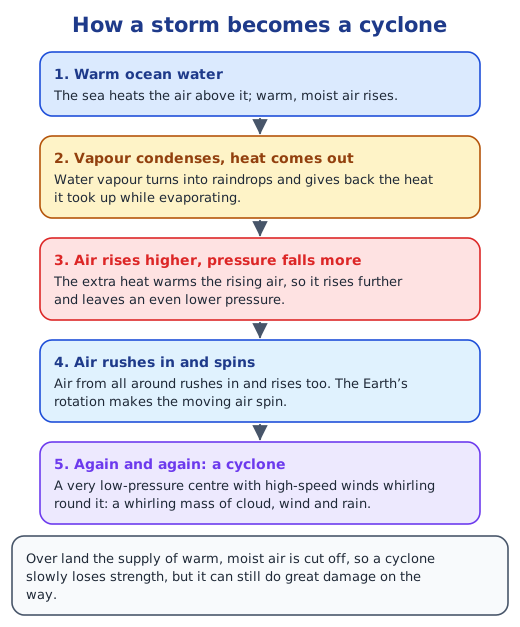
Cyclones are huge storms that form over warm ocean water. Warm, moist air rises from the sea and its vapour condenses into raindrops. Evaporation took up heat; condensation now gives that heat back to the air, which warms the rising air further. It climbs even higher and leaves an even lower pressure. Air rushes in from all around and rises too, and the Earth’s rotation makes the moving air spin. Repeated again and again, this builds a very low-pressure centre with high-speed winds whirling round it: a whirling mass of cloud, wind and rain.
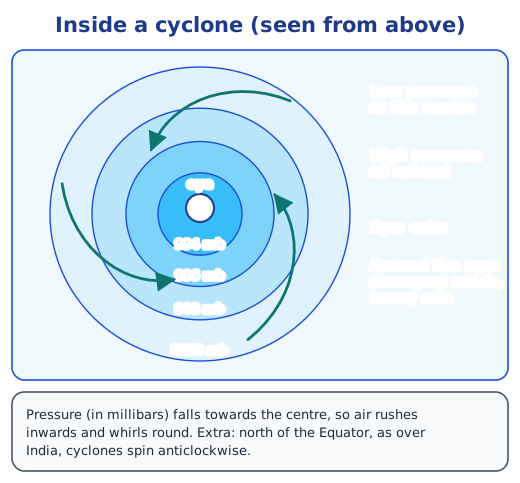
The lowest pressure is at the centre, the eye, where the wind is calm. Around it are strong winds and heavy rain. As a cyclone moves from the sea towards the land its winds are faster than those of ordinary thunderstorms; over land it no longer gets moist air, so it slowly weakens.
What damage can a cyclone do, and how do we stay safe?
Cyclone Amphan in 2020 had peak winds of 270 km/h. Winds push seawater ashore as a surge 3–12 m high, flooding the coast and beyond. Heavy rain floods rivers and can trigger landslides; salt water spoils drinking water and farmland; fallen trees block roads; power cuts last for days.
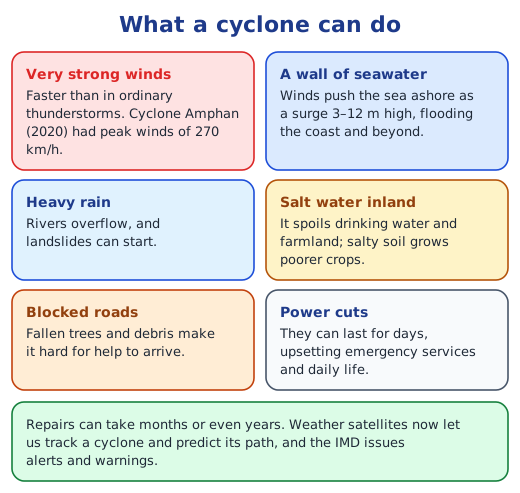
Weather satellites now track cyclones and predict their path. Stay updated on the alerts and warnings of the India Meteorological Department (IMD), whose colour-coded warnings you met in Grade 7. If you live where cyclones are common, keep an emergency kit ready, and when a cyclone comes, move quickly to the nearby designated cyclone shelter.
See the chapter notes and the NCERT solutions, or go back to air pressure and wind.
Practice
-
Lightning is caused by:
Show answer
Answer: (b) a sudden flow of built-up electric charges
-
Thunder is heard because lightning:
Show answer
Answer: (b) heats the air so fast that it expands
-
A cyclone loses strength over land because:
Show answer
Answer: (b) its supply of moist air is cut off
-
Name two things you should do if lightning catches you in an open field.
Show answer
Answer: Keep away from tall objects such as trees, and crouch down in a low-lying open place, touching the ground as little as possible.
-
What does a lightning conductor do?
Show answer
Answer: It gives electric charges an easy path from above the building, down a metal rod, into the ground, protecting the building.
Questions students ask
How is a thunderstorm formed?
Hot land warms the moist air above it, which rises, cools and forms clouds, while cooler air rushes in below. Very high up, droplets freeze, and strong winds going up and down rub ice and water drops together and charge them. When charges build up, lightning and thunder follow.
Why does lightning happen?
Charges separate inside a cloud: positive at the top and negative at the bottom, and the ground below becomes positive. Air normally keeps them apart, but when the build-up is very large, charge flows suddenly through the air as a bright flash.
What is the eye of a cyclone?
It is the centre of the cyclone, where the pressure is lowest. The wind there is calm, but all around it are the strongest winds and the heaviest rain.
How can we stay safe during a cyclone?
Stay updated on the weather reports, alerts and warnings of the India Meteorological Department (IMD). If you live where cyclones are common, keep an emergency kit ready, and when a cyclone comes, move quickly to the nearby designated cyclone shelter.
Stuck on a question?
Take a photo and Lagnever AI explains it step by step. Try it for 7 days for ₹2.
Get it on Google Play Open in browser
For parents: after the trial, the plan renews monthly by UPI or card autopay. You can cancel anytime in the app.