
Land and sea breezes
Answer in short
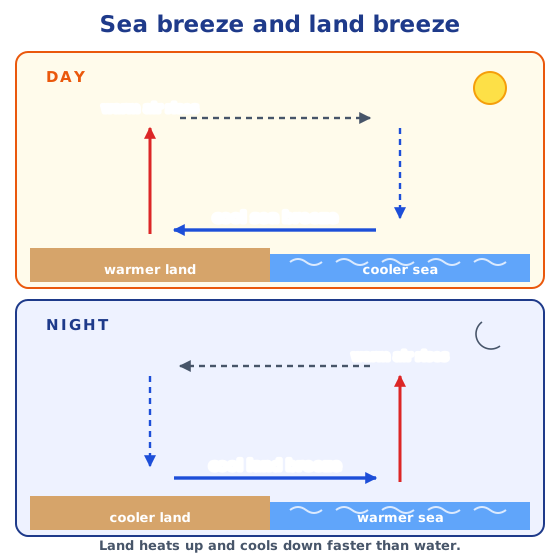
Land heats up and cools down faster than water. By day the land is warmer, so warm air over it rises and cooler air moves in from the sea: a sea breeze. At night the land cools first, so warm air over the sea rises and cooler air flows out to sea: a land breeze. Both are convection.
Stuck on a question? Take a photo and Lagnever AI explains it step by step. Try it for 7 days for ₹2. Get it on Google Play
Hot sand, cool water
On a winter holiday in Kerala, Palden noticed something at the beach. During the day the sand felt hotter than the sea water, but at night the sand was cooler than the water. Different things heat up and cool down at different rates, and near the coast this makes the wind change direction every day.
Soil and water in the sun
Activity 7.4 checks this. Two identical bowls are filled halfway, one with soil and one with water, and a thermometer is placed in each, with its bulb inside the soil or water but not touching the bowl. The set-up is kept in sunlight, and the temperatures are noted every 5 minutes.
| Time | What the thermometers show (sample) |
|---|---|
| 0 minutes | soil 28 °C, water 28 °C |
| 10 minutes | soil 34 °C, water 30 °C |
| 20 minutes | soil 38 °C, water 32 °C |
The soil’s temperature rises more than the water’s in the same time, so soil heats up faster than water. When both bowls are brought indoors, the soil also cools down faster. (Your readings will depend on the day; the pattern stays the same.)
The sea breeze by day
In the daytime, the land near the sea heats up faster than the water. The air above the hot land warms up, expands, becomes lighter and rises. Cooler air from over the sea moves in to take its place. This cool wind from the sea to the land is a sea breeze. It brings relief on hot days, which is why houses in coastal areas often have windows facing the sea.
The land breeze at night
After sunset, the process reverses. With no sunlight, the land cools down faster than the sea. Now the air above the sea is the warmer air, so it rises, and cooler air from the land moves out to take its place. This cool wind from the land to the sea is a land breeze. People living near the seashore notice that the wind blows one way by day and the other way at night.
A daily loop of air
Both breezes are convection at work: warm air rises, cooler air sinks and flows in sideways near the ground, and higher up the air flows back to close the loop. The only thing that changes between day and night is which side, land or sea, is warmer.
| Time | What happens |
|---|---|
| Day | land is warmer; air rises over the land; sea breeze from sea to land |
| Night | sea is warmer; air rises over the sea; land breeze from land to sea |
Why the coast has milder weather
Because water heats and cools slowly, large water bodies act like a store of warmth. During the day the sea stays cooler than the land and its breeze cools the coast; at night the sea stays warmer and keeps the air near it from getting very cold. So places near the sea, such as coastal Kerala, have milder temperatures than places far inland, where days can be much hotter and nights much colder.
People and the breezes (Extra)
Sea and land breezes have long shaped coastal life. Traditionally, fishermen with sail boats have set out early, helped by the land breeze blowing towards the sea, and come back later in the day with the sea breeze blowing towards the land.
Read about all three ways heat travels in conduction, convection and radiation. Answers to the textbook questions are in the NCERT solutions for Chapter 7; see all of Chapter 7 notes.
Practice
-
A sea breeze blows:
Show answer
Answer: (b) from the sea to the land during the day
-
At night, the air above the sea rises because the sea is:
Show answer
Answer: (b) warmer than the land
-
In Activity 7.4, which heats up faster in sunlight?
Show answer
Answer: (b) Soil
-
Why are windows of houses in coastal areas often placed facing the sea?
Show answer
Answer: So that the cool sea breeze, which blows from the sea to the land during the hot day, can enter the houses and keep them cool.
-
How do large water bodies prevent extreme temperatures in the areas around them?
Show answer
Answer: Water heats up and cools down more slowly than land. By day the sea stays cooler and its breeze cools the land; at night it stays warmer, so nearby places do not get very hot by day or very cold at night.
Questions students ask
What is a sea breeze?
A cool wind that blows from the sea to the land during the day. The land heats up faster than the sea, so the warm air above the land rises and cooler air from over the sea moves in to take its place.
What is a land breeze?
A cool wind that blows from the land to the sea at night. The land cools down faster than the sea, so the warmer air above the sea rises and cooler air from the land moves out to take its place.
Why does land heat up faster than water?
The chapter shows it by experiment: soil in sunlight warms more than water in the same time, and also cools faster. (Extra: water needs much more heat than soil to rise by the same temperature, and the Sun's heat spreads through a large depth of water.)
Stuck on a question?
Take a photo and Lagnever AI explains it step by step. Try it for 7 days for ₹2.
Get it on Google Play Open in browser
For parents: after the trial, the plan renews monthly by UPI or card autopay. You can cancel anytime in the app.