
Class 7 Science Chapter 7: Heat Transfer in Nature Notes
This chapter in five lines
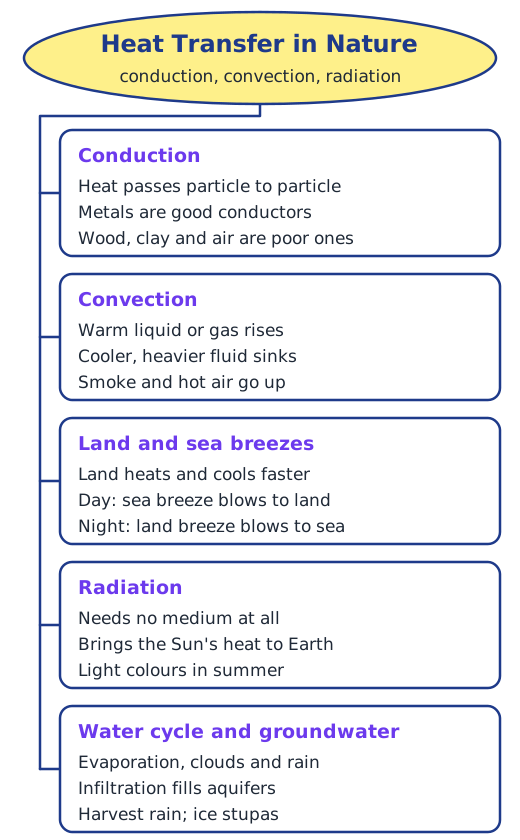
Heat Transfer in Nature explains the three ways heat moves. In conduction, heat passes from particle to particle, mainly in solids; metals are good conductors, while wood, clay and air are poor ones. In convection, warm liquids and gases rise, which causes sea and land breezes. Radiation needs no medium and brings the Sun's heat. The Sun also drives the water cycle, which refills rivers and the groundwater stored in aquifers.
Why some places feel warmer
The chapter begins in Gangtok, where Pema and her brother Palden sit by a fire on a winter evening. Palden has just visited Kerala, which felt warm and humid even in winter. Kerala is closer to the equator and has a long coastline, and the Sun is the main source of heat for the Earth. Watching their grandmother cook thukpa in a metal pan, they wonder why cooking pans are made of metal. The answers lie in the ways heat travels.
Conduction
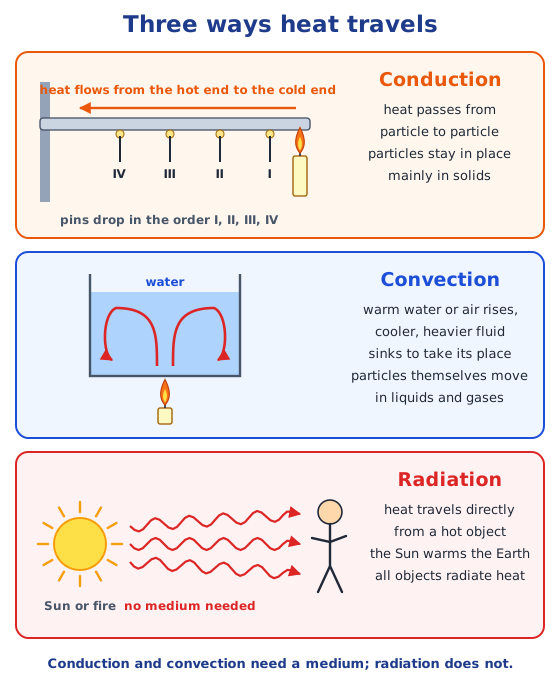
When one end of a metal strip with wax-stuck pins is heated (Activity 7.1), the pins drop one by one, the nearest first. Heat moves along the strip from the hot end to the cold end: each particle passes heat to its neighbour, while the particles stay in place. This is conduction, the main way heat moves in solids.
Materials that let heat pass easily, such as metals, are good conductors, which is why we cook in metal pans. Wood, glass, clay and porcelain are poor conductors or insulators, so tea stays hot longer in a clay or porcelain cup. Air is a poor conductor too. Woollen clothes trap air in their pores, two thin blankets hold a layer of air between them, and some houses keep out heat and cold with hollow bricks or with walls of two wooden layers filled with mud and cow dung, as in the Mori block of Uttarkashi.
Convection
A paper cup hung over a candle rises (Activity 7.2), because the air inside warms, expands, becomes lighter and goes up. Smoke rises for the same reason. In water heated from below (Activity 7.3), a coloured streak rises in the middle and sinks at the sides: warm water rises and cooler water takes its place. Heat transfer by the actual movement of the particles of a liquid or gas is convection. Read more in conduction, convection and radiation.
Sea and land breezes
Soil heats up faster than water in sunlight, and also cools faster (Activity 7.4). So by day, warm air over the land rises and cooler air moves in from the sea: a sea breeze. At night the land cools first, warm air over the sea rises, and a land breeze blows from the land to the sea. Read more in land and sea breezes.
Radiation
The warmth we feel from a fire, and the Sun’s heat on Earth, reach us by radiation, which needs no medium. All objects radiate heat, which is why a hot utensil cools on its own. Light-coloured clothes reflect most of the heat falling on them, so they suit summer; dark clothes absorb more heat and suit winter. When water is heated in a pan, all three happen together: the pan heats by conduction, the water by convection, and we feel warmth by radiation. The bukhari, an iron stove used in the upper Himalayas, both cooks and warms a room using all three.
The water cycle and groundwater
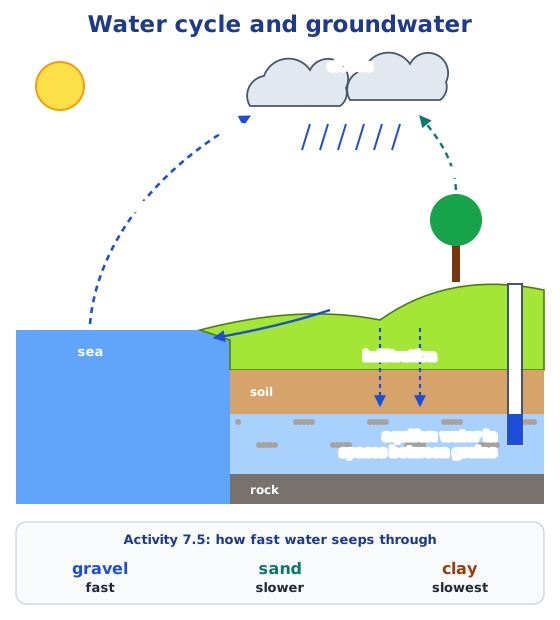
The Sun’s heat evaporates water from oceans, rivers and lakes, and plants give off vapour by transpiration. Rising vapour cools and condenses into clouds, which bring rain, snow and hail: precipitation. This water cycle redistributes water and keeps the total amount on Earth the same. In the 6th century CE, Varahamihira of Ujjaini described ways to predict seasonal rainfall in his Brihatsamhita.
Some rainwater seeps into the ground: fastest through gravel, slower through sand and slowest through clay (Activity 7.5). This infiltration stores groundwater in aquifers, which wells and bore wells tap. Groundwater is being used up faster than it is refilled, so rainwater harvesting, recharge pits and Ladakh’s ice stupas help to save water. Read more in water cycle and groundwater.
Answers to every question are in the NCERT solutions for Chapter 7.
Key terms
| Term | Meaning |
|---|---|
| Conduction | Transfer of heat from the hotter part of an object to the colder part, particle to particle, without the particles moving away. |
| Good conductor | A material that lets heat pass through it easily, such as copper, aluminium, iron or steel. |
| Poor conductor (insulator) | A material that does not let heat pass easily, such as wood, plastic, glass, clay, porcelain, wool or air. |
| Convection | Transfer of heat by the actual movement of the particles of a liquid or a gas: the warm part rises and the cooler part sinks. |
| Sea breeze | Cool air that moves from the sea to the land during the day, when the land is warmer than the sea. |
| Land breeze | Cool air that moves from the land to the sea at night, when the land has cooled faster than the sea. |
| Radiation | Transfer of heat directly from a hot object, with no medium needed; this is how the Sun's heat reaches the Earth. |
| Medium | A material, solid, liquid or gas, through which heat can travel; conduction and convection need one, radiation does not. |
| Water cycle | The continuous movement of water: up as vapour, down as rain, snow or hail, through soil, rocks and plants and back to water bodies. |
| Transpiration | The release of water vapour from trees and plants into the air. |
| Infiltration | The seeping of surface water through soil and rocks into the ground. |
| Groundwater | Water that seeps into the ground and is stored in the spaces between sediments and in openings in rocks. |
| Aquifer | An underground layer of sediments or rocks that stores water in its pore spaces; wells and bore wells draw water from it. |
Topics in this chapter
Practice
-
Cooking pans are made of metal because metals are:
Show answer
Answer: (b) good conductors of heat
-
In which state of matter does heat travel mainly by conduction?
Show answer
Answer: (a) Solids
-
During the day, a sea breeze blows because:
Show answer
Answer: (b) the land heats faster than the sea
-
Which way of heat transfer needs no medium?
Show answer
Answer: (c) Radiation
-
Water seeps most slowly through:
Show answer
Answer: (c) clay
Questions students ask
What are the main topics of Class 7 Science Chapter 7?
The three ways heat travels, conduction, convection and radiation; good and poor conductors; sea and land breezes; how houses and clothes use heat transfer; the water cycle; and how water seeps underground to form groundwater in aquifers.
Is Heat Transfer in Nature in the new Class 7 Curiosity book?
Yes. Heat Transfer in Nature is Chapter 7 of Curiosity, the Class 7 Science textbook (Reprint 2026-27). It comes after Chapter 6, Adolescence: A Stage of Growth and Change.
How many questions does Chapter 7 have at the end?
The “Let Us Enhance Our Learning” section has 10 questions, the first with three parts, plus three exploratory projects. Our NCERT solutions page answers all of them, along with Activities 7.1 to 7.5 and the in-text questions.
Stuck on a question?
Take a photo and Lagnever AI explains it step by step. Try it for 7 days for ₹2.
Get it on Google Play Open in browser
For parents: after the trial, the plan renews monthly by UPI or card autopay. You can cancel anytime in the app.