
Water cycle and groundwater
Answer in short
In the water cycle, the Sun's heat evaporates water from oceans, rivers and lakes, and plants release vapour by transpiration. The vapour cools and condenses into clouds, which bring rain, snow or hail. Some of this water seeps into the ground through soil and rocks, which is infiltration, and is stored as groundwater in layers called aquifers.
Stuck on a question? Take a photo and Lagnever AI explains it step by step. Try it for 7 days for ₹2. Get it on Google Play
The Sun sets water moving
Wet clothes dry faster on a sunny day, because the Sun’s heat speeds up evaporation. The same heat evaporates water from oceans, rivers and lakes all the time. Water exists in three states in nature: liquid in oceans and rivers, solid as snow and ice in the mountains and polar regions, and gas as water vapour in the air. In summer, some snow and ice melts and flows down as rivers; fresh snow in winter makes up for it.
The water cycle
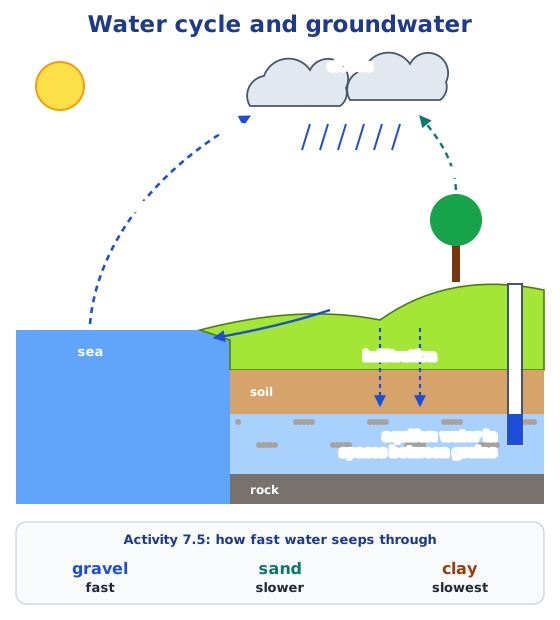
- Evaporation: water in oceans, rivers and lakes is heated by the Sun and rises as water vapour.
- Transpiration: trees and plants also give off water vapour.
- Condensation: rising vapour cools and turns into tiny drops that form clouds.
- Precipitation: clouds bring the water down as rain, snow or hail.
- Back again: rainwater flows into ponds, rivers and oceans, or seeps into the ground.
This continuous movement is the water cycle. It carries water from the oceans to the land and back, refilling rivers, lakes and the ground, while the total amount of water on the Earth stays the same. Long ago, in the 6th century CE, the astronomer and mathematician Varahamihira of Ujjaini described ways to predict seasonal rainfall in his book Brihatsamhita, using clouds, winds, the stars and the moon.
How water seeps underground
Activity 7.5 compares three cut, upside-down plastic bottles filled with clay, sand and gravel. The same amount of water is poured into each, and the water that drips out in 10 minutes is collected.
| Bottle | How fast water seeps |
|---|---|
| Gravel | fast |
| Sand | slower |
| Clay | slowest |
Gravel pieces leave wide, open, connected spaces, so water passes easily; clay particles leave only tiny gaps. This seeping of surface water through soil and rocks is infiltration.
Groundwater and aquifers
The water that seeps down is stored in the spaces between sediments and in the cracks and openings of rocks. This is groundwater. The underground layers that hold it are aquifers. Wells, hand pumps and bore wells reach down into aquifers, which can lie a few metres or hundreds of metres below the ground.
Saving groundwater
Groundwater is not unlimited. A growing population uses more and more of it, fewer trees and more concrete surfaces in towns let less rainwater soak in, and so groundwater levels are falling. Rainwater harvesting collects rainwater instead of letting it run off, and recharge pits let it soak back into the ground.
In Ladakh, streams often dry up in spring, when the Sun is not yet strong enough to melt the mountain snow. In winter, people pipe stream water down and spray it into the freezing air, where it freezes layer by layer into a tall cone called an ice stupa. It melts slowly in spring and gives water for farming through the summer.
Why it matters
The water cycle is the reason rain keeps falling and wells do not run dry for good. Knowing how water moves, and how slowly the ground refills, helps us use water carefully, whether by harvesting rain at school or by not wasting it at home.
Read how heat moves through solids, liquids and gases in conduction, convection and radiation. Answers to the textbook questions are in the NCERT solutions for Chapter 7; see all of Chapter 7 notes.
Practice
-
Water vapour released by plants is called:
Show answer
Answer: (b) transpiration
-
Rain, snow and hail falling from clouds are examples of:
Show answer
Answer: (a) precipitation
-
An underground layer of rocks and sediments that stores water is called:
Show answer
Answer: (b) an aquifer
-
Why does water seep faster through gravel than through clay?
Show answer
Answer: The spaces between gravel pieces are wide and connected, so water passes through them easily; the spaces between clay particles are very small, so water passes very slowly.
-
Name two ways to refill groundwater.
Show answer
Answer: Rainwater harvesting, which collects and stores rainwater, and recharge pits, which let rainwater soak back into the ground.
Questions students ask
What is the water cycle?
The continuous movement of water on the Earth: up as water vapour from water bodies and plants, down as rain, snow or hail, through soil, rocks and plants, and back into rivers, lakes and oceans. It redistributes water and keeps the total amount the same.
What is infiltration?
The process by which surface water seeps through soil and rocks into the ground. It happens more easily where the spaces between soil and rock particles are wide, open and connected.
What is an ice stupa?
A tall, cone-shaped heap of ice made in Ladakh in winter by spraying stream water into freezing air. It melts slowly in spring and gives water for farming when the streams have dried up.
Stuck on a question?
Take a photo and Lagnever AI explains it step by step. Try it for 7 days for ₹2.
Get it on Google Play Open in browser
For parents: after the trial, the plan renews monthly by UPI or card autopay. You can cancel anytime in the app.