
Conduction, convection and radiation
Answer in short
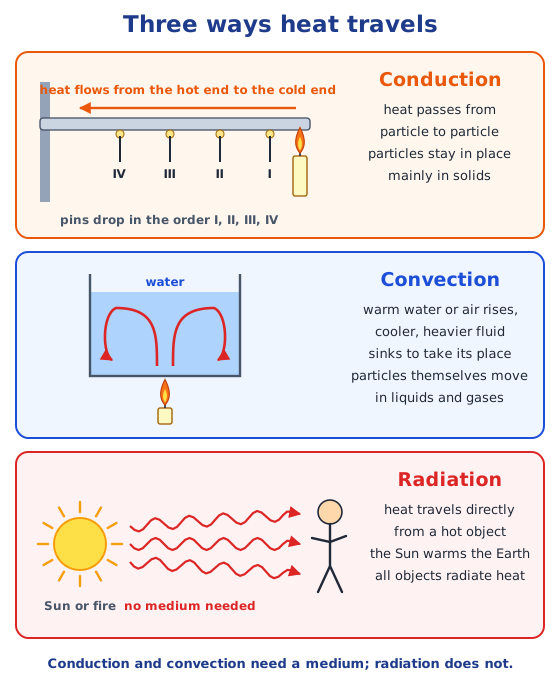
Heat travels in three ways. In conduction, heat passes from particle to particle while the particles stay in place, mainly in solids. In convection, warm liquid or gas rises and cooler fluid sinks, so the particles themselves move. In radiation, heat travels directly from a hot object with no medium, which is how the Sun warms the Earth.
Stuck on a question? Take a photo and Lagnever AI explains it step by step. Try it for 7 days for ₹2. Get it on Google Play
Heat always flows from hot to cold
When two things at different temperatures touch, or are near each other, heat flows from the hotter one to the colder one. It can travel in three ways: conduction, convection and radiation.
Conduction: passing heat along
Fix a metal strip to a stand, stick four pins to it with wax, and heat the end away from the stand with a candle. The pin nearest the flame falls first, then the next, and so on. Heat travels along the strip, and as it reaches each pin the wax melts. Each particle of the metal passes heat to the particle next to it, but the particles themselves do not move from their places. This is conduction, and it is the main way heat moves through solids.
Good and poor conductors
Materials that let heat pass easily are good conductors: copper, aluminium, iron and steel, that is, metals. Materials that do not are poor conductors, also called insulators: wood, plastic, glass, clay, porcelain, wool and air. A strip of wood or glass would not make the pins fall, because heat hardly moves along it.
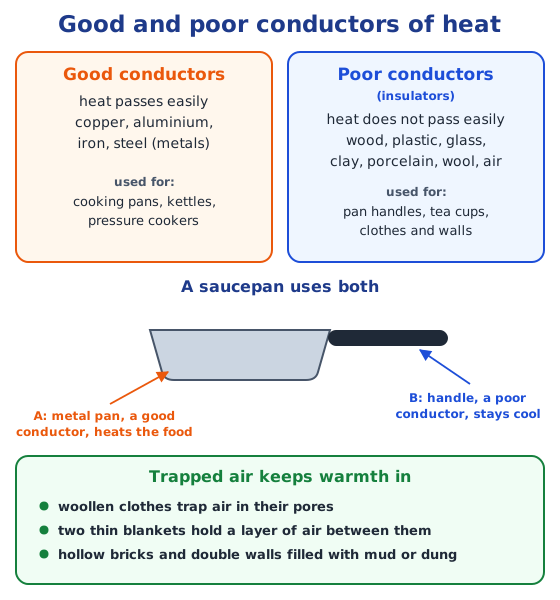
We use both kinds every day. Cooking pans are made of metal so the food heats quickly, while their handles are made of a poor conductor. Tea stays hot longer in a clay or porcelain cup. Air trapped in the pores of wool, or between two thin blankets, slows the heat leaving our body, so we stay warm. Houses in very cold or very hot places use the same idea, with hollow bricks or walls of two wooden layers filled with mud.
Convection: warm fluid rises
Hang two paper cups upside down from the ends of a balanced stick and put a candle under one. That cup rises, because the air inside it warms, expands, becomes lighter and goes up. A balloon left in the Sun swells for the same reason, and smoke, a mix of hot gases and tiny particles, rises because it is warmer than the air around it.
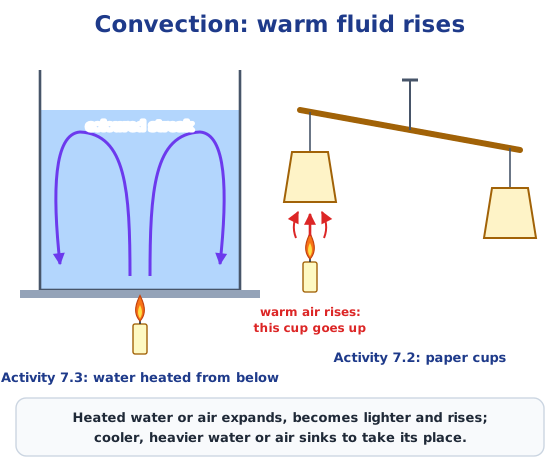
Liquids behave the same way. Put a grain of potassium permanganate at the bottom of a beaker of water and heat it from below: a coloured streak rises in the middle and comes down at the sides. Warm water rises, cooler, heavier water sinks to take its place, and the cycle goes on until all the water is hot. Heat carried by the actual movement of the particles of a liquid or gas is convection.
Radiation: no medium needed
Sitting near a fire, we feel warm even though nothing flows between us and the flames. The heat reaches us directly by radiation, the same way the Sun’s heat crosses space to reach the Earth. Radiation needs no medium. Every object radiates heat: a hot pan kept away from the flame cools down because it radiates heat to its surroundings. Light-coloured clothes reflect most of the heat falling on them, while dark ones absorb more, so we wear light colours in summer and dark ones in winter.
Comparing the three
| Way | How heat moves |
|---|---|
| Conduction | particle to particle; particles stay in place (solids) |
| Convection | particles move; warm fluid rises (liquids, gases) |
| Radiation | directly from a hot object; no medium needed |
All three can happen at once. When water is heated in a pan, the pan heats by conduction, the water by convection, and our hands feel warm by radiation. Read how convection makes the wind change direction at the seaside in land and sea breezes. Answers to the textbook questions are in the NCERT solutions for Chapter 7; see all of Chapter 7 notes.
Practice
-
Which material is a good conductor of heat?
Show answer
Answer: (b) Copper
-
Smoke from burning firewood rises because of:
Show answer
Answer: (b) convection
-
The warmth we feel sitting near a fire reaches us mainly by:
Show answer
Answer: (c) radiation
-
Why do we prefer two thin blankets to one thick blanket in winter?
Show answer
Answer: The layer of air trapped between two thin blankets is a poor conductor of heat, so it reduces the heat flowing from our body to the surroundings and keeps us warmer.
-
When water is heated in a pan on a stove, name the way heat reaches the pan, the water and our hands.
Show answer
Answer: The pan gets heat from the flame by conduction, the water inside heats up by convection, and the warmth we feel near the flame and the hot pan comes by radiation.
Questions students ask
What is the difference between conduction, convection and radiation?
In conduction, heat passes from particle to particle without the particles moving away. In convection, the particles of a liquid or gas move, carrying heat with them. Radiation needs no particles at all: heat travels directly from a hot object, even through empty space.
Why are cooking utensils made of metals?
Metals are good conductors of heat, so heat from the flame passes quickly through the utensil to the food. Their handles are often made of a poor conductor, such as plastic or wood, so that they stay cool to touch.
Is air a good or a poor conductor of heat?
Air is a poor conductor. That is why air trapped in woollen clothes, between two thin blankets or inside hollow bricks keeps us and our houses warm in winter.
Stuck on a question?
Take a photo and Lagnever AI explains it step by step. Try it for 7 days for ₹2.
Get it on Google Play Open in browser
For parents: after the trial, the plan renews monthly by UPI or card autopay. You can cancel anytime in the app.