
NCERT Solutions Class 7 Science Chapter 7: Heat Transfer in Nature
Answers to Activities 7.1 to 7.5, the in-text questions, all 10 “Let Us Enhance Our Learning” questions and the exploratory projects in Chapter 7, Heat Transfer in Nature, of Curiosity (Reprint 2026-27). The page numbers match the book. Activities have sample readings; yours will differ. Short notes: Chapter 7 notes.
Conduction (pages 89–92)
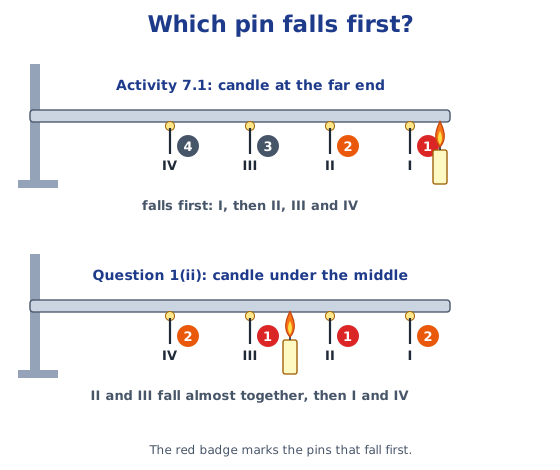
Activity 7.1: pins on a heated metal strip.
| Table 7.1 | Sample answer |
|---|---|
| Prediction | Pin I, nearest the flame, falls first |
| Observation | Pins fall one by one: I, II, III, then IV |
| Reason | Heat travels along the strip from the heated end; the wax nearest the flame melts first |
Why do the pins not fall together? Heat takes time to travel along the strip, reaching pin I first and pin IV last. This passing of heat from particle to particle is conduction.
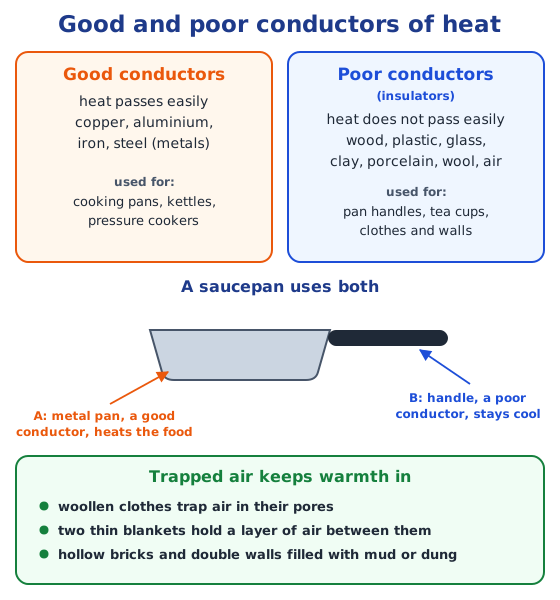
A strip of wood or glass? The pins would not fall, because wood and glass are poor conductors of heat: heat hardly travels along them.
Table 7.2 (sample):
| Material | Good or poor conductor |
|---|---|
| Steel, copper, aluminium, iron | good conductor |
| Wood, plastic, glass, rubber | poor conductor |
| Clay, porcelain, cloth, wool | poor conductor |
| Air | poor conductor |
Does your list include air? Air belongs with the poor conductors. That is why air trapped in woollen clothes or between two thin blankets keeps us warm.
Can houses be built that are not much affected by outside heat and cold? Yes: walls of two wooden layers filled with mud and cow dung, as in the Mori block of Uttarkashi, or outer walls of hollow bricks. Wood, mud and trapped air are poor conductors, so they slow the flow of heat in or out.
Convection (pages 92–94)
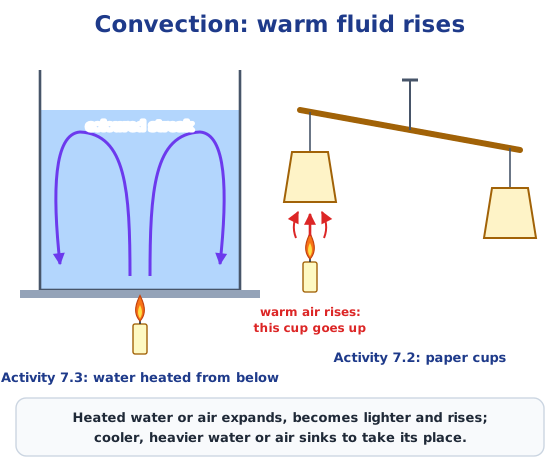
Activity 7.2 (Table 7.3): the cup above the candle rises. The air in that cup warms, expands, takes more space and becomes lighter, so it rises and lifts the cup.
Why is the smoke going up? Smoke is a mix of hot gases and tiny solid particles. It is warmer and lighter than the surrounding air, so it rises.
Activity 7.3: do liquids also rise when heated? Yes. The coloured streak from the potassium permanganate rises in the middle and comes down at the sides. Water at the bottom heats up, expands, becomes lighter and rises; cooler water from the sides sinks to take its place, until all the water is hot. This is convection.
Land and sea breeze (pages 94–96)
Activity 7.4 (Table 7.4, sample readings):
| Time | Soil and water |
|---|---|
| 0 minutes | soil 28 °C, water 28 °C |
| 5 minutes | soil 31 °C, water 29 °C |
| 10 minutes | soil 34 °C, water 30 °C |
| 15 minutes | soil 36 °C, water 31 °C |
| 20 minutes | soil 38 °C, water 32 °C |
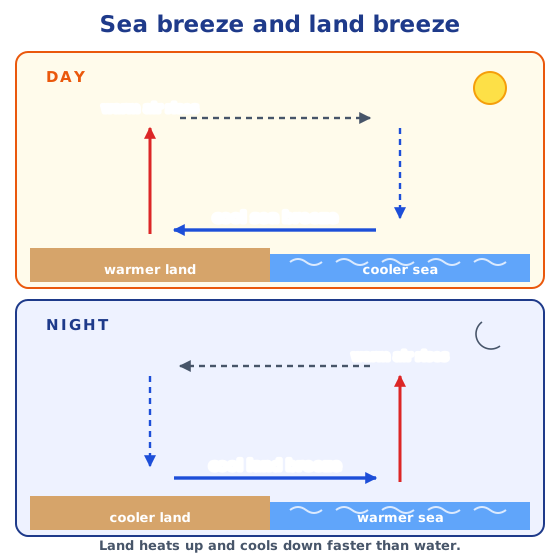
The temperatures did not rise by the same amount. The soil heated faster: it rose by about 10 °C in 20 minutes, the water by about 4 °C. Brought indoors, the soil also cooled faster. So by day the land is warmer and a sea breeze blows from the sea to the land; at night the land is cooler and a land breeze blows from the land to the sea.
Radiation (pages 96–97)
How does heat from the fire reach us? Directly, by radiation, which needs no medium. The Sun’s heat reaches the Earth the same way.
Why does a hot utensil kept away from the flame cool down? It radiates heat to its surroundings.
Dive Deeper: light clothes in summer, dark in winter. Light-coloured clothes reflect most of the heat falling on them, so they keep us cooler in summer. Dark surfaces absorb more heat, so dark clothes keep us warmer in winter.
Water heated in a pan (Fig. 7.8) and the bukhari: the pan heats by conduction, the water by convection, and the warmth we feel around the flame and pan is radiation. A bukhari uses all three to cook and to warm a room.
Water cycle and seepage (pages 98–101)
Activity 7.5 (Table 7.5):
| Bottle | Prediction and observation |
|---|---|
| Clay | very slow |
| Sand | slow |
| Gravel | fast |
Do your findings match your predictions? Usually yes: water seeps fastest through gravel and slowest through clay, because the spaces between gravel pieces are wider. How does water seep through the Earth’s surface? Through the spaces between soil and rock particles; this is infiltration, and the stored water is groundwater in aquifers.
Let Us Enhance Our Learning (pages 102–104)
1. Choose the correct option
(i) (c) A is a good conductor and B is a poor conductor of heat. A is the metal pan, which heats the food; B is the handle, which should stay cool to hold.
(ii) (d) Pins II and III will fall almost at the same time. The candle is under the middle of the strip, between II and III, so heat reaches them first and together, and pins I and IV later.
(iii) (c) On the ceiling. Smoke is hot and rises by convection, so it reaches the ceiling first.
2. Lassi in a leaky tumbler placed in another tumbler
Yes. A layer of air is trapped between the two tumblers, and air is a poor conductor of heat. It slows the flow of heat from the warm surroundings into the lassi, so the lassi stays cold longer. (The outer tumbler also catches the leak.)
3. True or false
(i) False. In solids, heat is transferred mainly by conduction; the particles cannot move about. (ii) True. In convection, the particles of the liquid or gas move and carry the heat. (iii) False. Clay has very small spaces between its particles, so it allows less seepage than sand. (iv) True. At night, cooler air moves from the land to the sea; this is a land breeze.
4. Where do melting ice cubes get heat from?
From their warmer surroundings: the air around them and the dish they sit in. Heat flows from these warmer things to the colder ice by conduction where they touch, by the movement of warm air (convection), and by radiation from nearby objects.
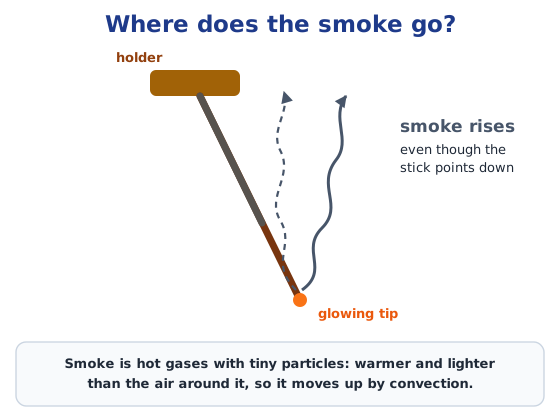
5. Smoke from an incense stick pointing downwards
The smoke still moves upwards. Smoke is a mix of hot gases and tiny particles, warmer and lighter than the air around it, so it rises from the glowing tip and curls up past the stick.
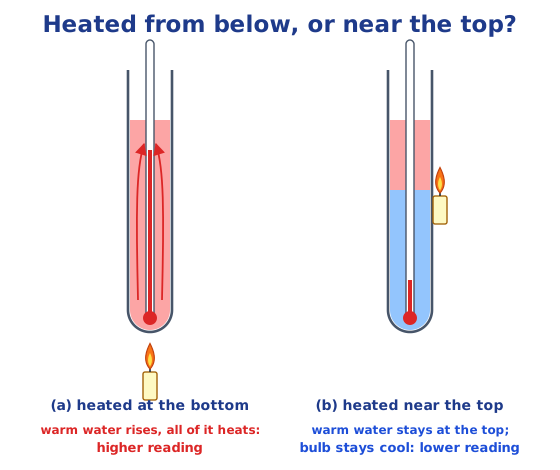
6. Which thermometer reads higher?
The thermometer in Fig. 7.16(a). There the flame heats the bottom of the test tube, so warm water rises and cooler water sinks, and convection soon heats all the water around the thermometer. In Fig. 7.16(b) the flame heats the tube near the top while the thermometer bulb is at the bottom. The warm water stays at the top, and since water is a poor conductor, the water around the bulb stays cooler.
7. Hollow bricks in hot regions
The air trapped inside hollow bricks is a poor conductor of heat. It slows the heat flowing from the hot outside into the house, so the rooms stay cooler in summer (and keep warmth in during winter).
8. How large water bodies prevent extreme temperatures
Water heats up and cools down more slowly than land. During the day the water body stays cooler than the land, and the cool sea breeze lowers the temperature nearby. At night the water stays warmer than the land, so the air nearby does not get very cold. Places near large water bodies therefore have neither very hot days nor very cold nights.
9. How water seeps underground and is stored
Rainwater on the surface seeps down through the spaces between soil and rock particles; this is infiltration. It is quicker where the spaces are wide, open and connected, as in gravel and sand, and slow in clay. The water is stored in the pore spaces of sediments and in openings in rocks as groundwater, and the layers that hold it are aquifers, from which wells and bore wells draw water.
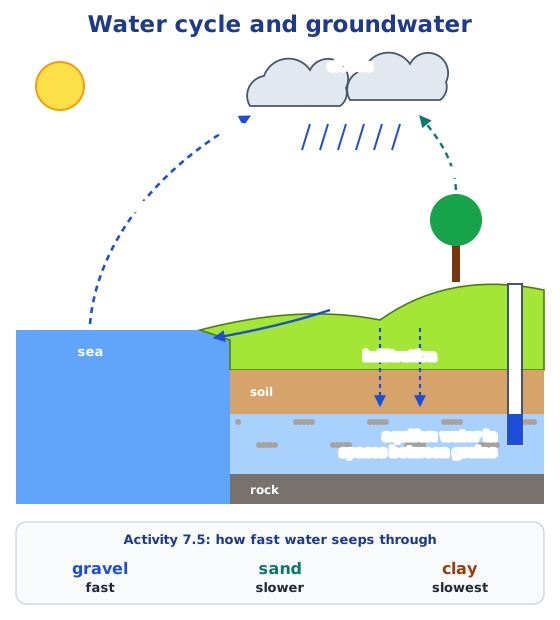
10. The water cycle redistributes and replenishes water
The Sun evaporates water from oceans, rivers and lakes, and plants give off vapour. Winds carry the vapour, which cools into clouds, and precipitation brings it down as rain, snow and hail, often far from where it rose: over land, on mountains and over the sea. Rain refills ponds, rivers and lakes and seeps into the ground to recharge aquifers; snow stored in winter melts in summer to feed rivers. In this way water keeps moving from oceans to land and back, refilling every source, while the total amount of water on Earth stays the same.
Exploratory projects (page 104)
- Visit a water harvesting site or recharge pit (sample report points): where rain is collected, such as a rooftop; how it is guided by pipes; how it is cleaned, for example through layers of gravel and sand (Extra); and whether it is stored in a tank or let into a pit to soak into the ground. Add labelled drawings and what the people there said.
- Paper wrapped on a metal rod: the paper does not catch fire easily. The metal, a good conductor, carries the candle’s heat away from the paper, and turning the rod spreads the heat further, so the paper does not get hot enough to burn.
- Paper spiral over a candle: the spiral starts to turn. Air heated by the candle rises (convection) and pushes against the slanting paper as it moves up.
Read more in conduction, convection and radiation, land and sea breezes and water cycle and groundwater.
Practice
-
Air trapped in woollen clothes keeps us warm because air is:
Show answer
Answer: (b) a poor conductor of heat
-
Heat from the Sun reaches the Earth by:
Show answer
Answer: (c) radiation
-
In Activity 7.3, the coloured streak in heated water rises in the middle and:
Show answer
Answer: (b) comes down at the sides
-
Which three processes happen when water is heated in a pan on a stove?
Show answer
Answer: The pan heats up by conduction, the water inside heats up by convection, and we feel warmth near the flame and the pan by radiation.
-
What is a bukhari?
Show answer
Answer: A traditional iron stove used in the upper Himalayas, burning wood or charcoal, with a pipe as a chimney. It warms the room and cooks food, using conduction, convection and radiation together.
Stuck on a question?
Take a photo and Lagnever AI explains it step by step. Try it for 7 days for ₹2.
Get it on Google Play Open in browser
For parents: after the trial, the plan renews monthly by UPI or card autopay. You can cancel anytime in the app.