
What is pressure?
Answer in short
Pressure is the force acting on each unit of area: pressure = force ÷ area. Its SI unit is the newton per square metre (N/m²), also called the pascal (Pa). The same force on a smaller area gives a bigger pressure. Liquids also exert pressure, in all directions, and it grows with the height of the liquid column.
Stuck on a question? Take a photo and Lagnever AI explains it step by step. Try it for 7 days for ₹2. Get it on Google Play
Why does a bag with narrow straps hurt more?
Megha and her brother Pawan set off for a picnic with equally heavy bags. Soon Pawan keeps shifting his bag, because it hurts his shoulders, while Megha is comfortable. The difference is in the straps. Pawan’s narrow straps press the whole weight of the bag onto a thin strip of each shoulder. Megha’s broad straps spread the same weight over a wider strip. Same force, different area, and so a different pressure.
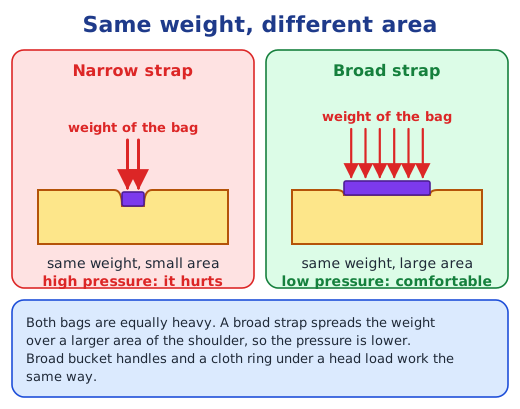
The same idea explains why a bucket of water is easier to carry by a broad handle, and why people who carry pots or baskets on their heads put a round pad of cloth under the load. In each case the load presses on a larger area, so the pressure is smaller.
How do we calculate pressure?
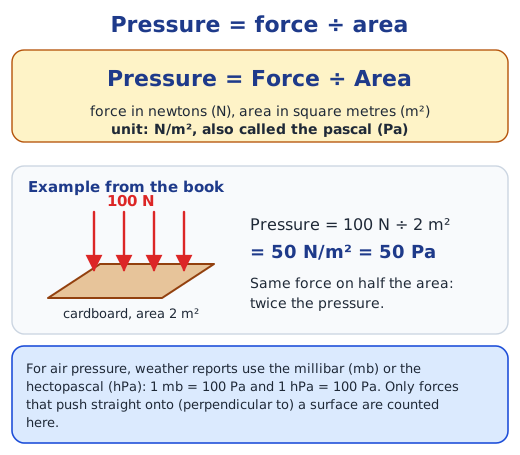
Pressure is the force acting on each unit of area:
Pressure = Force ÷ Area
In this chapter we count only forces that push straight onto a surface, at right angles to it. Force is measured in newtons (N) and area in square metres (m²), so pressure is measured in newtons per square metre (N/m²). This unit is also called the pascal, written Pa.
The book’s example: a force of 100 N acts on a sheet of cardboard of area 2 m².
Pressure = 100 N ÷ 2 m²
= 50 N/m² = 50 Pa
Push with the same 100 N on just 1 m² and the pressure doubles to 100 Pa.
Why is a nail pointed and a knife sharp?
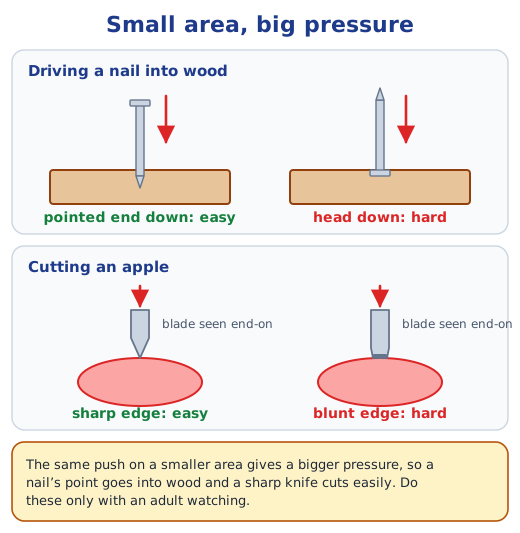
Try these with an adult watching. Push a nail into a block of soft wood, first with its point and then with its head. Slice an apple with a knife’s sharp edge, then try its blunt back. The point and the sharp edge win easily. They touch the wood or the apple over a tiny area, so the same push gives a much larger pressure. When the area is small, the pressure is high, and that makes piercing and cutting easy.
Do liquids exert pressure?
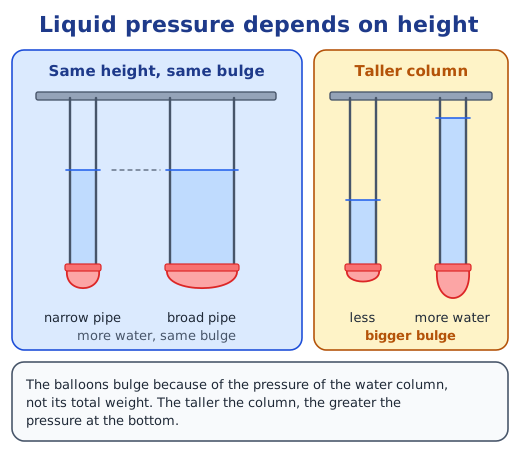
Take two see-through pipes, each about 25 cm long, one narrow and one wide. Tie a balloon over the bottom of each, clamp them upright and pour water into both up to the same height. Both balloons bulge, and by the same amount. Yet the wide pipe holds much more water, so the weight of the water cannot be what decides the bulge. It is the pressure of the water column, and that depends on its height. Pour more water into one pipe and its balloon bulges further: a taller column gives a greater pressure at the bottom.
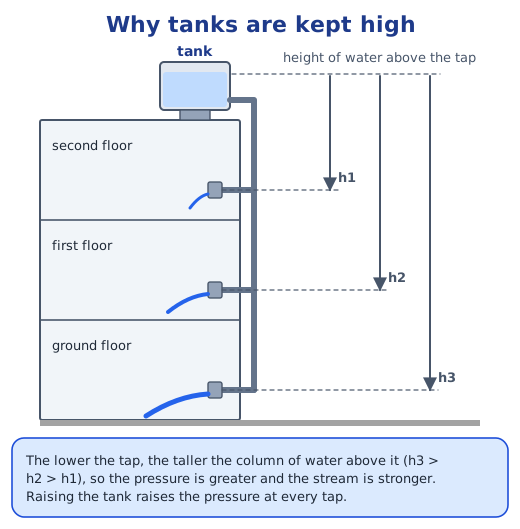
Why are water tanks kept on rooftops?
An overhead tank stands high so that the water in the pipes below it forms a tall column. The lower a tap is, the taller the column above it, so the pressure there is greater and the water rushes out in a strong stream. A tap on a lower floor gets a stronger stream than one on a higher floor.
Do liquids push on the sides of a container?
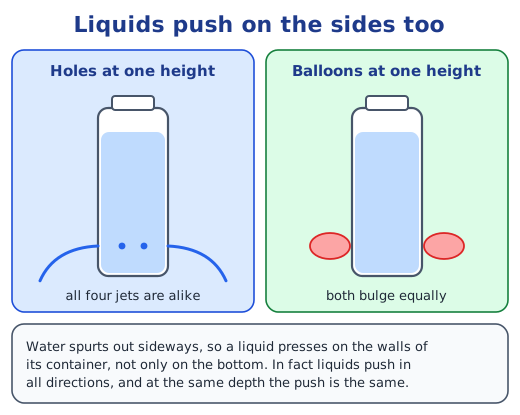
Ask an adult to make four small holes around a plastic bottle, all at the same height near the bottom (a needle warmed a little goes through easily). Cover the holes with tape, fill the bottle with water and pull the tape off. Water spurts out of all four holes alike. So water presses on the walls of its container, not just the bottom; in fact liquids push in all directions. That is also why water sprays out of a leaking joint in a water pipe. Do this over a tray or outdoors.
Why is a dam wider at the base?
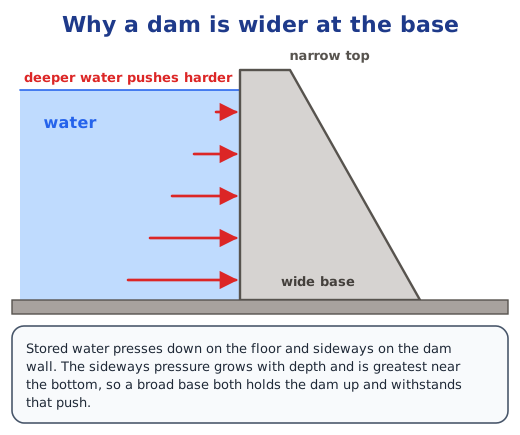
The water behind a dam presses down on the floor and sideways on the dam wall. Because pressure grows with depth, the sideways push is greatest near the bottom. Engineers make the base broad so that it both holds the dam up and withstands this large push.
Air presses on things too, which is the next topic: air pressure and wind. See also the chapter notes and the NCERT solutions.
Practice
-
A force of 300 N acts on an area of 3 m². The pressure is:
Show answer
Answer: (b) 100 Pa
-
Which is easiest to push into a wooden board?
Show answer
Answer: (b) a nail, point first
-
Two pipes, one narrow and one wide, are filled with water to the same height. The pressure at the bottom is:
Show answer
Answer: (c) the same in both
-
Why does a heavy bucket hurt less with a broad handle?
Show answer
Answer: The broad handle spreads the same weight over a larger area of the hand, so the pressure on the hand is lower.
-
Water spurts out of a hole in the side of a pipe. What does this show?
Show answer
Answer: Water presses on the walls of the pipe, not only on the bottom; liquids exert pressure in all directions.
Questions students ask
What is the formula for pressure?
Pressure = force ÷ area. With force in newtons (N) and area in square metres (m²), pressure comes out in N/m², a unit also called the pascal (Pa). For example, 100 N on 2 m² gives 50 Pa.
Why is a knife sharpened?
A sharp edge touches the food along a very thin line, so a small area takes the push of your hand. The pressure is large, and the knife cuts easily; a blunt edge spreads the same push and hardly cuts.
Does liquid pressure depend on the amount of liquid?
Not at the bottom of the container. It depends on the height of the liquid column: the taller the column, the greater the pressure. A thin and a wide pipe filled to the same height press equally.
Why are overhead water tanks kept at a height?
The higher the tank, the taller the column of water above each tap, so the water reaches the taps at a greater pressure and flows out in a strong stream.
Stuck on a question?
Take a photo and Lagnever AI explains it step by step. Try it for 7 days for ₹2.
Get it on Google Play Open in browser
For parents: after the trial, the plan renews monthly by UPI or card autopay. You can cancel anytime in the app.